Test Cricket vs T20: Which Format Is More Challenging?
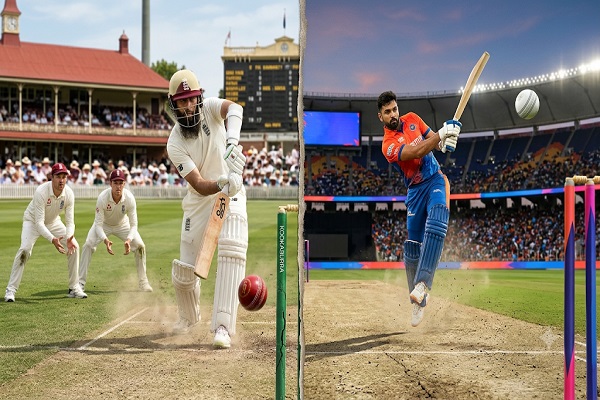
Cricket is one of the world's most popular sports, offering different formats that test players in unique ways. Among them, Test cricket and Twenty20 (T20) cricket stand out for their contrasting styles, strategies and demands. While Test cricket is known for patience, endurance and technical excellence, T20 cricket focuses on speed, power and quick decision-making.
Both formats require exceptional skills, but the challenges they present are very different. So, which format is more challenging for cricketers? Let's explore.
1. Understanding Test Cricket and T20
Test Cricket
Test cricket is the longest format of the game, traditionally played over five days. Each team usually has two innings, giving players time to build partnerships, study bowling conditions and develop long-term strategies.
The format demands concentration, discipline and physical endurance. Players must remain mentally focused for extended periods while adapting to changing pitch and weather conditions.
T20 Cricket
T20 cricket is a shorter format in which each team faces a maximum of 20 overs. Matches generally finish in around three hours, making the game faster and more action-packed.
Batters are expected to score quickly, bowlers must defend limited runs, and fielders need to maintain high intensity throughout the match. Every over can significantly influence the result.
2. Batting: Patience vs Aggression
Batting in Test cricket requires strong technique and patience. Players often face challenging bowling spells, swinging deliveries and changing pitch conditions. They must carefully judge which balls to defend and when to attack.
In T20 cricket, the approach is different. Batters frequently look for boundaries and innovative shots to maintain a high scoring rate. They have limited deliveries to make an impact, so quick decisions are essential.
Which is more challenging? Test batting demands greater concentration over long periods, while T20 batting requires faster reactions and more aggressive shot selection.
3. Bowling: Consistency vs Innovation
Test bowlers must maintain accuracy and consistency across long spells. They need to create pressure, exploit pitch conditions and use variations to dismiss batters. Patience is essential because wickets may not come quickly.
T20 bowlers face a different challenge. They have fewer overs and must prevent batters from scoring freely. Yorkers, slower balls, cutters and changes in length are important tools for controlling the scoring rate.
Which is more challenging? Test bowling tests endurance and sustained accuracy, while T20 bowling demands precision under intense pressure.
4. Fitness and Physical Endurance
Fitness plays an important role in both formats, but the demands differ.
Test cricket requires players to remain active for several days. Batters may spend hours at the crease, while bowlers need to recover between spells and maintain their performance across a long match.
T20 cricket requires explosive movements, quick running between wickets, fast fielding and repeated high-intensity efforts. Players must deliver maximum energy in a shorter period.
Test cricket places greater demands on prolonged endurance, whereas T20 cricket places a strong emphasis on explosive fitness and recovery.
5. Mental Strength and Pressure
Mental strength is essential in every format.
In Test cricket, players must remain patient even when they are not scoring quickly or taking wickets. A batter may need to defend for hours, while a bowler may have to keep trying different strategies without immediate success.
In T20 cricket, pressure can change rapidly. A few boundaries, a wicket or an expensive over can shift the momentum. Players must make decisions within seconds and handle high-pressure situations.
Test cricket tests sustained mental concentration, while T20 cricket tests rapid decision-making and composure.
6. Strategy and Game Planning
Test cricket allows teams to develop strategies over several sessions. Captains must consider pitch conditions, weather, field placements, bowling combinations and the match situation.
T20 cricket requires more immediate planning. Captains and coaches frequently adjust their bowling combinations, batting order and field settings according to the match situation.
Both formats demand tactical intelligence, but Test cricket involves longer-term planning, whereas T20 cricket requires quick tactical adjustments.
7. Skill Development and Adaptability
Test cricket helps players develop strong defensive techniques, patience, shot selection and the ability to handle different bowling conditions.
T20 cricket encourages innovative batting, power-hitting, variations in bowling and athletic fielding. Players often need to develop new skills to stay competitive in the shorter format.
Modern cricketers increasingly need to adapt to all formats. Success in one format does not automatically guarantee success in another.
8. Role of Technology in Modern Cricket
Technology has become an important part of modern cricket. Video analysis, performance tracking, ball-tracking systems and data analytics help players and teams understand strengths and weaknesses.
In Test cricket, teams use analysis to study bowling patterns, batting techniques and pitch behaviour over extended periods.
In T20 cricket, data can help identify favourable match-ups, scoring areas and bowling strategies for specific batters.
Technology supports preparation in both formats, helping teams make more informed decisions.
Conclusion: Which Format Is More Challenging?
There is no single answer because Test cricket and T20 cricket challenge players in different ways.
Test cricket can be considered more demanding in terms of endurance, technical discipline and prolonged concentration. Players must perform consistently over several days while adapting to changing conditions.
T20 cricket is challenging because of its fast pace, limited opportunities and intense pressure. Players have very little time to make decisions, and even a small mistake can affect the outcome.
Ultimately, both formats require exceptional talent, preparation, fitness and mental strength. Rather than deciding that one format is universally harder, it is more accurate to say that Test cricket tests patience and endurance, while T20 cricket tests speed, power and adaptability