States' Fiscal Deficit-to-GSDP at Risk of 0.2-0.4% Slippage by CareEdge Ratings
The evolving fiscal landscape amid the West Asia crisis is likely to put pressure on the state government finances. Challenges stem from growth-related concerns amid the conflict in West Asia. Moreover, states have introduced freebies and welfare schemes during the last two to three years amid elections in several states. This has resulted in rising spending pressures across states, adversely impacting their overall fiscal position. On the positive side, at the aggregate level, states have played an important role in supporting the Centre’s capex-led growth strategy while strengthening their own revenue sources. Against this backdrop, our report reviews the FY27 budgets of 25 states, with Part A focusing on receipts, Part B on expenditure patterns, and Part C on fiscal deficits. Together, these 25 states account for about 98.4% of India’s GDP.
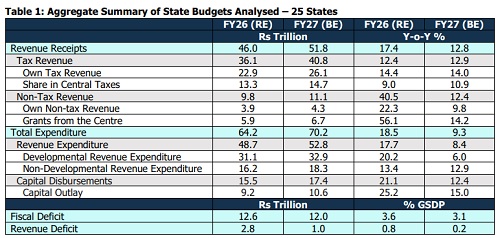
The aggregate state fiscal deficit is estimated to have widened sharply to 3.6% of GSDP in FY26 from 3.2% in FY25. Growth in both tax and non-tax revenues is estimated to have improved in FY26 relative to the previous year. However, the fiscal deficit increased mainly due to higher expenditure growth. There has been a strong growth in developmental spending due to the rollout of freebies and welfare schemes in several states.
Looking ahead, state finances are likely to face a challenging environment in FY27 amid the ongoing economic uncertainties. A moderation in India’s growth momentum could weigh on the buoyancy of states’ own tax collections, while weaker Central government tax revenues may reduce the divisible pool of tax proceeds to the states. Also, Centre’s grants might come under pressure, given that the Central government finances are under strain due to ongoing economic uncertainty. Furthermore, high spending towards freebies and welfare schemes could further constrain the states’ fiscal position. These factors increase the risk of deviating from the budgeted FY27 aggregate fiscal deficit target of 3.1% of GSDP. With the possibility of slippage in revenue receipts, we estimate its impact on the fiscal deficit to be in the range of 0.2-0.4% of GSDP in FY27, assuming states do not deviate from their budgeted expenditure target.

A. Analysis of Receipts Profile – Analysis of 25 State
Budgets States’ Tax Collections Likely to be Hit Amid the Ongoing Economic Challenges The aggregate state tax revenues are budgeted to rise by 12.9% in FY27, marginally higher than the estimated growth of 12.4% in FY26. More importantly, states' own tax revenues, which constitute 64% of total tax revenues, are budgeted to rise by an encouraging 14% in FY27, broadly in line with the estimated growth for FY26. On an aggregate basis, the states analysed have budgeted a nominal GSDP growth of 11.7% and tax buoyancy of 1.2 for FY27.
We expect the ongoing economic challenges arising from the West Asia conflict to weigh on India's real GDP growth in FY27. The magnitude of the slowdown will depend on how long the conflict persists and the timeline for restoring the energy supply chains. We project India’s GDP growth in FY27 to be at 6.7%, premised on the assumption of crude oil prices averaging at USD 90/bbl. However, we believe growth could dip even lower to around 6.5% if the conflict lingers longer, with crude oil prices averaging at USD 100/bbl. At the same time, higher inflation is likely to push up the nominal GSDP growth to around 13–13.5%, exceeding the assumptions made by states. Overall, while stronger nominal GSDP growth is a positive for the tax revenues, slower economic activity and weaker consumption are expected to weigh on the tax buoyancy. We expect state tax buoyancy to be in the range of 0.7-0.9 in FY27, lower than the budgeted 1.2. Additionally, based on our assumption of lower tax collections at the Central government level, we expect the tax transfers to the states to be lower by Rs 0.5 trillion in FY27
Non-Tax Revenues to Remain Encouraging
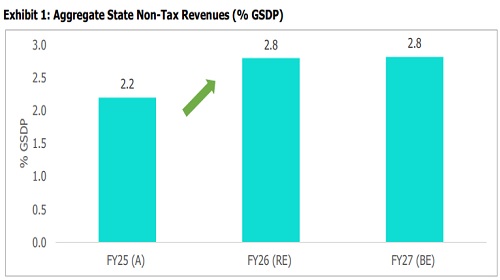
Amid rising concerns about state tax collections, the positive aspect is that the aggregate state non-tax revenues are budgeted to rise by 12.4% in FY27, following an estimated 40.5% growth in FY26. The Supreme Court’s judgment in July 2024, clarifying that royalties on mining leases are to be classified as non-tax revenue, has been a positive for the growth in states’ non-tax revenues. Furthermore, several states have implemented a series of measures to boost their non-tax revenues - Rajasthan and West Bengal introduced reforms to implement faceless management of mines to improve transparency and enhance the revenue collections (RBI Study of State Budgets 2025-26). As a result of such measures implemented by states, non-tax revenue is estimated to have increased to 2.8% of GSDP in FY26 (RE), from 2.2% in FY25. This improvement is expected to be sustained in FY27, with non-tax revenue budgeted at 2.8% of GSDP (Refer to Exhibit 1).
Fiscal Impact of Revenue Shortfall Seen at 0.2–0.4% of GSDP in FY27
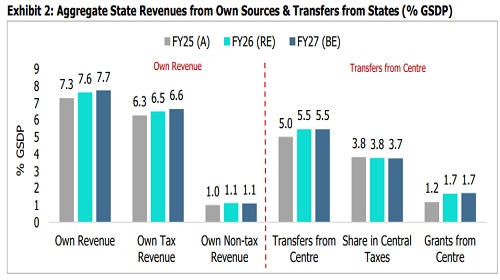
With the GST Compensation Cess officially ending in 2022, states have focused on boosting their own-source revenues. The own revenues of the states, which include both tax and non-tax sources, are estimated to have risen to 7.6-7.7% of GSDP in FY26 (RE) & FY27 (BE) compared to 7.3% in FY25. (Refer to Exhibit 2). However, given the expected lower state tax buoyancy, sustaining this momentum in the states’ overall own revenues could prove challenging in FY27. Focus on boosting the states’ own tax revenue becomes even more critical given the changes to the Central Grants. (Refer to Box 1 for Changes in Grants Recommended by the Finance Commission). The states have budgeted grants from the Centre to be at 1.7% of GSDP in FY27, the same level as in the previous year (Refer to Exhibit 2). However, these grants might come under pressure given that the Central government’s finances are also facing pressure from the ongoing economic uncertainty
Above views are of the author and not of the website kindly read disclaimer



.jpg)