Economy : Financing Fragility Over Real Fixes by Choice Institutional Equities Ltd
India's external accounts are sending a deceptively reassuring signal. Headline trade numbers show robust 17.5% export growth even as the deficit hits a record USD 86.8 Bn. But, peel back the layers and a more fragile story emerges: Exports are being flattered by a weak rupee and a China-dependent re-export model, services exports (long India's reliable buffer) have gone into contraction, FDI has all but dried up and FPI outflows persist. To plug the widening gap, policymakers are increasingly relying on engineered debt inflows rather than organic capital, a strategy which works only as long as global conditions remain benign. What follows is less a story of resilience than one of financing over fixing, with real implications for how Indian equities, the rupee and rate-sensitive sectors behave as the unwinding happens
Trade Deficit Widens to a Multi-year High
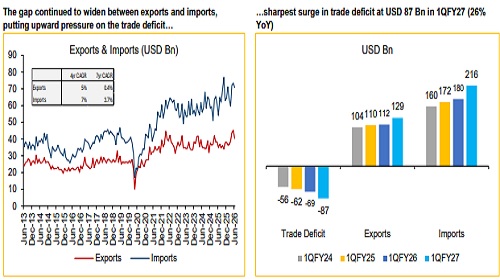
The trade deficit jumped to USD 30.4 Bn in Jun’26, pushing the 1QFY27 cumulative deficit to USD 86.8 Bn, the highest first-quarter reading on record apart from the COVID-19-affected 1QFY21.
Assuming nominal GDP growth of 9.5% for the quarter, this deficit works out to nearly 9.3% of GDP. The broader CAD is estimated to have widened to about USD 17 Bn, or 1.8–1.9% of GDP, for the quarter.
Oil Imports Remain the Key Driver
Oil imports continue to anchor the overall deficit. The oil import bill eased slightly, from USD 22.7 Bn in May to USD 19.3 Bn in June, but persistently elevated crude prices, even as India diversifies its sourcing, are likely to keep the bill high. A temporary US sanctions relief tied to Russian exports allowed a sharp jump in oil imports from Russia, which hit a record USD 8.5 Bn in May and now make up almost 38% of India's total oil imports. The waiver's future is uncertain: India is pushing to extend it to build strategic reserves, while continuing efforts to diversify supply sources geographically
Precious Metal Imports Begin to Cool Down
Gold and Silver imports rose 33.6% over the quarter, but June saw a 1.9% contraction, suggesting that the pace is now slowing down. Precious metals have fallen back to about 2.9% of total imports. Easing of gold prices as well as import restrictions are expected to keep gold imports restricted.
Exports Benefit from a Weaker Rupee Rupee
depreciation against USD has meaningfully supported export growth. Overall exports rose 17.5% YoY for the quarter and 15.5% YoY in June alone. Oil exports grew more modestly at 9.4% YoY, while non-oil exports stayed strong at 16.4% YoY. Electronics (+29% YoY) and engineering goods (+13.7% YoY) led the gains. Notably, the rise in exports of electronics mirrors the rise in electronics imports, pointing to a re-export/assembly model, where Indian firms import components and add value before exporting the finished product, rather than a deepening of domestic manufacturing capability.
Trade Deficit with China Hits a Record
India's trade deficit with China reached a record USD 11.5 Bn as imports from China grew 40% in June 2026. Since India does not import oil from China, this surge reflects non-oil, non-gold goods, underscoring how Chinese competition is squeezing Indian manufacturers, particularly in engineering and semi-finished goods, with likely margin pressure ahead.
Services Exports Lose Momentum
Net services exports contracted 6.8% YoY in Jun’26, as export growth slowed down to just 2.9% while services imports jumped 12.7% YoY. Services exports have effectively plateaued around USD 34 Bn on average in 1QFY27. There are growing signs that AI adoption is weighing on traditional IT/BPM outsourcing, a trend projected to persist as efficiency gains reduce headcount and revenue in lower-value segments
FDI Stays Structurally Weak
FDI inflows remain volatile and increasingly opportunistic, reflecting limited longterm commitment from foreign investors. FDI fell to just 0.17% of GDP in FY26 and is forecast to stay subdued at around 0.2% in FY27. Even though 1QFY27 net FDI may have reached USD 7 Bn (up 40% YoY), the bigger picture is one of structural weakness: Global capital is rotating towards AI and semiconductor-led growth in the US and Taiwan and India's R&D spend is not competitive enough to attract it. This is not something a rate cut or a trade deal can quickly fix. Weak domestic demand and years of soft private capex (manufacturing to GDP ratio has averaged 13-14% over the past 10 years) compound the problem; rising repatriation trends alongside growing trade protectionism add further pressure.
FPI Flows Stay Inconsistent
Net FPI flows are estimated to have remained negative in 1QFY27, with outflows of around USD 14.4 Bn, consistent with a broader pattern, as FPI flows have been negative or flat in 7 of the last 10 years. Structural drags include elevated Indian equity valuation as compared to its global peers, weak earnings growth, rupee depreciation (which hurts dollar returns for foreign investors), a strengthening US dollar and India's exclusion from the global AI investment theme.
For Detailed Report With Disclaimer Visit. https://choicebroking.in/disclaimer
SEBI Registration no.: INZ 000160131








.jpg)