Why Are More Pre-Retirees Looking Beyond Traditional Investment Products for Retirement Security?

Pre-retirees are looking beyond traditional investments because retirement now requires both growth and dependable income planning. Fixed deposits, provident funds, and small-savings products can provide stability, but each has limits around liquidity, reinvestment, taxation, or inflation protection.
A stronger retirement strategy often combines products that address different objectives such as growth, income generation, liquidity, and capital preservation. The right mix depends on retirement timing, household expenses, risk tolerance, healthcare needs, and existing income sources.
Why Has Retirement Security Become a Priority for Today's Pre-retirees?
Retirement security matters more because many households must fund several decades without regular employment income. Longer retirement periods increase exposure to inflation, healthcare costs, market volatility, and changing household responsibilities.
Today's pre-retirees recognise that retirement is no longer just about accumulating a corpus. Rising longevity, healthcare inflation, and uncertain investment returns have shifted the focus towards creating sustainable income and preserving purchasing power throughout retirement.
As a result, many individuals are reviewing their retirement plan to ensure it can support long-term income needs, healthcare expenses, and changing financial priorities after retirement.
Are Traditional Investment Products Enough to Support a Long Retirement?
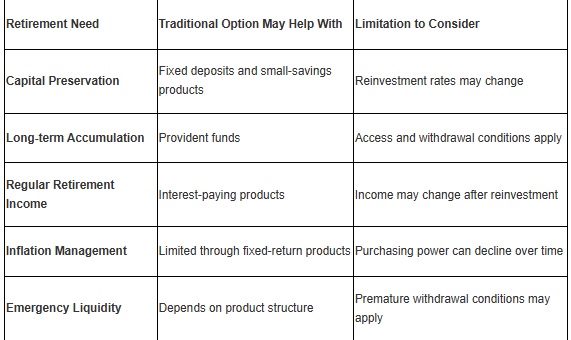
Traditional products can remain useful, but relying on one category creates concentration and reinvestment risks. Fixed deposits may provide predictable interest, while provident funds and small-savings schemes support capital preservation and disciplined accumulation.
India Post currently lists the Senior Citizens Savings Scheme at 8.2% annually, although small-savings rates can change. These products may not independently address every retirement objective, particularly long-term inflation, liquidity, or lifelong income needs.
While traditional products can provide stability, many investors now combine them with other retirement-focused solutions to address income, liquidity, and inflation-related needs more effectively.
What Retirement Risks Are Causing Investors to Rethink Their Financial Strategy?
Many pre-retirees are re-evaluating traditional investment strategies because retirement risks such as inflation, longevity, healthcare costs, and market volatility can significantly affect long-term financial security once salary income stops.
Longevity creates another challenge because the retirement corpus must support expenses for an uncertain period. Healthcare spending can also become less predictable as age and medical requirements change.Poor liquidity planning may force investors to sell long-term assets during unfavourable market conditions.
Why Does Predictable Income Matter More After Retirement?
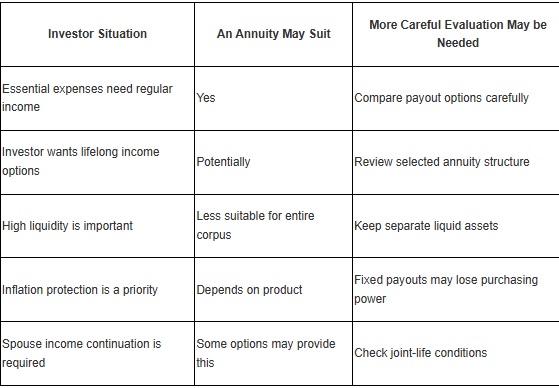
Predictable income helps retirees separate essential monthly spending from market-dependent withdrawals and irregular investment returns. An annuity plan can help convert an eligible purchase amount into periodic income, providing greater cash-flow predictability for retirees who want their essential expenses to be less dependent on market fluctuations, subject to product terms and selected options.
However, annuities can offer limited liquidity after purchase, and income structures differ across immediate and deferred products. They may suit investors prioritising income certainty, but not those requiring unrestricted access to the entire retirement corpus.
IRDAI regulates annuity and pension products within India's current life-insurance product framework.
What Alternatives are Pre-retirees Exploring Beyond Traditional Investment Products?
Pre-retirees are increasingly expanding beyond traditional fixed-return products to include retirement solutions that can support long-term growth, income generation, liquidity, and inflation management.
Options can include NPS, provident funds, small-savings schemes, debt investments, market-linked funds, annuities, and liquid reserves. PFRDA's NPS exit and withdrawal regulations were last amended on 20 July 2026, so investors should check current rules.
This shift reflects a growing preference for retirement strategies that balance capital preservation with the need for long-term financial flexibility and income security.
What Features Are Investors Looking for in Modern Retirement Solutions?
As pre-retirees move beyond traditional investment products, they are increasingly looking for solutions that offer a clearer balance between income certainty, liquidity, inflation management, flexibility, and transparency. Investors now evaluate retirement products based on how effectively they address real retirement risks rather than only headline returns.
Investors are paying closer attention to how retirement products handle income generation, liquidity access, inflation risk, family protection, and taxation. Increasingly, product selection is being driven by retirement outcomes rather than return expectations alone.
How are Insurance-based Solutions Becoming Part of Retirement Planning Strategies?
Insurance-based retirement solutions are increasingly being used alongside traditional investments to address retirement income needs that fixed-return products may not fully solve. Many pre-retirees view these products as a way to add greater income predictability while addressing specific retirement income requirements.
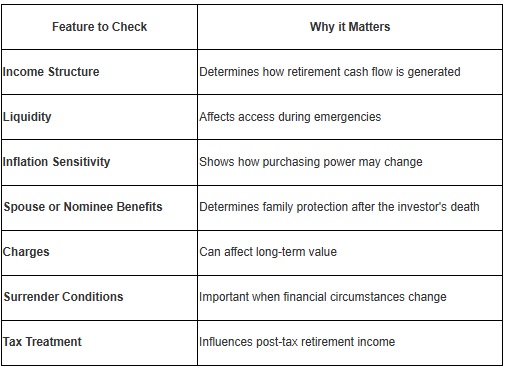
Buyers should review premium commitments, vesting conditions, annuity choices, surrender rules, exclusions, charges, and policy disclosures carefully.
For AY 2026–27, eligible annuity-plan contributions can qualify under Section 80CCC within the old tax regime. The combined deduction limit across Sections 80C, 80CCC, and 80CCD(1) is ?1.5 lakh.Tax treatment can still vary by product structure and individual circumstances, so current rules should be checked.
How Can Pre-retirees Combine Growth, Stability, and Income for Better Retirement Security?
Pre-retirees are increasingly recognising that retirement security requires more than a single investment solution. Many investors are moving beyond traditional products and building retirement strategies that can support long-term growth, regular income needs, liquidity requirements, and capital preservation simultaneously.
This shift reflects changing retirement priorities, with investors focusing on balancing income security, inflation management, and financial flexibility rather than relying exclusively on fixed-return products. PFRDA's 2026 framework also recognises multiple retirement-income approaches, including drawdown and retirement-income options under NPS.
As retirement expectations evolve, pre-retirees are increasingly prioritising flexibility, income certainty, and long-term financial resilience over reliance on any single investment product. This shift is reshaping how retirement security is being planned and funded in India.
Conclusion
The retirement planning landscape is changing as pre-retirees increasingly look beyond traditional investment products to address evolving financial realities. Longer life expectancy, inflation, healthcare costs, and the need for dependable retirement income are encouraging investors to consider a broader mix of solutions that can support different retirement objectives. Rather than relying on a single product category, many are building more balanced retirement strategies designed to improve income security, liquidity, and long-term financial resilience.
The information shared is for educational purposes only. Mutual fund investments are subject to market risks. Please read all scheme-related documents carefully before investing