Economy Update : India a relative winner, but further tariffs could be a headache by Emkay Global Financial Services Ltd

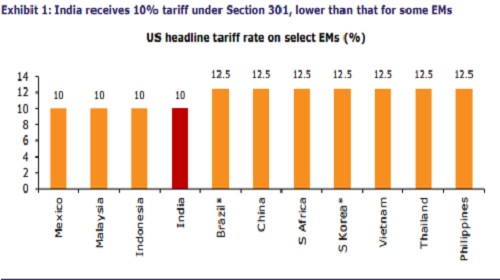
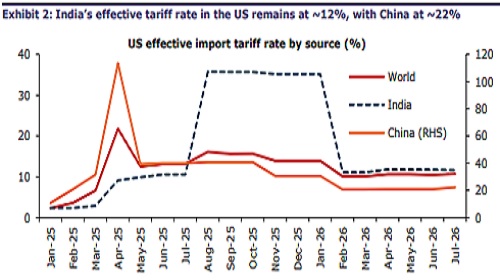
India’s headline tariff rate in the US remains at 10% under the new Section 301 tariffs, with some peers (China, Vietnam, Brazil, Thailand) facing higher tariffs of 12.5%. Accounting for other tariffs that are still in place, India’s effective tariff rate in the US (~12%) is much lower than for several competitors. However, textiles and apparel are likely to see erosion of relative competitiveness due to the lack of TRQ exemptions received by Bangladesh and other nations. Separate generic pharma tariffs (to be implemented from Aug-28 onward) are a headwind, but Indian exports may remain competitive. India’s exports to the US have seen marked improvement after IEEPA tariffs were struck down in Feb-26; this trajectory should continue in the coming months. However, potential additional Section 301 tariffs are a headwind, and BTA negotiations will be crucial to ensure a relatively low tariff rate.
Trump’s Section 301 tariffs on India at 10%, relatively better than for some peers
The US has imposed tariffs on 60 nations, including India, under Section 301 (following an investigation on forced labor practices), on 24-Jul-26, ahead of the expiry of the 10% global headline tariff under Section 122. India, along with 16 other nations (such as Indonesia, Bangladesh, Mexico, Canada, UK), is being tariffed at 10%, while the likes of China, Vietnam, and Brazil, among 38 other countries, are being tariffed at 12.5%. These rates will be applied on top of existing MFN rates. However, the EU and Taiwan will face 10% tariff net of their respective MFN rates, with Switzerland, Japan, and South Korea receiving the same net-ofMFN treatment at 12.5%. As earlier, ‘sectoral’ tariffs under Section 232 are unaffected, while certain specified goods and products will not be tariffed at all. As a result, ~55% of India’s exports to the US will attract this additional 10% tariff, with the remaining 45% either exempt (generic pharmaceuticals, smartphones, etc) or facing Section 232 tariffs (steel, aluminium, auto parts, etc). India’s effective tariff rate in the US is estimated to be unchanged at ~12%, lower than that for Bangladesh (~25%), China (~22%), Vietnam (~14%), and Indonesia (~14%).
Textiles may lose relative competitiveness; pharma tariffs may not hurt
However, as with all things regarding US tariffs in the Trump administration, the devil lies in the details. Indian textile and apparel exports have not received tariff-rate quota (TRQ) exemptions under the Section 301 tariffs, which were awarded to the likes of Bangladesh, Cambodia, Indonesia, and Malaysia. The exemption applies to specified volumes of textile and apparel imports which use US-origin cotton and fiber. Hence, while the tariff burden remains at 10%, there will be a relative loss of competitiveness for Indian textile exporters vs key competitors. Additionally, earlier in the week, President Trump announced tariffs on imported generic medicines, to be imposed from Aug-28, at 100%, before being increased to 200% from Aug-29. The two-year grace period is intended to give manufacturers time to relocate generic drug manufacturing to the US. India, which supplies ~50%/~30% of US generic drug volume/value, respectively, would be significantly impacted by such tariffs. However, with Indian generics being 7-10x cheaper than branded alternatives, they would remain competitive even after a 100% tariff, with the higher costs being borne by US healthcare providers, insurers, and patients. The long implementation timeline also raises the prospect of this policy being modified or overturned due to legal or political considerations.
Further Section 301 tariffs are a potential issue, with BTA negotiations to be crucial
India’s exports to the US saw a marked improvement after the IEEPA tariffs were ruled unlawful by SCOTUS in Feb-26, with India’s tariff rate then dropping to 10% (vs 50% earlier). India’s monthly exports to the US have averaged $8.4bn in the four months since, vs $6.5bn in the prior six months. The improvement is likely to have been led by the likes of Gems and Jewelry and Marine Products sectors which had been previously hurt by the punitive tariff rates; Electronic Goods exports have remained strong. We believe the Section 301 tariffs are unlikely to markedly change the trajectory of India’s total exports to the US in the coming months. However, the relatively lower tariff than for some competitors may provide marginal benefits. We note that the Trump administration is also expected to announce the results of a separate Section 301 investigation (on excess manufacturing capacity), with India among the 16 countries being investigated. This could see the tariff rate on India being raised further, and closer to the IEEPA rate of 25%. In this context, ongoing negotiations on the India-US bilateral trade deal will be crucial to ensure a lower tariff rate and preferential access for Indian exports in the US market.
For More Emkay Global Financial Services Ltd Disclaimer http://www.emkayglobal.com/Uploads/disclaimer.pdf & SEBI Registration number is INH000000354











.jpg)