Research report on Manthan- Electronic Manufacturing Services by Praveen Sahay, Vice President - Prabhudas Lilladher Capital

Mobile Phone Manufacturing Scheme (MPMS): Towards an Integrated Manufacturing Ecosystem
The Government of India has approved the Mobile Phone Manufacturing Scheme (MPMS) with a total budgetary outlay of INR 625bn over a five-year period. The primary objective of MPMS is to increase domestic value addition while strengthening India's electronics manufacturing ecosystem. The scheme seeks to promote local component manufacturing, encourage indigenous product design and research & development, improve supply-chain resilience, support the development of Indian mobile phone brands and enhance the country's export competitiveness.
What's Different from the Earlier PLI?
MPMS retains the sales-linked incentive structure of the earlier PLI scheme, while adding incentives for higher domestic component sourcing and indigenous product design/R&D. Thus, the scheme rewards manufacturers across three layers—production, localization and innovation.
Under the scheme, manufacturers are eligible for a base manufacturing incentive ranging from 2.25% to 5% of eligible sales. In addition, companies can earn an incremental localization incentive of up to 1.5% by increasing domestic procurement of components, along with a further design and R&D incentive of up to 3% for developing indigenous products and intellectual property.
Salient Features of MPMS:
The Scheme has two Target Segments - TS1: Mobile-phone manufacturers and EMS companies registered in India with a minimum FY26 turnover of INR 100bn are eligible. Existing brands need to achieve INR 50bn of incremental sales annually over FY26 sales, while a new brand must first achieve INR 100bn of annual sales in India before becoming eligible
TS2:
Indian mobile-phone brands with a minimum FY26 turnover of INR 10bn are eligible, subject to requirements relating to Indian ownership, management control, domestic IP/trademarks and in-house design and R&D capabilities.
Key Beneficiaries:
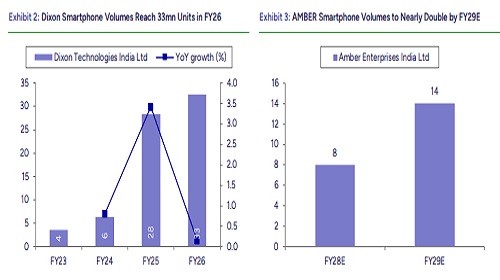
Dixon has received PN3 approval to form a JV with Vivo India for smartphone manufacturing. Vivo sold ~35mn units (~23% market share) in CY25, while the JV is expected to manufacture ~20–22mn units annually, equivalent to nearly two-thirds of Vivo's India volumes. The JV is expected to strengthen Dixon's position in the mobile EMS segment and provide a significant volume opportunity under MPMS.
Amber has entered into a manufacturing collaboration with Oppo India for Oppo, OnePlus and Realme smartphones. Production is expected to start with ~8–9mn units in FY28, scaling to ~14–15mn units in FY29. Trial production is targeted at Q4FY27, followed by commercial production in Q1FY28. The company is expected to initially undertake assembly/SMT, followed by HDI PCB and component manufacturing.
Please refer disclaimer at https://www.plindia.com/disclaimer/
SEBI Registration No. INH000000271