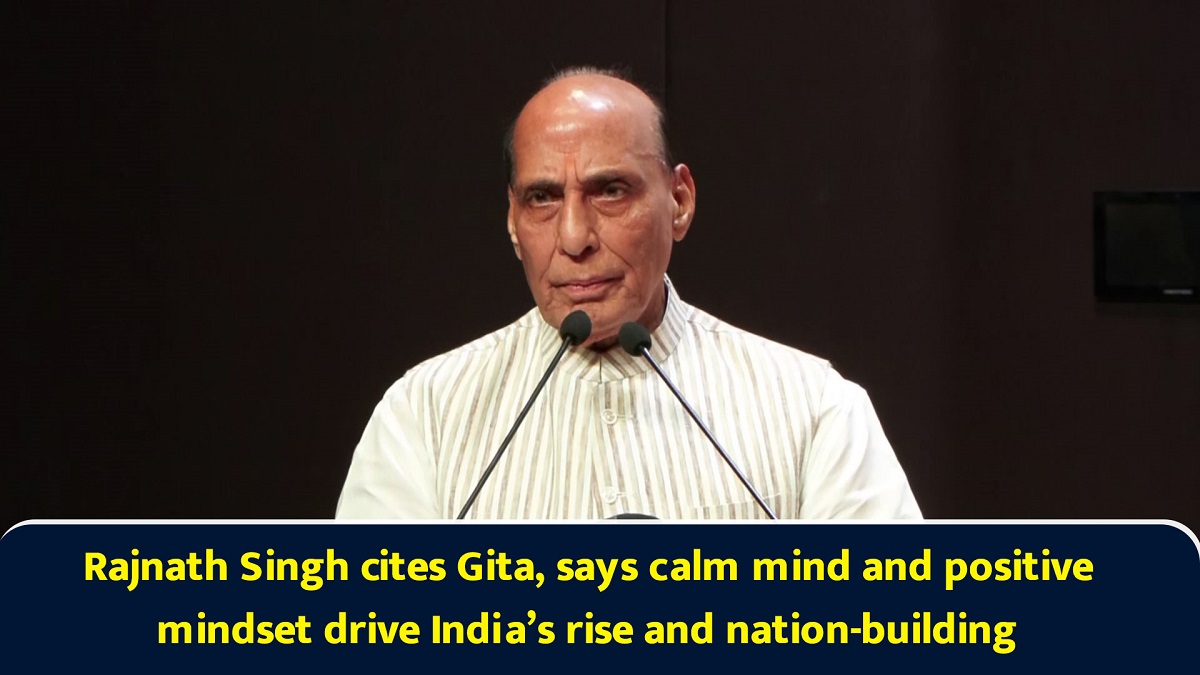
Rajnath Singh cites Gita, says calm mind and positive mindset drive India`s rise and nation-building
Ladies and gentlemen, you just heard Sudhanshu Trivedi's speech.
You might think that Sudhanshu Trivedi reads a lot.
He must have read thousands of books.
Otherwise, how could he have so much knowledge?
I want to inform you that
It's been about thirty-four, thirty-five... thirty-four, thirty-five years. He has been our companion for thirty-four, thirty-five years.
I mean, in the political field, we have been together constantly, even working fourteen, fifteen hours a day. We do almost everything together—traveling, sitting, eating, and drinking—and even today, it's still almost the same.
You will be surprised to know that I have never seen Sudhanshu Trivedi reading.
And without God's grace, this wouldn't be possible.
And this is the merit of his past lives.
Actually, we usually don't go to events together.
Because I know that once they speak, nothing but trouble is going to come my way.
But since I'm here, I have to at least fulfill the formality of speaking.
So first of all, Param Aadarniya Saksh Shri Ji Maharaj...
I bow my head and offer my respects.
Today, I'm here with all of you at the launch event of this book, Gita Sanjeevani, a great mantra.
believe it's my good fortune, and this is a divine moment in my life.
And along with that, this program is also a unique retreat for self-reflection.
You need to reflect on yourself.
So, what could be a greater and purer scripture than the Gita?
The Gita as directly spoken by Shri Krishna, the hero of the entire universe and the world's teacher, Lord Shri Krishna.
To present it in a new, modern, and simple way, I bow to the author of this book, the highly respected Sakshi ji, from the bottom of my heart.
And I also thank you for this excellent work.
And ladies and gentlemen, look at the coincidence.
Is your original name also Shri Krishna?
Your original name is Shri Ram Krishna Upadhyay.
Meaning, Dwapar means Dwapar, so Shri Krishna ji's explanation of the Gita in the Kali Yuga is being done by Shri Krishna ji himself; what could be happier than this?
Ladies and gentlemen, I know your life well; ever since I was the MP of Ghaziabad in 2009, I have known you.
Your life is proof of how the Indian philosophical tradition lives on, flourishes, and grows richer from generation to generation.
If anyone wants to understand this, I think your life itself is proof of it.
And the way you took initiation from Swami Sudarshanacharya Ji Maharaj and carried forward this life tradition is in itself very inspiring.
Many of you would also be aware. Sakshi Shri Ji.
He was in government service at one time and has seen and understood every class of society, and then when he found that the satisfaction he was supposed to get from there was not being received, he naturally turned towards spiritual service.
And ladies and gentlemen, who is fully spiritual, who is fully spiritual
The one whose mind is big is spiritual.
A person with a small mind can never be spiritual.
And as a person's mind keeps getting bigger, in the same proportion, he keeps achieving spiritual heights, keeps growing.
And the more spiritual you keep becoming, the more you will keep experiencing happiness, you will also keep experiencing joy, and a time will come when you can also experience ultimate bliss.
So I believe that our Sakshi Shri Ji Maharaj has a big heart.
Otherwise, the kind of work they are doing in their life, perhaps by the grace of God, they would not have received that inspiration. But ladies and gentlemen, now the question arises about government services.
Usually, a person has all the basic necessities to live a normal life. So what was it that drew Sakshi Shree Ji toward spirituality? What was left missing?
He was desperate to find it, and Maharaj ji moved forward in this direction. As far as I understand, that essence is the search for one's own dharma.
Ladies and gentlemen, when the soul isn't satisfied even after achieving everything in the outside world, a person turns back to their true path. The day a person learns to listen to the questions within,
I believe that his real spiritual journey begins on that very day. And this is the journey that turns Ram Krishna Upadhyay ji—also known as Sakshi Shri Maharaj or Upadhyay ji—into Sakshi Shri.
The way Sakshi Shree ji has enlightened people through the Science Divine Foundation is truly unique.
Your warm and affectionate personality.
Your clarity makes you a really dynamic personality. I believe the ideas you've shared in this book are definitely an inspiration in themselves for our youth. This book is truly a source of inspiration for the young people of our country.
Friends, a lot has already been said about the Gita and its nectar-like book, the great mantra. Still, I'd like to share a bit with you about the unique aspects of the Gita that I've been able to see, understand, and apply in my life. We all know that in the battle of India, to end Arjuna's dilemma...
Lord Shri Krishna gave this teaching of the Gita to clear up Arjuna's doubts. But the Gita isn't just a teaching meant for Arjuna—it's a mirror to all of our lives, and Kurukshetra is Arjuna and Krishna.
They were back then, and they're still here today—this is exactly what Sakshi Shri Maharaj has said. The only difference is that today, Kurukshetra is less outside us and more within us.
Ladies and gentlemen, the dilemmas running through Arjuna's mind before the battle of Kurukshetra naturally run through our minds as well. Desire, anger, greed, attachment, pride, envy, and who knows how many other waves run through a person's mind. These are all instincts, and they are what make us restless and make us dance to their tune. This is why I see the Gita as a guiding light that can show us the way to live our lives properly.
It can teach us the art of living.
Ladies and gentlemen, in my limited studies, I have seen that the Gita is the only scripture that discusses human instincts so deeply. You have also discussed this in the Mahamantra. Sometimes it is in the form of attachment or aversion, and sometimes as sattva, rajas, and tamas. But in reality, it is human instinct.
Which drives a person, and I feel that a person might turn away from their duty and knowledge for a moment, but turning away from their instincts is very difficult in itself.
Friends, I want to give you an example of this. You all remember the incident when Lord Shri Krishna goes to pacify Duryodhana. The Lord has that discussion with Duryodhana about right and wrong. During that time, Duryodhana said something very clear. Duryodhana said: Janami dharmam na cha me pravruttih janami adharmam na cha me nivruttih.
Meaning, Krishna, you have come to teach me about right and wrong. Do you think I don't know about this? Duryodhana says.
Hey, I am also a disciple of the same Guru.
Whose disciple Dharmaraj Yudhishthira has been. And you are teaching me a lesson on right and wrong. Janami dharmam. I know very well what dharma is. But what can I do, I just cannot bring myself to do it.
And I know what adharma is, but I also cannot stay away from it. It just doesn't let me go. It feels like some other god is sitting inside me and making me say all this. What can I do? This is instinct, and this is our nature.
Friends, this is not just Duryodhana's tragedy. This is not just Duryodhana's tragedy; it is the tragedy of many.
The thief knows that stealing is wrong, but he still steals. People know that lying is wrong, yet they still lie. People know that corruption is a sin, yet they remain engaged in it. People know that harming others is adharma, but they still do it. Man knows that lying, slandering, and harming others is also wrong now, but people.
People constantly do this because their instincts are just that way, and their knowledge gets lost somewhere behind their instincts. This is the power of instinct, and this is the play of instinct.
And friends, in such a situation, the question arises: can we ever overcome this instinct? Can we get out of this cycle? We find the answer to this in the Gita, and I congratulate Sakshi Shri ji for giving a proper answer to these questions in this book.
The Gita says, Yoga? karmasu kau?alam. This means yoga is skill in action. And skill in action comes when our instincts are calm and our mind is steady, when we act without being attached to the fruits of our actions.
When we do our duty without ego, our instincts automatically come under control. And this principle is not just a spiritual principle, nor is it a political or social principle; it is also a national principle.
Ladies and gentlemen, when we talk about the nation, we must understand that the nation is also a mind. The nation is also a mind. That mind of the nation also has many instincts, and if the nation's instincts are not calm and its mind is not steady, the nation can never become great, and our India can never become great either today.
We should understand that today India's instincts are changing. The juncture at which India stands today is a moment of opportunity. Today our youth are proud of the country's identity. Today our scientists are making everything from Chandrayaan to Gaganyaan a reality. And today our startups are making their mark in the world. All this is happening when our instincts are positive or our.
The mind is focused on nation-building.
But friends, the danger is not yet averted. The tendency to slander, the tendency to distrust, the tendency to fear, the tendency of ego—these can all weaken us from within. We must avoid them, and the Gita can be a powerful medium in doing so; there is no other alternative.
And I thank Sakshi Shri ji for this.
That they have shed light on many such nectar points of the Gita in this book which are extremely relevant in today's times. Not only is the Gita explained in this book, but it has also been connected to modern life.
And friends, this book is not just to be read.
This book is not just to be read, listen carefully, this book is there to be lived, this book is to be lived.
Friends, I have a personal experience behind saying this. I have been a teacher by profession, a student of Physics, and also a Physics teacher. Books used to be our reading habit earlier, but after entering public life, due to many busyness, it is not possible even if we want to many times. Even if I turn just a few pages of books, there is no satisfaction, but still, I complete the formality. When this
took this book in my hands, I had turned just a few pages.
Then I can say that I saw the power to bind the mind in this book.
I didn't make them read the whole thing, just a few pages, a few pages.
t's not like I had never read the Gita before. But the way Gita has been presented by Sakshi Shri Maharaj with a new dimension in this book, Sakshi Ji Maharaj, you are certainly worthy of congratulations for that.
Friends, when I was turning the pages of this book, one thing came to my mind. And I think that almost everyone must have the Gita kept in their house. Everyone must have turned its pages at some point, and for thousands of years, the knowledge of the Gita has been in every home. No one here hears the Gita, Ramayana, etc. for the very first time in life. That is, if you discuss the Gita, etc. with anyone.
Then they must have heard it at some point, yes, not read it, but heard it. It is not remembered when it was heard for the first time, but it has definitely been heard.
But you might have noticed one more thing that whenever we try to understand the Gita, we need some medium, some guru. Instead of just directly reading the verses and their meanings, we find the flavorful and relevant explanations of those meanings mucmore interesting. This is because the knowledge of the Gita, once you hear it.
But friends,h this doesn't end there; it unfolds at a new level of our consciousness every time.
Krishna had narrated the Gita to Arjuna. But not every human being is Arjuna. The circumstances in front of Arjuna, his state of mind, his life experience—but our questions are different, our confusions are also different, and our level of consciousness is also different. Therefore, even though the Gita remains the same, the meaning of it keeps changing for us.
And this is where the need for a guru comes to the fore. A guru doesn't add anything to the Gita. A guru doesn't add anything to the Gita, he just broadens our perspective. For example, when one person reads the Gita, they see the importance of action. When another reads it, they see knowledge, and a third reads it, they see devotion. A fourth person sees
the solutions to life's struggles in it, and someone else sees the questions of the soul, nature, consciousness, and the ultimate truth in that same Gita.
But the work of broadening the perspective of the observer, but the work of broadening the perspective of the observer, if someone does it, only a guru does it, no one else but a guru can do it.
Respected friends, gurus don't just tell us what the meaning of a verse is. They give us the ability to see how many more dimensions that meaning can have.
Friends, just like a child sees the ocean, they only see a lot of water. But a sailor sees paths in that same ocean, a scientist sees currents, temperature, and ecology in it. A poet sees beauty in it, the ocean is the same, the difference is not in the ocean, but in the eyes of the observers.
The Gita is also like this, the Gita is also like this. As our consciousness keeps expanding, the meaning of the Gita also keeps getting deeper, and gurus help us expand our consciousness in that direction.
Friends, gurus do not present a different version of the Gita to us. Gurus do not present a different version of the Gita to us. They give us the ability to see that same Gita with a new perspective. And a guru is the one who opens new doors of the Gita for us. And we enter through one door of the Gita, the guru shows us many doors of it.
For example, let's say you've read a part of the Gita.
Samatvam Yoga Uchyate. That means staying the same in every situation, in happiness and sorrow, is yoga itself.
You discussed this in the tenth Mahamantra and you have read it, but this shloka can only come out of the book and enter your life with the help of a Guru; there is no other way.
The Guru will tell you, the Guru will tell you that the Gita is not just to be read. The Gita is to be seen and lived. And here, this book acts as a living Guru.
Ladies and gentlemen, Sakshi Shri Ji gives us 11 Mahamantras through this book. Sakshi Shri gives 11 Mahamantras through this book. Every chapter is a lesson in itself. As I said right at the beginning, this program is a medium for self-reflection. Therefore, from this stage, I urge the people of our country, especially the youth and our young friends, to reflect on themselves.
And friends, our youth are the future of this country.
Our young people have energy, our young people have passion, our young people have dreams, but they must also recognize their inner tendencies. You have to find your Swadharma and you have to understand that life is a practice. Today, a big challenge for our youth is the tendency to compare. The tendency to compare is there; today our youth have started measuring their lives less by their own experiences and more by the lives of others.
When we see someone's success on social media, our own achievements naturally start feeling small. And when we see someone moving ahead, restlessness starts building inside us, and sometimes we feel inferior, sometimes jealous, and sometimes it feels like we have fallen behind in life.
But friends, we have to understand this. Life is not a competition. Life is not a competition where everyone has to reach the same place at the same time. Every person has their own journey, their own circumstances, their own abilities, and their Swadharma. The question is not which tendency is present inside us. The question is which tendency we are strengthening within ourselves. This is why
This is why I bow to Sakshi Shri Ji from the bottom of my heart, that through this book, he has not just tried to present the Gita as a scripture, but he has tried to connect it with our lives today.
Friends, this book not only inspires us to understand the life-related meanings of the verses of the Gita beyond the verses themselves, but also gives us patience when we are troubled. When we are confused, the Gita gives us wisdom. And when we are afraid, the Gita gives us courage. And when success creates ego within us, the Gita reminds us of humility.
Friends, in my opinion, the biggest feature of this book is that it inspires us to look within ourselves before trying to change the outside world.
Anyway, when a person learns to look within themselves,
24:39then they begin to understand that their biggest battle is not with another person, but with those tendencies of their own mind that repeatedly make them unstable.
Friends, today a person is more connected to the outside world than ever before. With a single click, we stay connected to the whole world, but in this rush, a big question arises: we are connected to the whole world, but are we connected to ourselves or not? We hear the voice of the whole world, but do we hear the voice within us? The Gita answers all these questions, only and only these
f anyone can answer all these questions, it is only the Gita. The Gita takes us on a journey from the outside to the inside.
Friends, in a way, the Gita is a conversation between the Arjun sitting inside us and the Krishna sitting inside us. Arjun represents our mind, which is filled with doubt, fear, attachment, and compassion. Krishna represents our inner soul, our intellect, and our consciousness.
When we read the Gita, in reality, we sit inside ourselves and converse with our own mind. The Gita teaches us that we are our own greatest friend and our own greatest enemy. When we connect with ourselves, we become our own friend; when we disconnect from ourselves, we become our own enemy. Sakshi Shree Ji has made the Gita a formula for self-dialogue in the Mahamantra. While reading this book, you will feel as if you are listening to the voice within yourself, and this book awakens the questions within us, and their answers also start emerging naturally from within.
Friends, forgive me, I am moving ahead very quickly. I wanted to explain this a little bit too.
Friends, at one point you all must have noticed where the Gita was delivered? The teachings of the Gita happened in the midst of the frenzy of war between two massive armies at Kurukshetra. And this in itself is a miracle that many messages of peace came from this battlefield. However, this is not a contradiction; it is a profound truth, and the Gita does not advise Arjun to run away from the war; it advises him regarding attachment to the fruits of action, like and dislike
It inspires us to fight without ego and fear, and that is truly what we call peace.
Let the war continue outside, but let our actions be selfless so that we remain at peace within. Nishkam Karma is explained by the witness Sri Krishna using a formula, and even though it looks very small, it sets the entire math of our lives right. That formula is: Karma minus desires is equal to Nishkam Karma.
Karma minus desires is equal to Nishkam Karma. Friends, this is the equation of self-science.
We all perform actions: some small, some big, some at home, some for the nation. A soldier's duty is to protect the borders, a teacher's is to teach, a farmer's is to grow food, a scientist's is to research, parents' duty is to shape their child's life, and a politician's is to serve the public. In this way, everyone fulfills their responsibility and follows their dharma.
But when the desire for results, the wish for praise, and the craving for rewards and prestige get attached to these actions, the very spirit of the action gets corrupted.
And when desires attach themselves to our actions, these actions become a bondage in life. A person keeps working, but finds no peace.
When we subtract these desires, the attachment to results, the ego, and the hunger for praise from our actions, what remains is Nishkam Karma. Friends, but people also wonder: does this mean we shouldn't work at all? Should we have no desires? Should we not dream at all? The answer is that we should dream, but we shouldn't let those dreams possess us.
We shouldn't let them bind us so much that we forget our duties. Desires shouldn't make us so restless that we lose our way from our dharma. When a soldier stands at the border, he doesn't want a medal; he is driven by a sense of duty. A mother serves her child without expecting anything in return. These are all living examples of Nishkam Karma.
And this formula of Nishkam Karma isn't just for individuals; it applies to the nation as well. If our leaders, administrative officers, soldiers, teachers, doctors, engineers, farmers, and laborers all perform their duties selflessly, the nation's mind will naturally remain stable. The nation's tendencies will be calm, and when they are calm, the country will definitely continue to progress and lead the way.
Therefore, the need of the hour is that we don't just read the Gita, but actually bring it into our behavior and our lives. Let's not just make a resolution today to read the Gita, but let's resolve to bring it into our lives, understand our minds, recognize our tendencies, and channel them in the right direction. Let's follow our own dharma and dedicate our actions to the nation.
And we will connect it with the welfare of society.
Friends, as I have said before, this book is not just a book, it is a mirror. I urge you all to read it, live by it, and change your lives. Finally, I sincerely congratulate Sakshi Shree ji, her entire team, and the publishers of this book. At the same time, once again, I bow to Sakshi Shree and conclude my remarks right here. To all of you.
Thank you very much.