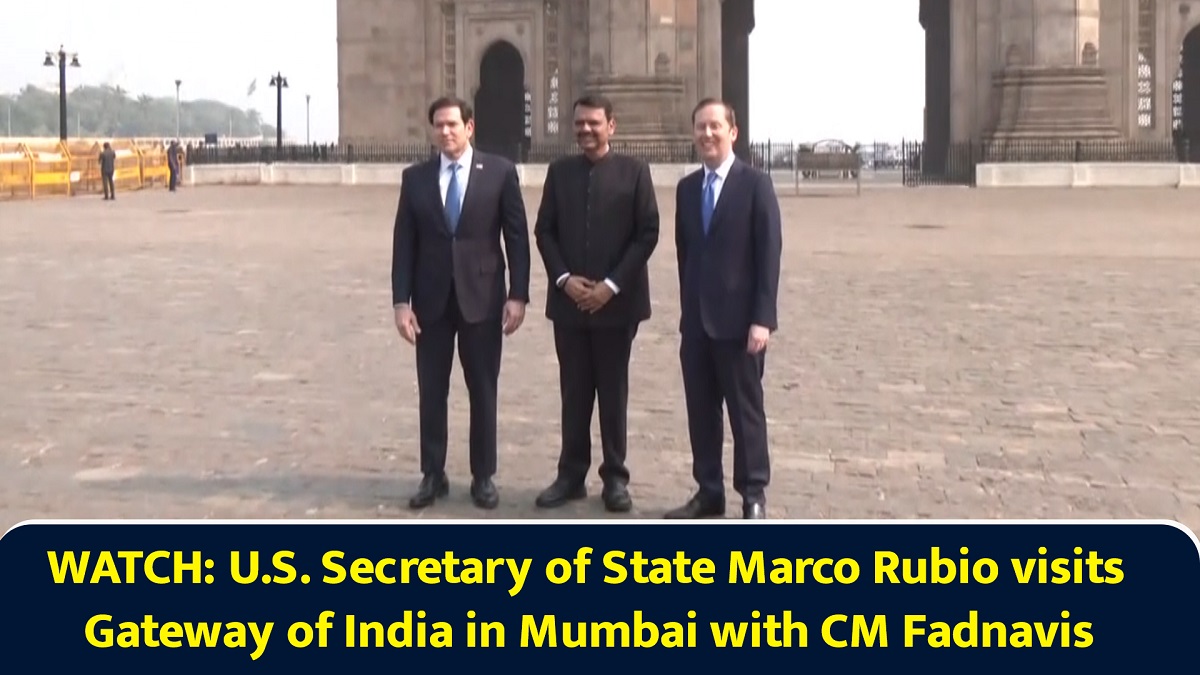
Rubio hails India-US ties as 21st century`s defining relation at `Freedom 250 reception` in Mumbai
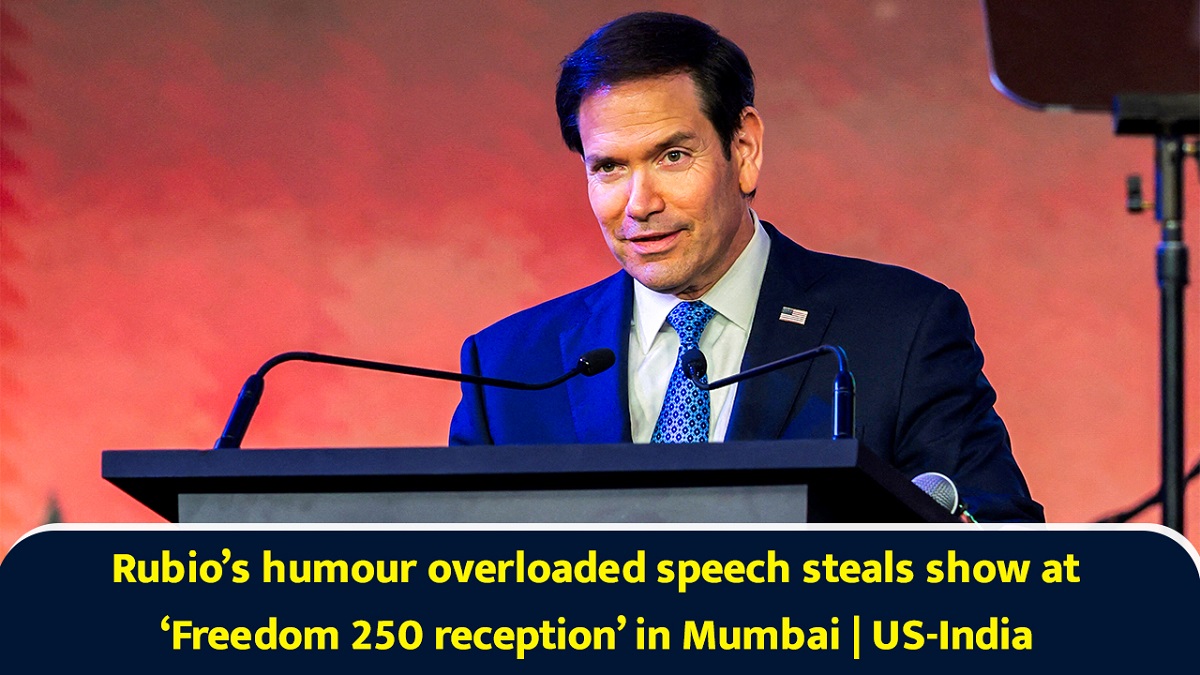
Speaker 0: To my great friend, the Secretary of State, Marco Rubio.
Speaker 1: Sergey left his phone, should I read what's on it or? You want to leave it here? All right.
Speaker 1: Well, thank you. It's a great honor to be back with all of you here today. And I say be back because I was just here 3 or 4 months ago. And it's interesting when I was here 3 or 4 months ago, Sergio threw a big 250 party.
Speaker 1: Uh, in Delhi, and now we're here another 250 party, uh, in Mumbai, and, um, I'm starting to think all our embassy does here is throw parties every.
Speaker 1: But we'll see what they come up with next year. You can't celebrate 251 the same way. It's just not the same ring to it, but it is an honor to be back. And I'm glad to be back. I said earlier today we had this press conference.
Speaker 1: We have members of the media there obviously and they were asking somebody asked the question why are you back in India after just four months. And I said well number one it happens to be the most populous nation on earth it happens to be the oldest democracy on earth it happens to be such a strong geopolitical partner the United States but here's where I ended by saying is I actually think we don't come enough.
Speaker 1: I actually think we don't come enough.
Speaker 1: And it's not just for the parties.
Speaker 1: Because if you think about the story and the history of the 21st century, it's being written in this region and it's being written right now. One day someone will write a book about the history of the 21st century. And there will be a chapter in there about other regions in the world, but the 21st century will be defined for better and for worse by what happens in this region.
Speaker 1: We know that, we can sense it, we can feel it. And and I just spoke to our our team over at the consulate a few about an hour ago and I told them that. I said, sometimes when you're living through history, you don't really you don't even realize you're living through history because it's moving so fast and it's happening so profoundly that sometimes you don't stop and realize the moment that you're in. I truly believe the relationship between the United States and India is defining in many ways in a positive way what the 21st century can look like.
Speaker 1: Now, just to prove to you that those are not idle words.
Speaker 1: because these are nice things to say in every country you go to, right? But just to prove that those are not idle words. And I see that the our colleagues from Washington, from the Congress are here, they know these issues that are being debated and I I'm also very grateful they have a very strong congressional delegation here, a bipartisan congressional delegation. Number one, I'm glad they're here because they pass the budgets that fund all our agencies and so don't go back and say that all we do is throw parties, guys, because that's and but the second is because they they perceive it in
Speaker 1: Congress as well.
Speaker 1: Think about the issues that today are dominating the world. Number one, everyone recognizes that we are living through a moment of extraordinary technological innovation. Unlike anything man has ever seen. We've seen technological advances in human history in the past. We've seen what it does, it's disruptive, positive, and negative. Industrialization was an incredible advance. It pulled millions of people out of poverty, it allowed countries to advance. It had a positive impact, it had some downsides to it too, and we spent decades dealing with it.
Speaker 1: Automation and the information age also had a dramatic implicate. Think about how we live life today compared to 20, 30, 40 years ago, the immediate and instant access to information, immediate and instant access to each other and to people. This was revolutionary. It had positives and it had negatives to it as well. But what we are living through now, in the age of super intelligence, in the age of quantum computing, is moving faster than any technological advance in all of human history.
Speaker 1: And at its best, technological advancement allows us to do as human beings is it allows us to do human things better.
Speaker 1: And so the challenge we face is how do we harness the power of super intelligence? How do we harness the power of all of these things in a way that is beneficial, understanding that there will be downsides to it. We have to mitigate the downsides, but we must dominate and accentuate the positive aspects of it.
Speaker 1: I say this to you because on that issue the United States and India is aligned. Perfectly aligned. We view it the same way, we have the same expertise, we have the same talented people working on it from engineers to creative thinkers and innovators. We are aligned and we want to see a world in which super super intelligence is used to the betterment of man and one in which the harms that it could cause are mitigated.
Speaker 1: If you look at geopolitics, no matter what you make, no matter what you innovate, it has to get from you to the places you're sending it to, unless you only want to sell to your own economy. That that requires free and unfettered ability to trade.
Speaker 1: That requires open sea lanes as an example, and in particular for the United States and India, a free and secure Indo-Pacific. On that,
Speaker 1: one in which no nation can claim dominance or ownership of international shipping lanes. On that issue, we are 100% and perfectly aligned.
Speaker 1: I could go on and on, but the point is, of course, no two nations on earth will ever be perfectly aligned on every issue, and of course, there will be times and points of disagreement. But on the core issues that matter, the core issues that define the national interest of both India and the United States, the alignment between our countries is extraordinary.
Speaker 1: Especially for two countries of this size. Especially for two countries of this magnitude because we can be aligned and not smaller countries don't matter, of course they do.
Speaker 1: But when you're talking about a country that's approximating 1.5 billion people and the largest economy in the world in the United States, when two powers like that can be aligned on these issues that are going to define the 21st century, then we have an opportunity together to write those pages in the history of the 21st century.
Speaker 1: And so while today we celebrate here the 250th birthday of the United States for the 18th time here in India.
Speaker 1: Hello
Speaker 1: I'm kidding. They've only done it 12. But
Speaker 1: It's a year-long celebration. But but while we're here to commemorate and understand that, we also understand that what we are focused on collectively is not just to be proud of what America has achieved over 250 years, but we're also here to celebrate what together we can achieve for the next 250 years.
Speaker 1: The truth of the matter is that we are making decisions now in geopolitics and economics and trade and in commerce that will impact people that have not even been born, that will define the world in ways we cannot even fully comprehend or appreciate.
Speaker 1: And what I'm excited about, what I challenge our team to be excited about at the Department of State, what I just challenged our team at the consulate here in Mumbai to be excited about, is be excited about the fact that today you are assigned to a place and you are working in a place.
Speaker 1: where the United States is in partnership with another powerful, influential, and advanced country, are hoping to write the story of the 21st century in a way that betters the values that we share in common. Values rooted in the dignity of the individual, values rooted in democratic principles, values rooted in the rule of law.
Speaker 1: and values always rooted in the belief that our job for those who serve in public office is to leave the next generation better off than ourselves. And to me, this is the best way to celebrate 250 years of the American miracle is to find partners from around the world who are together and working together.
Speaker 1: We can take the things that made America exceptional as a nation.
Speaker 1: and share it in partnership with friends like you. And so we are grateful for the opportunity to be here tonight and to be with all of you. I'll see you again in three months because I'm coming now every three months. So, um, thank you very much.