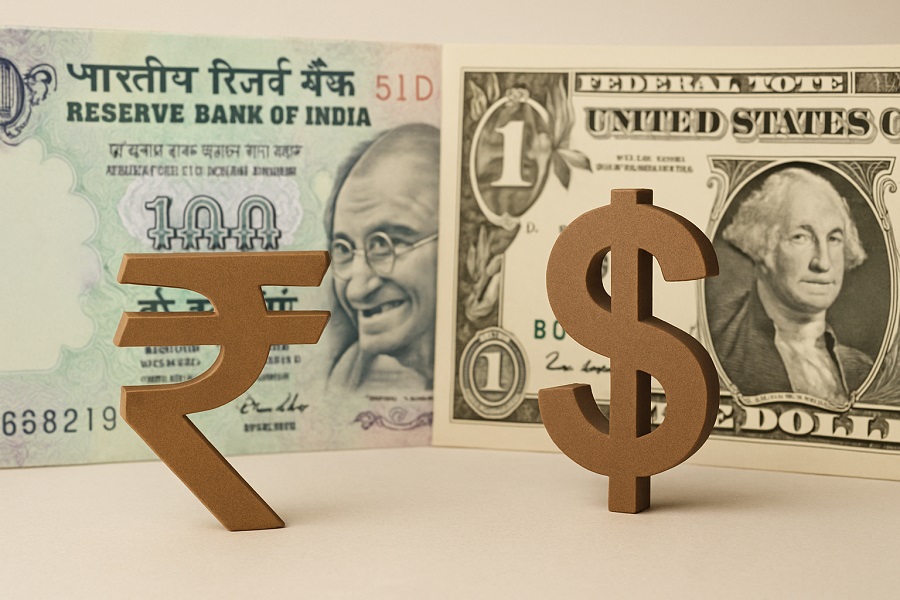
Quote on Global Currency Markets Enter a Volatile Phase as US Dollar Weakens; Rupee Likely to Stabilise Around Rs.90 by Mr. Parag Morey, Head of Sales, Emkay Wealth Management
Below Quote on Global Currency Markets Enter a Volatile Phase as US Dollar Weakens; Rupee Likely to Stabilise Around ?90 by Mr. Parag Morey, Head of Sales, Emkay Wealth Management
Emkay Wealth Management Ltd, the wealth management arm of Emkay Global Financial Services in its latest navigator report on currency cited that, global currency markets are witnessing heightened volatility as the US Dollar continues to lose strength against major global currencies, driven by expectations of further interest rate cuts by the US Federal Reserve and evolving geopolitical developments. Since the beginning of 2025, the Dollar Index has declined by nearly 9 per cent, falling from levels of 109.96 in early January to around 98.60 currently, reflecting a structural shift in global currency dynamics.
The US Dollar has remained particularly weak against the Pound Sterling and the Euro, while showing selective strength against the Japanese Yen. However, against the Chinese Yuan, the dollar has continued to depreciate steadily, indicating broader pressure across Asian currencies. Market participants attribute this trend largely to the Federal Reserve’s accommodative stance, having already reduced the Fed Funds Rate to the 3.50–3.75 per cent range, with expectations of further rate cuts in the coming months.
Currency experts note that investor sentiment is also being influenced by speculation around a potential change in the US Federal Reserve leadership by mid-2026. Expectations that a new Fed Chair may align monetary policy more closely with executive priorities have added to assumptions of prolonged low interest rates, which could further weaken the US Dollar against global majors.
In addition to monetary policy, geopolitical uncertainties remain a key variable shaping currency movements. Recent developments in regions such as Venezuela and Iran have heightened concerns around global trade routes and energy supplies. Any disruption to shipping lanes or oil flows could trigger short-term spikes in crude prices, potentially prompting a temporary flight to the US Dollar as a safe-haven currency, even amid its broader weakness.
Closer home, the Indian Rupee appears to have found relative stability around the ?90 mark against the US Dollar. While intermittent volatility has been observed on both sides, market estimates suggest the currency may consolidate around current levels in the near term. India’s status as a net importer continues to weigh on the Rupee from a trade perspective; however, improving prospects for foreign investment inflows could provide some support.
Overseas investors have been net sellers in Indian equities over the past 18 months, but this sustained sell-off has also led to more attractive valuations across sectors. Analysts believe that deeper rate cuts in the US, which would significantly compress dollar yields, could revive investor appetite for emerging markets such as India.
Mr. Parag Morey, Head of Sales, Emkay Wealth Management said, “The global currency landscape is clearly transitioning into a phase where monetary policy divergence and geopolitical risks will play a defining role. A softer US Dollar, coupled with potential capital reallocation towards emerging markets, creates both opportunities and risks for investors. For India, sustained foreign inflows, supported by stable macro fundamentals, could help the Rupee maintain its current range despite global volatility.”
Looking ahead, currency markets are expected to remain sensitive to policy signals from the US Federal Reserve, geopolitical developments, and global risk sentiment. Investors and businesses are advised to closely monitor these factors and adopt prudent hedging strategies to navigate the evolving foreign exchange environment.
Above views are of the author and not of the website kindly read disclaimer