Power Banks: How to Choose the Right One
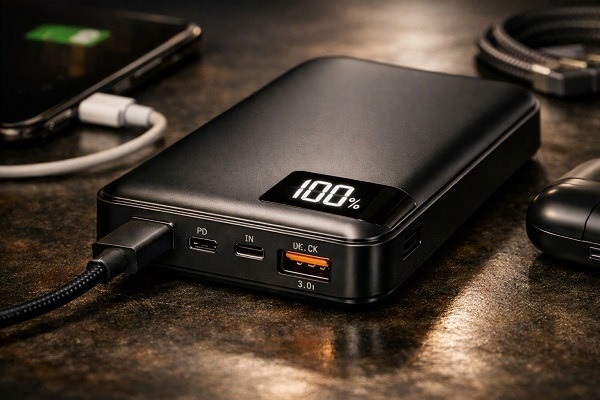
A power bank can be a useful gadget when you are travelling, working outside, or simply need extra battery backup for your smartphone. With so many options available, choosing the right power bank can sometimes be confusing. Capacity, charging speed, ports, size, and safety are some of the important factors to consider before buying one.
1. Check the Capacity
Power bank capacity is usually measured in **mAh (milliampere-hours)**. Common options include 10,000mAh, 20,000mAh, and higher capacities.
A **10,000mAh power bank** is generally suitable for everyday smartphone users who need occasional backup. A **20,000mAh model** can be more useful for frequent travellers or people who need to charge multiple devices.
Remember that the actual usable capacity is lower than the advertised number because some energy is lost during voltage conversion and charging.
2. Look at Charging Speed
Capacity isn't the only important factor. Charging speed can make a big difference.
Look for power banks that support **fast charging** if your smartphone supports it. The output power is usually expressed in watts (W). Higher wattage can allow compatible devices to charge faster.
However, your phone, cable, and power bank all need to support compatible charging standards for you to get the expected speed.
3. Choose the Right Ports
Modern power banks commonly come with **USB-C** ports, while some also include USB-A ports.
USB-C can be particularly useful because it may support both input and output charging, depending on the model. If you have several devices, consider buying a power bank with multiple ports.
4. Consider Size and Weight
A high-capacity power bank can provide more backup but may also be larger and heavier.
If you mainly need emergency smartphone charging, a compact 10,000mAh model may be more convenient. For long trips, a larger capacity may be worth carrying.
The best option depends on how much portability matters to you.
5. Check Safety Features
Safety should be a priority when choosing a power bank. Look for products from reputable manufacturers that offer protections such as **overcharge protection, over-current protection, short-circuit protection, and temperature protection**.
Avoid extremely cheap products from unknown sources, particularly if the product does not clearly provide specifications or safety information.
6. Check Airline and Travel Rules
If you frequently travel by air, check the applicable airline and airport rules before carrying a high-capacity power bank. Portable batteries are subject to restrictions, particularly regarding their energy capacity and where they can be carried.
It is better to check the current rules of your airline before travelling.
7. Look for Reliable Build Quality
A power bank should be durable enough for regular use. Check the quality of the casing, ports, buttons, and cable compatibility.
A slightly more expensive power bank from a reliable manufacturer can be a better choice than a very cheap product with questionable build quality.
8. Wireless Charging Can Be Useful
Some power banks support wireless charging, which can be convenient for compatible smartphones and other devices.
However, wireless charging can be less efficient than wired charging and may generate more heat. If charging speed is your priority, a wired connection may be preferable.
9. Think About Your Actual Requirements
Before buying a power bank, ask yourself a few simple questions:
* How many devices do I need to charge?
* How frequently will I use it?
* Do I need fast charging?
* Do I travel frequently?
* Do I need wireless charging?
* How much weight am I comfortable carrying?
Answering these questions can help you avoid paying for features you don't actually need.
Conclusion
Choosing the right power bank is mainly about finding a balance between **capacity, charging speed, portability, safety, connectivity, and price**. A compact 10,000mAh model may be enough for everyday emergency charging, while a larger model can be more suitable for travel or multiple devices.
Instead of choosing a power bank only because it has a large mAh rating, consider the complete package and select a reliable model that matches your daily requirements.