Note on MPC August 2026 by Yogesh Kalwani, Head Investment, InCred Wealth

Holding the Line; RBI Balances Inflation Risks with Growth Resilience
The Monetary Policy Committee (MPC), in its August meeting, unanimously kept the policy repo rate unchanged at 5.25%. Consequently, the Standing Deposit Facility (SDF) rate remains at 5.00%, while the Marginal Standing Facility (MSF) rate and the Bank Rate remain at 5.50%. The MPC also retained its neutral policy stance, reaffirming its intent to remain data-dependent and respond appropriately to evolving macroeconomic conditions. The RBI acknowledged that inflation has moved above the target after remaining below it for sixteen consecutive months. However, the increase has largely been driven by food and fuel prices, while underlying demand-side inflation remains contained, with core inflation excluding precious metals continuing to stay benign. At the same time, domestic growth remains resilient, supported by robust manufacturing and services activity, healthy domestic demand and improving exports, although uncertainties surrounding the southwest monsoon, El Niño conditions, geopolitical tensions and global trade continue to cloud the outlook.
Assessment & Outlook on Inflation:
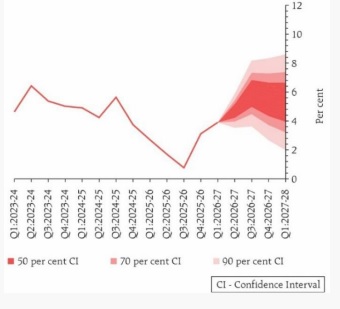
CPI inflation increased to 4.4% in June after remaining below the target for 16 consecutive months. The increase was primarily due to higher food, fuel and fuel-induced inflation in select categories such as restaurant services. Core CPI (excl. food and fuel) remained unchanged at 3.9% during May-June. Core inflation, excl precious metals, was even lower at 2.3-2.5%. Going forward, El Niño’s impact on rainfall distribution continues to remain a major risk although proactive supply management and adequate stock of foodgrains should provide comfort. Global oil prices have remained volatile with sharp two-way movements triggered by geopolitical developments, blurring the nearterm outlook. Inflation remains moderate, though second-round price pressures continue to pose risks. Taking this into account, CPI inflation for FY27 is projected at 5.0% (down from 5.1%) with Q2 at 4.7%, Q3 at 5.9%, Q4 at 5.5%. Inflation for Q1FY28 is projected at 5.3%. Core inflation for FY27 is expected at 4.3% (from 4.7%) however excluding precious metals it is expected to be lower before converging with core inflation from Q4.
Assessment & Outlook on Growth:
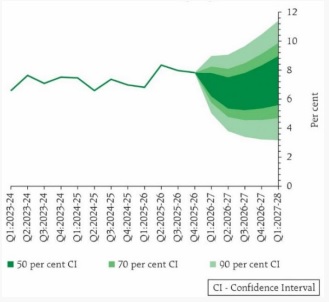
Amidst persistent global uncertainty, domestic economic activity has exhibited resilience as reflected by the high frequency indicators. Private consumption continued to be driven by buoyant discretionary spending, while investment activity remains steady on the back of robust government spending on infrastructure and construction. Merchandise exports rebounded with double digit growth while services exports growth sustained its momentum. Looking ahead, the prospects for agriculture are clouded by deficient and uneven southwest monsoon amidst El Niño conditions. Net external demand is expected to derive strength from bilateral trade agreements and market diversification. Renewed tensions in West Asia which are disruptive of global supply chains, volatility in international financial markets, and weather-related shocks pose downside risks to growth. Given this backdrop, real GDP growth for FY27 is projected higher at 6.7% (from 6.6%) with Q1 at 7.0%, Q2 at 6.4%, Q3 at 6.5% and Q4 at 6.8%.
System liquidity, as measured by the net position under the liquidity adjustment facility (LAF) stood at an average daily surplus of 1 lakh cr since the last MPC meeting. Seasonal currency returns, government cash balance drawdowns, and capital inflow measures are expected to support banking system liquidity in the near term. Short-term money market rates moderated in July (weighted average call rate (WACR) on average traded 6bps above policy repo rate in Jun-July), while G-Sec yields eased across maturities, supported by government and RBI measures to attract foreign capital. Credit transmission softened in May–June due to firmer deposit and lending rates, despite a cumulative decline in lending rates. Nevertheless, credit growth continues to remain robust (bank credit saw growth of 17.7% vs 9.9% a year ago). Through its conduct of two-way operations, the RBI said it will proactively ensure sufficient liquidity in the banking system, guided by the objective of aligning the WACR to the policy repo rate.
Banks and NBFCs continue to exhibit strong financial health, supported by robust capital, liquidity and asset quality, with only a marginal softening in bank NIMs.
India's current account deficit remained low and sustainable at 0.6% of GDP (US$25.4 billion) in FY2025-26 despite global volatility. During Apr-May’26, the current account recorded a surplus of $2.8 billion, primarily led by robust surplus in services trade ($34.3billion) and strong remittance receipts ($29.6 billion). In Q1FY27, India’s merchandise trade deficit widened to $86.6 billion (from $68.7 billion in Q1FY26), mainly driven by imports of crude oil, electronic goods and gold. Current account risks from global trade and energy remain, but strong external sector fundamentals and recent trade agreements are expected to mitigate the impact. Gross FDI inflows were buoyant at $30.7 billion during Apr-Jun, higher than U$26.7billion a year ago, underscoring the continued interest of global investors in India. Net FDI inflows increased to $7.9 billion during Apr-Jun. FPI to India saw a turnaround during Jun-July period with net inflows of $7.1 billion, primarily driven by the debt segment, after registering net outflows during Apr-May. During FY27 so far, net outflows in the equity segment stood at $11.6 billion, while the debt segment registered net inflows to the tune of $7.3 billion. Capital flow measures undertaken in June have supported inflows as a result, the balance of payments is expected to register a healthy surplus this year. India’s forex reserves ($692.9 billion as of July end) continue to be adequate in terms of the standard metrics of reserve adequacy with import cover of over 10 months and external debt cover of 90.8%.
Exchange rate to remain market-driven, with RBI acting to curb volatility and ensure orderly market conditions.
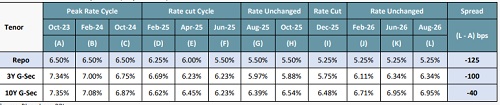
Today’s policy continued with its cautious undertone. With inflation expectations at 5.0%, the current real rate has dropped to just 15bps. To ensure meaningful real rate in the economy (~125bps of real rate), we expect RBI to resort to rate hikes to the tune of 75 to 100bps over the course of this fiscal year. The timing of initiation of these hikes could be in H2FY27 as the RBI gets further clarity on the progress of monsoons, GDP and CPI data prints, impact of the measures for INR stability and the extent of normalization on the geopolitical front. These events will continue to shape market expectations, and hence we prefer a dynamic and continuously reassessed approach to debt investments. While the Fx measures and tax exemptions could support the G-Sec yields, our view on rate hikes through this FY could act in a counterbalancing manner, thus keeping long term yields in a tight band. We thus continue to prefer positioning debt portfolios towards shorter duration investment opportunities.
Deployment Strategy:
Investors should continue to allocate up to 60% of fixed income portfolio towards accrual-oriented strategies (up to 3yr average maturities). Credit environment continues to remain stable, and credit spreads remain attractive. Thus, balance 40% allocation of fixed income portfolio is suggested towards high yielding assets (via bonds /funds).
Debt Market Yields & Spreads (Key Tenors):
Above views are of the author and not of the website kindly read disclaimer