India’s Unmanned Systems Market Projected at USD 18.4 Billion by FY31 by CareEdge Ratings

Synopsis
• India’s unmanned systems market grew from USD 529.3 million in FY21 to USD 1,289.8 million in FY26, reflecting a CAGR of 19.5%, with defence buyers accounting for about 82% of the total market share. CareEdge Advisory puts the addressable opportunity over the next five years till FY31 at about USD 18.4 billion.
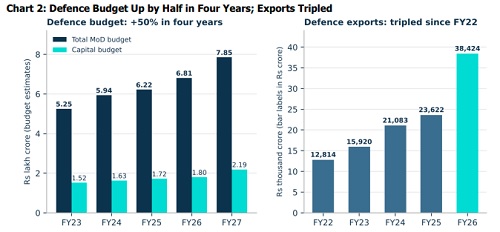
• Rising defence budgets, a 75% domestic earmark for capital acquisition and defence exports that tripled to Rs 38,424 crore in FY26, provide a strong funding base for this growth.
• Purchase approvals have tilted decisively towards drones and counter-drone systems, while procurement reforms and a scaling industrial base position Indian manufacturers well to capture a sustained growth phase.
A Long Runway Ahead
Anchored in defence developments and purchases, India’s unmanned systems market more than doubled in the last five years, from USD 529.3 million in FY21 to USD 1,289.8 million in FY26 (FY referring to the Indian financial year), as per CareEdge Advisory estimates. The Unmanned Systems defence segment grew from USD 465.8 million to USD 1,057.7 million over the same period, reflecting a CAGR of 17.8%. Ariel Drones accounted for roughly 78– 83% of the overall market share in FY26.
Commercial demand grew even faster, at about 29.6% per year, from USD 63.5 million to USD 232.2 million during FY21 to FY26, as drones moved into farm spraying, land surveying, highway monitoring and mining. That lifted the commercial share from about 12% to 18%, as Chart 1 shows. For defence suppliers, a larger civilian market spreads the cost of factories, engineers and certified pilots across more customers.
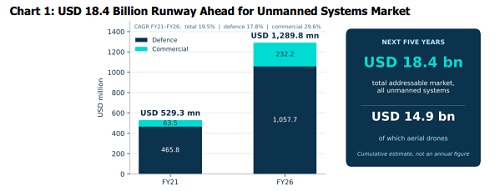
CareEdge Advisory estimates a total addressable market opportunity of about USD 18.4 billion by FY31, of which aerial drones account for about USD 14.9 billion. Spread evenly, that is about USD 3.7 billion a year, nearly three times the FY26 market size. Even a partial capture of that opportunity would mark a significant change for Indian manufacturers. Counter-drone systems, which the research does not size separately, offer further opportunity, and their momentum is clearest in the approval pipeline.
Defence Budgets and Exports Rising
The Ministry of Defence’s budget allocation rose from Rs 5.25 lakh crore in FY23 to Rs 7.85 lakh crore in FY27, reflecting a CAGR of about 10.6%, as Chart 2 shows. Its share of the Union Budget climbed from 13.31% to 14.67%. The capital budget, which pays for new equipment, rose from Rs 1.52 lakh crore to Rs 2.19 lakh crore, and the Ministry fully used its revised FY26 capital outlay of Rs 1.86 lakh crore.
Measured against GDP estimates from the Ministry of Statistics and Programme Implementation (MoSPI), defence allocations have held between 1.96% and 2.04% of GDP over FY23 to FY26. Defence spending is growing in tandem with the economy, and the sharper shift it is witnessed at the receiving end. Indian industry’s reserved share of the capital acquisition budget rose from 68% in FY23 to 75% in FY27. In rupees, the earmark grew 64%, from Rs 84,598 crore to Rs 1.39 lakh crore.
Exports tell the strongest growth story. India’s defence exports tripled from Rs 12,814 crore in FY22 to Rs 38,424 crore in FY26, a CAGR of about 31.6%, including a 62.66% jump in FY26 alone. Private firms contributed about 45%, and Indian defence products now reach more than 80 countries. The government targets Rs 50,000 crore of exports by 2029. Cost-efficient drones, loitering munitions and surveillance systems are natural candidates for buyers who cannot afford larger platforms.
Approvals Tilt Towards Drones
The Defence Acquisition Council (DAC), the Defence Ministry’s top body for approving arms purchases, is where future demand first becomes visible. Its approvals, called Acceptance of Necessity (AoN), are the formal green light to begin buying. In FY26, the DAC granted AoN to 55 proposals worth Rs 6.73 lakh crore, the highest for any year. Three meetings between July and October 2026 added about Rs 3.74 lakh crore more.
The focus and value of approvals have decisively shifted. Lists in 2023 and 2024 were built largely around submarines, fighter aircraft and patrol vessels. Since July 2025, unmanned systems or counter-drone equipment have appeared in eight of the nine DAC rounds, against two of eight before, as Chart 3 traces. The August 2025 round, worth about Rs 67,000 crore, included medium-altitude, long-endurance drones for all three services. Earlier, a 2023 approval for 31 MQ-9B long-endurance drones was converted into a contract in October 2024.
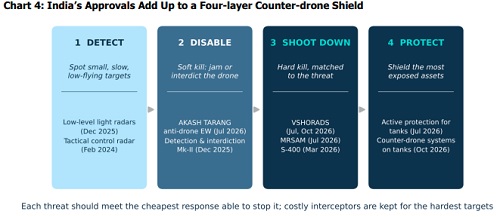
Counter-drone demand has followed close behind. December 2025 brought lightweight radars to track small, lowflying drones and a system to detect and disable them. July 2026 added AKASH TARANG, an electronic warfare system against drones. October 2026 included counter-drone systems to protect tanks, alongside long-range kamikaze drones, which dive onto their targets, and surveillance drones. The FY27 budget document itself names drones among forthcoming capital purchases.
Evolving Threats Fuel Demand
The deepest driver of demand is a cost imbalance. Drones are cheap to build, quick to replace and easy to field in large numbers, while the missiles traditionally used to stop them are expensive and limited in supply. An adversary that sends waves of low-cost drones can exhaust a defender’s interceptor stocks, or force it to let some through. Every military now has to plan around that imbalance.
Recent conflicts have turned the argument into evidence. The Russia–Ukraine war and the 2026 conflict involving the US, Israel and Iran both saw drones used at scale, often alongside missiles, including for long-range strikes. Closer to home, government accounts of Operation Sindoor credit Indian drones and loitering munitions, and indigenous anti-drone systems, with a role in that operation.
The result is twin demand. Forces must buy drones to watch and strike and buy defences that can stop enemy drones without spending a costly missile each time. Chart 4 shows how India’s approvals map onto four layers: detect, disable, shoot down and protect. Each layer is a market in its own right, for radars, jammers, short-range air defence and protection fitted to tanks. DRDO, the Defence Research and Development Organisation, has also tested an integrated system combining interceptors, short-range weapons and lasers, pointing to cheaper ways of defeating drones.
Policy and Industry Aligned
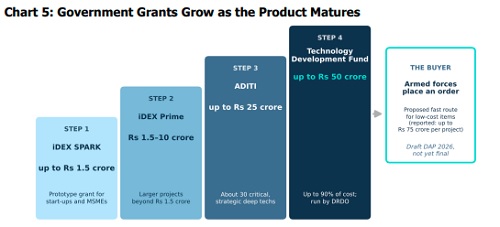
Policy and industry are now moving in tandem. The draft Defence Acquisition Procedure (DAP) 2026, released in February 2026, proposes a low-cost acquisition route for fast-moving items, which trade reports put at up to Rs 75 crore per project. It also allows single-vendor buying for mature Indian technology, compensates vendors that clear trials and raises minimum indigenous content in the top-priority category from 50% to 60%. Before an order, firms can climb a ladder of grants worth Rs 1.5 crore to Rs 50 crore, from iDEX SPARK to the Technology Development Fund, as Chart 5 shows. iDEX alone had signed 551 development contracts by March 2026. The industrial base is ready to respond. Defence production reached a record Rs 1.78 lakh crore in FY26, with private firms contributing 24%. The civilian drone sector adds depth, with 38,575 registered drones and 39,890 certified remote pilots by February 2026.
CareEdge Advisory’s View
For India, drones and the shields against them have moved from the margins of defence planning to its centre. The market has more than doubled in five years, and the next five years offer an opportunity several times larger. Three milestones will mark the pace. The first is FY27 contract signings for unmanned and counter-drone systems, as approvals turn into orders. The second is the final DAP 2026, with its low-cost fast route and 60% indigenouscontent rule. The third is exports, as they climb towards the Rs 50,000 crore target for 2029. In a contest of cheap machines, the advantage goes to the side that can build and defend at scale, and India is building that capacity.
“India’s unmanned systems market is moving from proof of concept to scale. The approvals, the budget earmarks and the export numbers all point the same way. The opportunity is real; the winners will be the Indian firms that secure their components and convert approvals into contracts fastest,” says Sagar Desai, Assistant Director at CareEdge Advisory.
Above views are of the author and not of the website kindly read disclaimer