Views on Fixed income strategy : Why not add credit risk yet? Dario Messi, Head of Fixed Income Research, Julius Baer

Below the Views on Fixed income strategy: Why not add credit risk yet? Dario Messi, Head of Fixed Income Research, Julius Baer
Credit spreads have widened in recent weeks. Although default trends remain benign, refinancing risks are gradually building. With borrowing costs still well above legacy coupon levels and maturity needs rising, patience is likely to be rewarded with better entry points to decisively add credit risk.
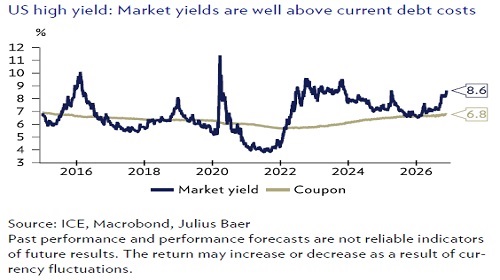
As we know, equity market dynamics cannot be fully translated into credit markets. Part of the reason is structural: major equity indices are dominated by large technology companies that carry relatively little leverage and therefore play only a limited role in credit benchmarks. The perspective also differs. What can be attractive from an equity holder’s standpoint, namely the use of leverage to enhance returns, is often less appealing for creditors, who are primarily concerned with downside protection and repayment capacity. Still, the recent equity market weakness matters for investors looking at riskier credit segments. Equity volatility has increasingly been accompanied by concerns about a slowing investment cycle and softer aggregate demand. It is therefore not surprising that the weaker and more leveraged segments of the bond market have come under pressure as well. Credit spreads widened across the board, with US high-yield spreads moving noticeably wider since October (from 260bp to over 370bp on average). While current spread levels are not alarming by historical standards, the move itself has been meaningful and has improved the carry available to investors. Given that default trends remain favourable, the natural question is whether this represents an attractive opportunity to increase credit risk exposure. For now, we would remain cautious. As outlined in our market outlook last week, we continue to expect greater differentiation within credit markets over the coming months. Importantly, current market yields, effectively the refinancing costs faced by issuers accessing debt markets today, have once again moved well above the average coupons embedded in existing debt. In other words, all else equal, as bonds mature and companies refinance, interest expenses are set to rise. This challenge arrives at a time when refinancing needs are increasing. As such, the full impact of higher borrowing costs has yet to be felt. In our view, these dynamics argue for patience.
Above views are of the author and not of the website kindly read disclaimer