Views on By Richard Tang, China Strategist and Head of Research Hong Kong, Jen-Ai Chua & Eric Mak, Equity Research Analyst Asia, Julius Baer

Below the Views on Views on By Richard Tang, China Strategist and Head of Research Hong Kong, Julius Baer, Jen-Ai Chua, Equity Research Analyst Asia, Julius Baer & Eric Mak, Equity Research Analyst Asia, Julius Baer
The US has tightened the rules targeting China’s access to advanced chips and compute. This is likely to result in near-term headwinds for Chinese cloud service providers and data centres in Southeast Asia. In view of the concurrent sell-off in US equities, we expect lingering volatility in Asia, but ‘anti-AI’ markets such as India may outperform.
The US Department of Commerce has issued interim rules requiring US licenses for (i) overseas data centres supplying significant processing power to firms headquartered in restricted countries like China; (ii) the export, re-export, or transfer of advanced semiconductors to Indonesia, Malaysia, Singapore, Thailand, and Brazil, where there is a higher-than-normal risk of non-official diversion of chips; and (iii) chip fabrication across all nodes, both mature and advanced.
The latest rules have wide-ranging implications for AI and chip-related players in Asia. TSMC and Samsung Electronics have reportedly suspended chip shipments to China pending more clarity on the new rules. If access to overseas foundries is not approved, SMIC could emerge as the sole foundry of advanced nodes available to Chinese fabless, setting the stage for higher wafer prices in 2027 given existing capacity constraints.
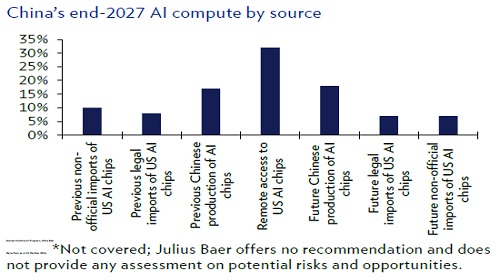
Chinese companies rely heavily on access to advanced chips and offshore compute to train large-scale frontier models. Given that remote access to US AI chips in overseas data centres accounts for an estimated 32% of China’s end-2027 compute and non-official chip imports for another 7%, tighter rules are likely to slow the pace of model upgrades by internet platforms such as Tencent and Alibaba.
The implications for Southeast Asian economies are also negative, as the region supplies an estimated 75% of China’s offshore compute. Slower chip deployment and delays in data centre fit-outs could hurt investment inflows, particularly in Malaysia and Thailand, where data centre capacity planned is highest. Manufacturing should be less impacted as long as AI hardware and hyperscaler capex stays intact.
Above views are of the author and not of the website kindly read disclaimer