IBC Recovery Gains Momentum in Q1FY27, Despite Continued Delays by CareEdge Ratings

Synopsis
• Fresh CIRP admissions remained subdued in Q1FY27, with 177 cases admitted, down 5.3% y-o-y, taking cumulative admissions to 9,166. Financial creditors (FCs) accounted for 65.5% of new admissions, highlighting their continued role in driving new insolvency filings. While cumulative admissions increased, the stock of ongoing cases remained broadly stable at 1,865 cases, indicating that case closures have largely kept pace with fresh inflows.
• Recovery outcomes improved sequentially during the quarter, with FCs recovering 28.6% of admitted claims, up from 22.8% in Q4FY26. Creditors continued to face an average haircut of 71.4%, while realisations remained significantly above liquidation value at 136.7%, underscoring the benefits of resolution-led outcomes despite elevated haircuts.
• Delays remain the key challenge for the insolvency ecosystem. Nearly three-fourths of ongoing CIRPs exceeded 270 days. Average resolution time increased to 757 days, while liquidation cases averaged 540 days, with nearly 70% pending for over two years. These prolonged timelines highlight the impact of ageing cases, litigation and procedural bottlenecks on recovery efficiency. Manufacturing accounted for the largest share of ongoing cases at 36%.
• Recent regulatory amendments aim to improve transparency, information quality and process efficiency, which could support faster resolutions and better creditor outcomes. Going forward, enhancing execution efficiency and reducing delays will be critical to strengthening the effectiveness of the insolvency framework.
Recovery Performance Improving, But Not Structural Yet
Figure 1: Summary of CIRPs Yielding Resolution
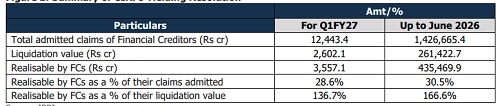
Recovery outcomes under the IBC improved sequentially in Q1FY27, with FCs recovering 28.6% of admitted claims compared with 22.8% in Q4FY26. Despite the improvement, recoveries remained marginally below the cumulative recovery rate of 30.5% achieved across all resolved cases up to June 2026, indicating that creditor losses on resolved accounts continue to remain significant.
During the quarter, FCs realised Rs. 3,557 crores against admitted claims of Rs. 12,443 crores. Notably, recoveries were 136.7% of liquidation value, reaffirming the value-accretive nature of resolution-led outcomes relative to liquidation. On a cumulative basis, creditors have realised Rs. 4.35 lakh crore, equivalent to 30.5% of admitted claims and 166.6% of liquidation value.
The actual realisation percentage is likely to be higher, as resolutions involving older cases often include significant amounts of accrued interest and other receivables added to admitted claims, over and above the actual principal outstanding and overdue amounts. While the improvement in quarterly recoveries indicates favourable outcomes from cases resolved during the period, overall recovery performance continues to be constrained by long-pending and deeply stressed accounts that typically carry lower realisation potential. Nevertheless, the substantial premium over liquidation value demonstrates that the IBC remains an effective mechanism for preserving enterprise value and enhancing creditor recoveries, even in cases involving significant haircuts.
Resolution Continues to Create More Value than Liquidation; However, Liquidation Continues to Dominate Exit Routes
Figure 2: Status of CIRPs
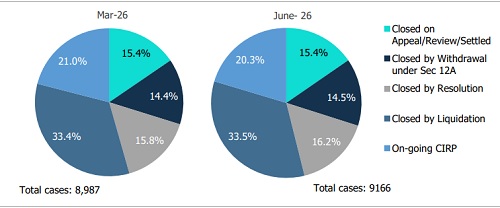
The status of CIRPs remained broadly stable in Q1FY27, indicating that case closures continued to broadly keep pace with fresh admissions. Of the 9,166 cases admitted under CIRP as of June 30, 2026, successful resolutions accounted for 16.2% (1,484 cases), up marginally from 15.8% (1,419 cases) at the end of FY26. At the same time, ongoing cases declined to 1,865 from 1,885, reducing their share to 20.3% from 21.0%.
Liquidation remained the dominant closure route, accounting for 33.5% (3,074 cases) of admitted CIRPs, broadly unchanged from 33.4% in FY26. The persistence of liquidation as the most common outcome indicates that a significant proportion of companies continue to enter the insolvency process after substantial deterioration in their financial and operational position, limiting the feasibility of revival through resolution plans
Cases closed through appeal, review or settlement remained stable at 15.4% (1,410 cases). In comparison, withdrawals under Section 12A increased marginally to 14.5% (1,333 cases) from 14.4% in FY26, indicating the continued use of negotiated settlements outside the formal resolution process.
Overall, the resolution mix showed modest improvement, supported by a gradual increase in successful resolutions and a decline in ongoing cases. However, the continued dominance of liquidation highlights the challenges in preserving stressed businesses as going concerns. While disposal rates have broadly matched fresh admissions, improving the quality and timeliness of resolutions remains critical to enhancing recovery outcomes under the IBC framework. Meanwhile, even as the CIRP pipeline remains stable, the predominance of liquidation over resolution suggests that value preservation remains constrained by delayed admission and severe financial stress at the time of insolvency.
.
Above views are of the author and not of the website kindly read disclaimer











More News

Capital Small Finance Bank Appoints Banking Veteran Conrad D?Souza as Independent Director