
Fresh Bank Spreads Narrow Sequentially to 2.90% in September by CareEdge Ratings

Synopsis
• Fresh lending rates fell 10 bps to 8.51% in September 2026, while fresh deposit rates fell 6 bps to 5.61%, narrowing the spread on fresh business by 4 bps to 2.90%.
• The deposit relief was due to liquidity rather than pricing. Funds raised under the RBI’s FCNR(B) swap window before it closed on August 31 lifted the system liquidity surplus above Rs 11 lakh crore in early September, so banks did not have to bid for bulk deposits. Three-month certificate of deposit (CD) rates fell 47 bps on monthly averages while the three-month treasury bill yield barely moved. That support has since gone: the surplus fell to Rs 0.1 lakh crore by October 31, the Monetary Policy Committee raised the repo rate 25 bps to 5.50% on October 7 and moved its stance to calibrated tightening, and three-month CD rates rose 55 bps in October.
• Foreign banks cut their fresh lending rate 22 bps to 7.76%, the sharpest cut by any group since January 2026, and their fresh deposit rate fell to 4.64%, the lowest since February 2026. September was the first full month in which the rupee liquidity from FCNR(B) deposits raised up to August 31 sat on bank books.
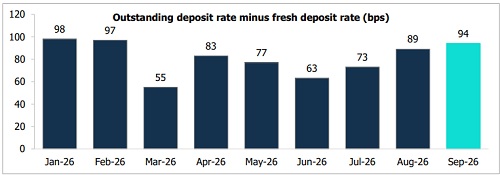
• The existing deposit book is still repricing lower. Banks are paying 94 bps less on fresh term deposits than the average on deposits already raised, the widest gap since February 2026, so every deposit that matures and renews lowers the cost of funds.
• We expect fresh spreads to widen modestly to 2.90-3.10% in October, and the spread on the existing book to hold through the December quarter. Loan yields move first, as 68.2% of floating rate loans are linked to an external benchmark, mostly the repo rate, and reprice almost at once. Deposits reprice only as they mature, so the pressure comes from the March quarter.
Bank Credit Growth Rises to 19.4%, 160 bps Above Deposit Growth, as Surplus Drains
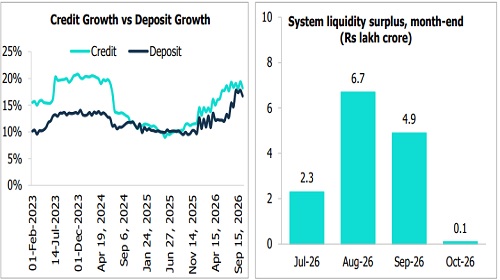
Bank credit grew 19.4% y-o-y in the fortnight ended September 30, 2026, against 17.8% for deposits, a gap of 160 bps. Credit growth picked up 30 bps over end-August, while deposit growth held flat, with both books building up sharply in absolute terms at the quarter end. Growth was broad-based: all four major sectors grew faster than in August.
Liquidity peaked at Rs 11.2 lakh crore in early September, fell to Rs 4.86 lakh crore by September 30, and continued to reduce in October. The decline reflects advance tax outflows, festive currency demand, and credit growth, alongside RBI absorption through reverse repo auctions, about Rs 1 lakh crore of open market sales between August and October policies, and a higher daily CRR maintenance floor from October 16.
Fresh Deposit Rate Falls 6 bps to 5.61% in September
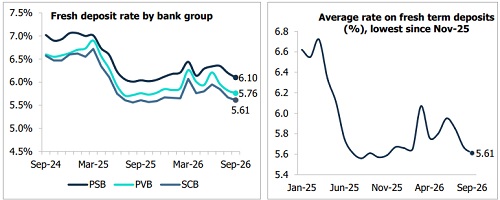
Banks paid less for fresh term deposits in September. The weighted average rate fell 6 bps to 5.61%, the lowest in 10 months, as banks had less need to chase deposits. The FCNR(B) money raised under the RBI’s swap window, which closed on August 31, left banks with surplus liquidity, enabling them to let expensive bulk deposits mature without replacing them, which pulled the average down. The money market reflects a similar trend. The threemonth CD rate averaged 47 bps less in September than in August, while the three-month T-bill yield barely moved.
September’s relief did not last and the surplus dissipated by October. The call rate rose above the repo rate in the second half of the month, reaching 5.66% on October 19, close to the 5.75% MSF rate, and three-month CD rates jumped 55 bps on monthly averages. Large deposits also got harder to bargain for. From October 1, banks must publish their bulk deposit rates by 10 am each business day and pay the same rate on similar deposits accepted that day, though they may vary bulk rates by liquidity run-off category
Fresh Lending Rate Falls 10 bps to 8.51%, Biggest Drop Since December 2025
Banks charged less on new loans in September. The fresh lending rate fell 10 bps to 8.51%, the biggest monthly drop since December 2025, though it is still 12 bps higher than a year ago. Foreign banks led the cut. Their rate fell 22 bps to 7.76%, more than any bank group has cut in a month since January 2026. Public sector banks cut 6 bps to 7.93%, and private banks stayed at 9.19%. The FCNR(B) swap window shut on August 31, making September the first full month in which banks had the money on their books. Foreign banks were also paying less for their own funds: their fresh deposit rate fell 6 bps to 4.64%, the lowest since February 2026. However, this was not a general cut in loan pricing. Fresh rates rose in seven of the 11 loan segments tracked by the RBI reports.
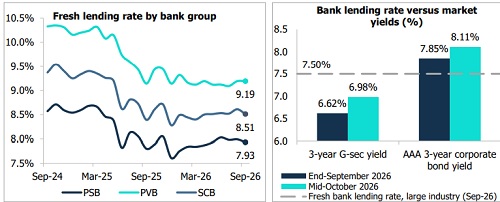
Banks continue to remain a cheaper source of funding for large corporate. In September, a new bank loan to large industry cost 7.50% on average, less than a three-year AAA bond. Bond yields rose in line with the increase in government bond yields. The gap between AAA paper and G-secs shrank, from 123 bps to 113 bps. Meanwhile, companies continue to access both markets. Corporate bond issuance rose 1.7% y-o-y to Rs 5.8 lakh crore in H1 FY27, and Q2 bounced back strongly after four quarters of decline. Commercial paper issuance rose 24.1% to Rs 11.1 lakh crore. Borrowers seem to be locking in money before rates rise further.
Public and Private Bank Spreads Widen, but All-Bank Spread Falls 4 bps to 2.90%
Both public and private sector banks earned more on new business in September, without increasing loan rates. PSBs widened their fresh spread 4 bps to 1.83%, the widest since November 2025. Their deposit rate fell 10 bps and their lending rate only 6 bps. Private banks widened 6 bps to 3.43%, the widest since January 2026. Their lending rate stayed flat while their deposit rate fell 6 bps. However, foreign banks moved in other direction, cutting their lending rates by 22 bps, much more than the 6 bps drop in their deposit rate, narrowing their spread by 16 bps to 3.12%.
Outstanding Spread Edges Up 1 bp to 2.41%; New Deposits Cost 94 bps Less
Rates on existing loans remained largely unchanged in September. The outstanding lending rate held at 8.96%, and it has not moved more than 1 bp either way since June. That is still 30 bps lower than a year ago and the lowest since June 2022. The outstanding deposit rate dipped 1 bp to 6.55%. That’s 27 bps below a year ago and the lowest since June 2023. As a result, the outstanding spread edged up 1 bp to 2.41%, the highest since November 2025. Deposits only reprice when they mature. The extent of further decline in funding costs depends on how far new deposit rates are below the rate on the existing book. In September that gap was 94 bps, the widest since February 2026. PSBs are the only group with a wider outstanding spread than a year ago, at 1.78% against 1.72%. Private banks are 10 bps narrower at 3.16%, and foreign banks 22 bps narrower at 2.98%. A bigger share of their loans repriced down with earlier repo cuts.
PSB Median MCLR Rises 5 bps in October; Private Bank Median Falls 10 bps
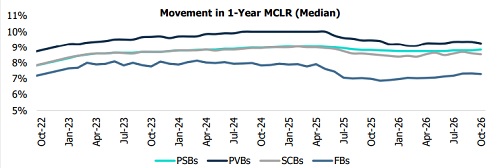
The all-bank median one-year MCLR fell 6 bps to 8.55% in October, but MCLR moves followed each group's own funding costs, with the two groups moving in opposite directions. The PSB median one-year MCLR rose 5 bps, while the PVB median fell 10 bps. Across the public sector banks reported by the RBI, the whole range shifted up, and six of the 11 banks shown below raised their rate with none cutting. The private bank median fell because of cuts at a few banks in the wider group. Among the six banks shown below, two raised their rate and one cut it. These revisions reflect the funding costs banks carried through the September quarter, not the repo increase, whose impact will be reflected later. With the surplus gone, further increases are likely through the December quarter.
Above views are of the author and not of the website kindly read disclaimer