


Fiscal Accounts : Centre and states remain comfortable, but for different reasons by Emkay Global Financial Services Ltd

Centre’s 4MFY27 fiscal position is comfortable, with improved revenue (driven by income tax) and controlled revex, while states are also well-placed, as they continue to conserve expenditure despite a pick-up in revenue. The Centre has continued to prioritize capex (30% yoy), driven by core sectors of Defence, Roads and Railways, while pushing states through capex loans. However, states have controlled both revex and capex. For FY27E, we expect the Centre to meet its FY27BE FD/GDP of 4.3%, with several buffers available to offset Middle East crisislinked strains. However, Brent sustaining above $90/bbl for an extended period would pose an upside risk of 0.2% of GDP, while potentially lower-than-budgeted nominal GDP growth also adds mild slippage risk. States, on the other hand, are expected to see fiscal slippage of 0.2% of GDP vs the FY27BE target of 3.1%, due to revenue pressure and a continued focus on capex.
Centre’s fiscal position improves as revenue picks up, while capex focus continues
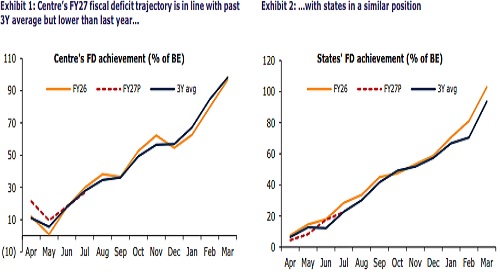
Fiscal accounts till July show the Centre’s fiscal position improving vs June, with revenue growth picking up substantially and expenditure staying relatively controlled. The Centre’s fiscal deficit (FD) at 27% of BE for 4MFY27 is much lower than last year’s 31% and in line with the 3Y average, reflecting a comfortable fiscal position. Gross tax revenue growth has risen to 11% yoy (vs 4% until June; 9% BE), driven by a recovery in income tax growth, while indirect tax collections have also picked up. Revex remains under control (8% yoy; in line with BE), while capex growth has been extremely strong (30% yoy vs 14% BE; 37% of BE achieved).
States running a tight ship through controlled expenditure; FD comfortable for now
States are also in a stable position, with 4MFY27 FD achievement at 22%, lower than last year’s 28% and in line with the 3Y average (23%). This is largely due to improved revenue, while expenditure remains controlled. States’ revenue growth improved to 10% yoy in 4MFY27 (vs 3% until June; 24% BE), as devolution from the Centre rose 4% yoy (vs -12% until June), while own tax revenue (OTR) growth also improved to 16% yoy (21% BE). Devolution is poised to improve further in August, with the Centre having released an extra instalment, providing a further boost to states’ coffers. We note that robust SGST growth (16%) is largely on account of higher IGST settlements from the Centre; pre-settlement SGST growth was just 5% yoy for 4MFY27. States have kept expenditure under control (5% yoy), with both revex (4% yoy) and capex (11% yoy) remaining muted, while achievement rates are in line with 3Y averages. Capex has been muted despite the Centre’s capex loan transfers rising 70% yoy in 4MFY27. As a result, states’ FD is 15% lower than in the same period last year
Centre likely to meet FY27BE FD/GDP of 4.3%, but nominal GDP could be a risk
We believe the Centre should be able to maintain the budgeted FD/GDP target of 4.3% (assuming Brent remains around current levels). The fiscal impact of potential excise duty cuts and higher fertilizer subsidies is likely to be offset by a combination of a drawdown from the Economic Stabilization Fund (ESF), modest rationalization of non-core capex and revex, a slightly higher-than-budgeted RBI dividend, and stronger import duty collections from precious metals. However, if Brent sustains above $90/bbl, the fiscal cushion would narrow materially, raising the possibility of fiscal slippage to the tune of 0.2% of GDP. An additional risk emanates from lower-than-budgeted nominal GDP following revisions to past GDP data. The FY27BE nominal GDP level (which assumes 10% growth over FY26) now requires 13.5%, which may be difficult to achieve and hence adds mild slippage risk.
States’ revenue pressures and capex focus to lead to fiscal slippage in FY27E
States’ revenue growth is expected to improve in 2H, which is seasonally stronger. Additionally, devolution from the Centre will improve as the extra installments are paid out. We also note that several major states (MH, AP, KA, TS, HR, UP) have raised alcohol excise rates and/or revamped their alcohol excise policies over the past 18 months; as a result, states’ excise revenue is expected to remain strong through the year. However, GST growth is likely to taper off, while grants are also likely to be lower than budgeted. States are thus expected to undershoot optimistic FY27BE revenue targets across both OTR and central transfers. While states will control expenditure to meet deficit targets, revex will be stickier, while capex will remain robust, aided by the Centre’s capex loan program. As a result, we expect states to slip and deliver FY27E FD/GDP of 3.3% (vs FY27BE FD/GDP: 3.1%).
For Detailed Report With Disclaimer Visit. https://choicebroking.in/disclaimer
SEBI Registration no.: INZ 000160131










Tag News
India's real estate sector faces ~INR 50 trillion capital requirement through 2036: Brickwo...

.jpg)
