Economy : Fighting the Tide: Why US Intervention Can't Lower the Cost of Money by Choice Institutional Equities Ltd

Key Takeaways
* The US problem is solvency, not liquidity - Federal debt is past USD 40 Tn (debt/GDP ~123%, heading toward the 133% record), the deficit has widened to USD 1.8 Tn (Jul'26 FYTD from USD 1.6 Tn), and interest now eats ~35% of tax revenue - one dollar in three. The term premium is rising because the market doubts the fiscal path; liquidity tools can't fix a solvency problem, which is why every intervention fades within hours.
* It's a global problem, so yields have nowhere to fall - IIF data show world debt up USD 29 Tn in 2025 to a record USD 348 Tn, with Japan >250% of GDP, the UK 105%, the Eurozone ~90%, China 80% (more with hidden liabilities) and India 85.5%. Every large sovereign is issuing at once, so no low-yield haven is left to absorb supply. The US 10Y term premium has been positive since Sep'24 and at ~0.8% sits near Taper-Tantrum levels.
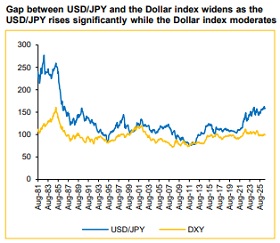
* The yen intervention was a US Treasury-market defence, and it failed - Japan is the largest foreign holder of USTs (USD 1.1 Tn); the August operation (first since 1998) was meant to prevent forced Japanese selling and a carry unwind. But USD/JPY round-tripped straight back to 159, and the risk is already live: Japan's short-term Treasury holdings are down 54% since Apr'26, driving the surge in short-dated US yields
* 2024–26 is a regime change in the yen–rate nexus - For the first time in two decades, the US–Japan differential is compressing from both ends (Japan normalising up, the US capped), while the yen stays weak and positioning stays crowded. Japan's curve is bear-steepening, and its short-term UST book is already shrinking: the classic set-up for a disorderly snap-back.
* Expect more intervention, not less - a ratchet, not a fix. The trigger is now endogenous: US fiscal stress itself can light the carry fuse, giving Washington a self-interested reason to keep capping yen appreciation. Escalation likely runs through the Fed's FIMA repo backstop first. But each successful defence enlarges the position that must eventually clear.
* Bessent's doubled buybacks (USD 4 Bn+/operation) bought one day - The 30-year dipped, then reversed above 5.27% within 48 hours, higher than before he moved. At USD 4 Bn against USD 32 Tn of public debt, it's a fire hose on an ocean: the wrong tool for a solvency problem, and one that adds bill-rollover risk and pressures Fed independence.
* The tariff revenue prop has been kicked away - The Supreme Court struck down the IEEPA tariffs 6-3 (Feb'26); ~USD 100 Bn of ~USD 166 Bn collected has been refunded. The inflationary cost persists (duties reimposed under other authorities) while the fiscal benefit reverses - the worst of both, compounded by the Iran oil shock.
* No consumer backstop remains - Savings/GDP has collapsed to ~2% (from 22%), wage growth has halved to 3.8%, and the jobs-tounemployed ratio is down to 1.06x; policy is carrying the whole load precisely when it is out of room.
* Market outlook - what cracks the calm - Geopolitics is a persistent overhang, not a fading one. The bigger fragility is the AI boom's circular financing; like the late-1990s, one fissure can unwind it, and this time it most likely originates in the banking sector as tighter funding severs the loop. The tell to watch is the 30-year yield through the buybacks; if it keeps rising, the props are being faded.
* India read: a vulnerability, not a haven - first-order down. Already underperforming global peers since mid-2024, with its own high debt (~85.5% of GDP), a structural current-account deficit and heavy crudeimport dependence. If US yields spike and the yen unwinds, India sells off with the world as currency, oil and outflow channels bite at once, with rich valuations amplifying the drawdown. The rotation-destination case is real but strictly second-order.
The problem is solvency, and the policy response keeps pretending it's liquidity
The US enters this cycle carrying a debt burden that has moved from large to structurally unmanageable, and the raw numbers make the shift hard to miss. Federal debt is past USD 40 Tn, debt/GDP sits at 123% and is climbing toward the 133% record, and outlays near USD 7 Tn run well ahead of USD 5.2 Tn of receipts, leaving a deficit that has widened to USD 1.8 Tn (Jul'26 FYTD) from USD1.6 Tn a year earlier. The cleanest gauge of the squeeze is the interest bill: federal interest expense now runs at 35% of tax revenue, far above pre-COVID levels. One dollar in three that the government collects is pre-committed to servicing debt before it meets any other obligation. This is the core analytical point, and everything flows from it: the term premium is rising because the market doubts the fiscal path, not because dealers lack cash. Every tool the US has reached for - buybacks, the yen operation, the repo backstop; are all liquidity tools. Applying liquidity tools to a solvency problem is why each produces a few hours of calm and then fades. One cannot repurchase their way out of a credibility problem that your own issuance calendar keeps reaffirming.
The yen intervention: a Treasury-market bailout dressed as FX policy
In early August, the US joined Japan to buy Yen, the first coordinated US–Japan yen intervention since 1998, and the rare case of direct US participation. The official framing was a yen at four-decade lows, but the real driver was selfpreservation. Japan is the largest foreign holder of US Treasuries (USD 1.1 Tn). Had Japan intervened alone, the natural funding source would have been selling Treasuries and driving US yields up exactly when Washington cannot absorb it. US participation, plus the pointed reminder that the Fed's FIMA repo facility lets Japan raise dollars against its Treasuries rather than dumping them, existed to neutralise that forced-seller risk. This was a defence of the US bond market with a Japanese label on it.
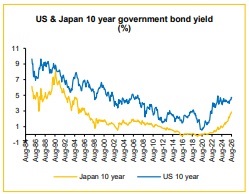
And the forced-seller risk is not hypothetical. Japan's holdings had recovered to 94% of their post-COVID peak through the start of Trump 2.0, but the recent drop is telling in its composition: Japan's short-term US Treasury holdings have fallen 54% since April 2026, and that liquidation lines up directly with the surge in shortdated US yields (the 2-year has risen more than the 10-year, flattening the curve). In other words, the mechanism the intervention is meant to prevent Japanese selling pushing up US funding costs- has already begun at the front end. It appears that the August operation is best read as an attempt to stop it spreading to the long end. The second channel is the carry trade. A sharp yen appreciation makes borrowing yen to buy dollar assets unprofitable and can force a disorderly unwind, the mechanism that tanked global equities in August 2024. With the US–Japan yield gap compressed to 1.8% from over 5%, the cushion is thinner and the reflex is to stabilise, not strengthen, the yen.
From the India market standpoint, equity markets are navigating elevated uncertainties around corporate earnings, capital flows, and valuations. Even before the Iran conflict intensified, Indian equities had underperformed most global benchmarks since mid-2024. The full economic impact of the shock is still unfolding, and shifting geopolitical realities point to the potential for recurrent disruptions ahead. India also enters this with its own constraints rather than as a safe haven. The sovereign carries a high debt load itself (around 85.5% of GDP, INR 325tn by FY27E) and there is a structural current-account deficit alongside a very high crude-import dependence. In this specific scenario, those are vulnerabilities, not cushions. If US yields spike and the yen unwinds, India sells off with the world, as the currency, oil, and outflow channels all bite at once, and rich valuations amplify the drawdown rather than blunt it. The rotation-destination case is real but strictly second-order and conditional.
For Detailed Report With Disclaimer Visit. https://choicebroking.in/disclaimer
SEBI Registration no.: INZ 000160131