Ethanol demand could reach 17.9 billion litres by FY31, taking capacity utilisation close to 100%: Brickwork Ratings

Existing 18.25 billion litre capacity can support E25 demand, while an E30 trajectory could push requirements beyond installed capacity and trigger fresh investments
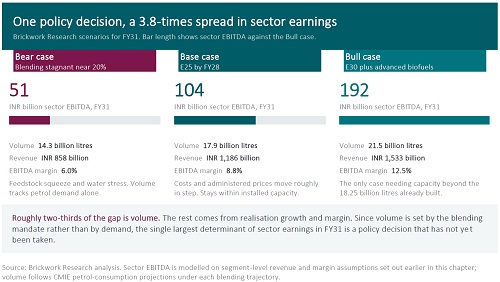
According to Brickwork Ratings (BWR), India’s ethanol sector is entering a phase where capacity utilisation, rather than capacity creation, will determine growth through 2030-31. The current installed distillation capacity of 18.25 billion litres is already sufficient to meet demand under the Base and Bear scenarios in BWR’s framework. The ratings agency estimates that ethanol demand could reach 17.9 billion litres by FY31 under an E25 blending scenario.
E25 can absorb most existing capacity by 2030-31
Ethanol demand is expected to rise from around 10.5 billion litres under the current E20 framework to 17.9 billion litres by FY31 in the Base case. This case translates into utilisation of approximately 98% of the existing 18.25 billion litre capacity. Under the Bear case, where blending remains at E20, demand is estimated at 14.3 billion litres, implying utilisation of around 78%. This indicates that existing capacity can accommodate demand through 2030-31 without significant industry-wide capacity additions under these scenarios.
E30 likely to create a capacity gap
Under the Bull case, assuming blending rises to E30, ethanol demand could reach 21.5 billion litres by FY31, taking requirements around 18% above the current installed capacity. An E30 trajectory would therefore mark the point at which the sector moves from utilising existing assets to requiring fresh capacity creation. Brickwork Ratings expects the pace of blending policy to consequently remain the key determinant of incremental capex and sector growth.
Grain-based capacity becomes increasingly important
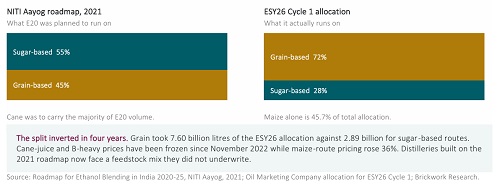
The demand outlook is also being reshaped by a structural shift in feedstock. Grain-based routes accounted for 72% of ESY26 Cycle 1 allocations, compared with 28% for sugar-based routes, reversing the 55:45 sugar-to-grain mix envisaged in the 2021 roadmap. Maize alone accounted for 45.7% of allocations. However, grain-based distilleries have seen EBITDA margins decline from 9.2% in FY21 to 6.7% in FY25, highlighting feedstock-cost pressure.
Utilisation and monetisation to drive the next phase
With E20 largely achieved and substantial capacity already in place, the sector’s focus is expected to shift towards higher utilisation, feedstock optimisation and monetisation of existing assets, including through co-products and emerging applications such as Sustainable Aviation Fuel. Fresh distillation capacity is likely to become more relevant if blending moves towards E30.
Credit outlook remains Stable amid strong financing support
BWR maintains a Stable credit outlook for the ethanol sector, supported by government-administered offtake and pricing, achievement of the E20 blending mandate and a sanctioned base of over Rs 420 billion to the sector as of October 2025 by banks and financial institutions. Separately, Rs 15.35 billion had been released to NABARD under the Ethanol Interest Subvention Scheme as of the last disclosed tranche. However, lenders are increasingly differentiating between producers based on feedstock mix and OMC allocation track record, with refinancing and interest-cost risks emerging as subvention benefits expire during FY26-FY28 for a meaningful share of this financing under the scheme.
Ethanol Supply Year (ESY) runs from 1 November to 31 October of the following year. The government changed the definition from the earlier December-November cycle starting in November 2023.
Above views are of the author and not of the website kindly read disclaimer