El Niño 2026 - Is India Ready? by CareEdge Ratings

The IMD has forecast rainfall over India at 90% of the Long Period Average (LPA), indicating a below-normal monsoon in the country. The probability distribution of rainfall is heavily skewed towards deficient rainfall, with a higher likelihood of El Niño conditions during the monsoon. The impact of a poor monsoon will be felt in agriculture and rural demand, as lower rainfall constrains crop output and weighs on farm incomes. This could, in turn, translate into broader price pressures through elevated food inflation. However, India seems better placed to handle this situation than in some past El Niño episodes. Reservoir levels as of end-April are better compared to past El Niño years, and robust foodgrain buffer stocks should help somewhat cushion inflationary risks. In parallel, the government’s proactive contingency planning provides an additional layer of support to mitigate potential disruptions. Moreover, over the last decade or so, the adverse impact of the monsoon on the agricultural sector and the overall economy has relatively reduced. While the aggregate impact of El Niño is likely to remain manageable, the possibility of localised disruptions cannot be ruled out. We have created a State-wise Poor Monsoon Resilience index (SPMRI) based on several parameters that indicate uneven vulnerability to poor monsoon across states.
Forecast of Below Normal Rainfall and El Niño Conditions
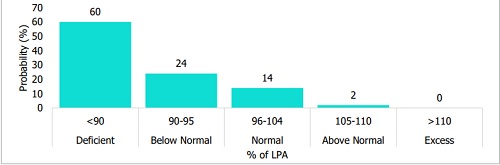
The India Meteorological Department (IMD), in its updated Long-Range Forecast for the South-West monsoon, stated that rainfall over the country in June – September is projected to be 90% of the long-period average (LPA)1 , down from 92% projected earlier, indicating a below-normal monsoon2 over most parts of the country. While some areas in Northwest and Northeast India, as well as other regions, are expected to receive normal or above-normal rainfall, the monsoon core zone (MCZ), which includes most of the country’s rainfed agricultural areas, is most likely to receive below-normal rainfall. The probability distribution of rainfall is skewed towards deficient rainfall, with an 84% likelihood of sub-normal conditions, higher than 66% projected in April 2026 (Exhibit 1)
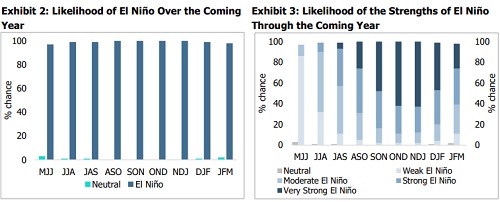
The IMD notes that sea surface temperatures indicate the formation of El Niño conditions during the monsoon season, while the Indian Ocean Dipole remains neutral. As per the National Oceanic and Atmospheric Administration (NOAA), there is a significant chance of at least a moderate-strength El Niño developing over June – September (Exhibits 2 and 3).
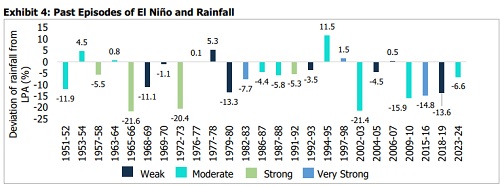
Analysing the Impact of El Niño Based on Past Patterns Since 1951-52, there have been 25 El Niño episodes. As Exhibit 4 demonstrates, not all El Niño occurrences necessarily imply lower rainfall. However, most El Niño episodes coincide with below the long-period average rainfall. If the strength of the El Niño is moderate or higher, the probability of lower rainfall increases - in the 16 instances of “moderate” or stronger episodes of El Niño, 12 years witnessed either below-normal or deficient rainfall (Exhibit 4). This becomes important given the increasing chances of a “moderate” or strong El Niño developing from the beginning of the first three months of this year’s monsoon.
Rainfall and Output: An Important but Weakening Linkage
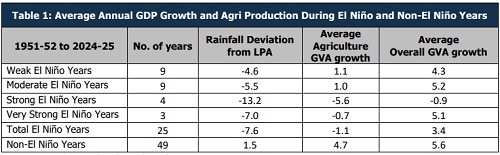
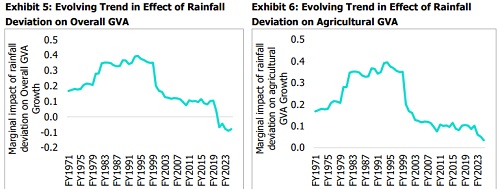
Since 1951-52, there have been 23 years in which agricultural GVA declined in the country. 57% or (13 of these contractions) occurred during El Niño years. Overall GVA growth was also lower in El Niño years than in Non-El Niño years (Table 1). However, there is evidence that the linkage between the growth rates of overall GVA and agricultural GVA, and rainfall variability has weakened over time. Exhibits 5 and 6 plot the time-varying coefficients capturing the sensitivity of agricultural and overall GVA growth to rainfall deviations. These are estimated using 20-year rolling regressions, with each coefficient reflecting the relationship over the previous 20-year window. The coefficient can be interpreted as the marginal effect of rainfall deviations on agricultural GVA growth and overall GVA growth, respectively. These effects have declined over time.
These developments may be attributed to a range of factors, foremost among them being the substantial structural transformation of the economy. The share of agriculture in GVA has declined markedly from 53.2% in FY1951 to 16.8% in FY2026, while the share of the tertiary sector has expanded from 35.5% to 54.9% over the same period (Exhibit 7). Consequently, rainfall-induced shocks now directly affect a relatively smaller segment of the economy, although their effects continue to be transmitted indirectly through channels such as inflation, employment and consumption. Another reason for the lower sensitivity towards rainfall is the rise in irrigated area. Gross area under irrigation as a percentage of gross sown area has gone up significantly from 17.1% in FY1951 to 60% in FY2024 (Exhibit 8). Therefore, the share of solely rainfed areas has declined markedly. Finally, the government’s efforts to promote sustainable farming and crops that require less water, such as millets and pulses, may also be playing a role in reducing the dependence of output growth on rainfall. Under the National Agricultural Research System led by ICAR, 2,996 climate-resilient crop varieties were released during 2014-2025. It is important to note that although the agriculture sector’s share of GVA has declined, it remains the largest source of employment in the country. According to the PLFS 2025, the agriculture sector accounted for 43% of total employment in 2025 (down from 46% in 2022). Hence, disruptions in the sector continue to have significant implications for a large share of the workforce.
While crop production remains the main source of agricultural income, there has been some diversification within the sector. National Accounts Statistics data on household incomes3 in the agriculture sector indicate that the share of income derived from crop production declined from 63% in FY2012 to 53% in FY2024. In contrast, the contribution of livestock increased from 24% to 33%, while the share of fishing and aquaculture rose from 4.4% to 7.5% over the same period. Although this diversification provides some resilience, crop-related activities continue to account for a substantial share of income, leaving rural incomes vulnerable to some disruption induced by poor rainfall. However, as discussed earlier, the adverse impact of the monsoon on the agricultural sector and the overall economy has diminished over the last decade or so.
Above views are of the author and not of the website kindly read disclaimer










Tag News
Market Round-up - 3rd August 2026 by Motilal Oswal Wealth Mangement