Economy Report by Choice Institutional Equities Ltd

* Key Takeaways -
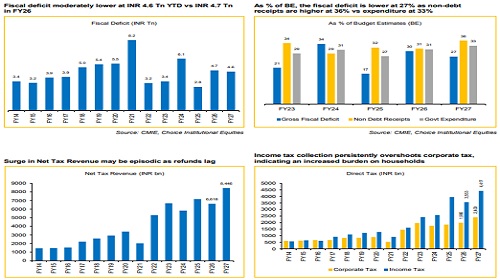
* The YTD (Apr–Jul FY27) fiscal deficit contracted 2.8% YoY to INR 4.55 Tn. It is optically the cleanest print in years, and at just 27% of BE versus 30% a year ago. But the improvement is arithmetic, not structural: it rests on a revenue mix that is quietly deteriorating and a spending mix tilting toward subsidies.
* Net tax revenue’s 27.6% YTD surge is flattered on both sides - refunds are being throttled, and devolution to states has been slashed. States’ share collapsed 13.1% YoY (from +16.9% last year), the mechanism that keeps net tax growing far faster than gross tax (11.4%). This is a transfer of the squeeze onto state balance sheets, not genuine buoyancy.
* The direct tax engine (income tax +24.3%, corporate +20.8%) is running well ahead of the underlying economy, and the income-tax line now persistently overshoots corporate tax - the household, not the corporate sector, continues to carry the direct-tax load.
* The indirect-tax side is where the weakness is undisguised: gross indirect tax down 0.5% and net indirect tax down 10.0% YTD, with net GST growth collapsing to 0.7% as refunds hit a record 15.6% of gross GST. Customs (+38.2%) is the only prop, and it is base- and duty-driven rather than demanddriven.
* Interest payments fell 4.5% YTD - a coupon-timing artefact against a 36% base, not debt relief. With T-bill yields backing up and the yield curve steepening, this is the single most likely line to reverse and re-tighten the arithmetic.
* The capex headline (+29.9%, YTD spend at a record INR 3.24 Tn) is becoming broad-based. Railway capex are also witnessing a rise, not just defence. While a 35.1% subsidy surge (fertiliser +46.2%) pushes core revex growth back up. The consolidation is being financed by squeezing states and deferring refunds, both of which will unwind.
* Our View -
The cleanest way to read the YTD print is not as consolidation but as a timing trade. The Centre has pulled three cushions forward into the first four months, namely withheld refunds, a compressed devolution share, and a favourable coupon calendar on interest, and each one is a claim the future has on the present. A deficit narrowed by deferring obligations is not a smaller deficit; it is a rescheduled one – fiscal space borrowed from the second half of the year. We continue to expect the fiscal space to remain squeezed as the unwind happens along with worsening borrowing costs for the government.
Apr–Jul FY27 fiscal deficit narrowed to INR 4.55 Tn, down 2.8% YoY, but the quality is thinner than the headline
For the first four months of FY27, the Centre delivered a fiscal deficit that actually shrank in absolute terms: INR 4.55 Tn against INR 4.68 Tn a year ago, or 27% of the full-year budget target versus 30% at the same point in FY26. Non-debt receipts ran at 36% of BE, comfortably ahead of expenditure at 33%. On every top-line metric the consolidation story remains intact: revenue receipts up 19.0% YTD, expenditure up a contained 12.7%. But the composition tells a less reassuring story. The four-month window now confirms that the deficit improvement is being manufactured through two levers that are less expected to hold: suppressed refunds and a sharp revenue cut in what the Centre passes down to states.
Revenue Receipts: A Net-Tax Number Flattered From Both Ends
Net tax revenue grew 27.6% YTD, to INR 8.45 Tn - spectacular on the surface, and a hard reversal of the 7.5% contraction in FY26. Yet gross tax revenue grew only 11.4%. The entire wedge between the two is the collapse in state devolution, which fell 13.1% YoY to INR 3.72 Tn, after rising 16.9% last year. In other words, the Centre’s net-tax strength is substantially a function of retaining a larger slice for itself rather than a broader tax base expanding. This is the same distortion we flagged in Q1, now larger and clearer, and it lands squarely on state finances at a time when their own revenue expenditure is climbing. Within direct taxes (+23.1% YTD), income tax rose 24.3% and corporate tax 20.8%. The persistence of income tax above corporate tax that is visible across the full FY14–FY27 series, is not a rounding quirk. It signals a structural shift of the direct-tax burden onto households rather than firms.
Indirect Taxes:
The Undisguised Soft Spot If direct taxes are flattered, indirect taxes are simply weak. Gross indirect tax slipped 0.5% YTD and net indirect tax fell 10.0%, dragged down by GST. Gross GST rose 7.3% for Apr–Jul, but net GST growth collapsed to 0.7%, because refunds surged ~65% and now run at roughly 15.6% of gross GST, the highest share in the series. Seasonally-adjusted net GST has been drifting lower since Apr’25, which is the more worrying signal: this is not one bad month but a trend. Customs duty (+38.2%) is offsetting the decline, but that reflects higher duties on precious metals and a soft base, not a revival in domestic consumption.
Expenditure:
Capex Broadens, But Subsidies Are Back Government capex reached a record INR 3.24 Tn YTD, up 29.9%, with core capex (ex-loans) up 29.6%. Encouragingly, the capex impulse is getting broadbased. Railway capex is gaining momentum, with defence still rising sharply amid geopolitical tensions. The offset is subsidies which is up 35.1% YTD, led by fertiliser (+46.2%) and food (+23.3%) as the Centre shields domestic consumption from elevated global prices. This pushed core revex (revex – interest payments) growth back up to 14.9% from 8.3% last year. The spending mix is doing two things at once - building assets and cushioning consumption. But the second is precisely the lowquality, hard-to-reverse expenditure that erodes consolidation durability.
Interest Payments:
The Reversal Waiting to Happen Interest payments fell 4.5% YTD, against a 36.2% jump in the same period last year. It continues to be a coupon timing and a base effect, and not an improvement in debt management. The forward risk is now more concrete than a month ago: the T-bill curve shows short-end yields easing while 6-month-andlonger yields push higher, a steepening that raises the Centre’s marginal borrowing cost. Meanwhile FII debt flows, which spiked after the Jun’26 policy announcement, have since collapsed and turned choppy — FAR-route flows swinging negative in recent weeks. Thinner passive foreign demand plus a steeper curve means the interest bill is set to re-accelerate just as the refund and devolution cushions fade.
Our View -
A Better-Looking Deficit, Built on Borrowed Time The cleanest way to read the YTD print is not as consolidation but as a timing trade. The Centre has pulled three cushions forward into the first four months, namely withheld refunds, a compressed devolution share, and a favourable coupon calendar on interest, and each one is a claim the future has on the present. A deficit narrowed by deferring obligations is not a smaller deficit; it is a rescheduled one. What looks like fiscal space today is space borrowed from the second half of the year. The more consequential shift is where the adjustment is landing. By holding devolution growth to –13% while retaining a larger net share, the Centre has effectively exported part of its consolidation to the states, precisely as their own revenue expenditure is rising. India's general government deficit, the number that actually matters for the sovereign's debt trajectory and the bond market's risk premium, is not improving in line with the Centre's optics; it is being redistributed within it. This matters because the external buffer that could have absorbed the strain is thinning at the same moment. The post-Jun'26 surge in FPI flows into domestic debt has not sustained its initial momentum, and rising global yields are feeding through to domestic government bond yields, set to inflate the interest burden even as the coupon-timing reprieve reverses. The government enters the second half with all three cushions deflating together: refunds due, devolution normalising, and interest re-accelerating into a market with thinner passive demand and a steeper curve. A subsidy bill growing 35% and structurally sticky offers no offset. The arithmetic says consolidation. The mechanics say the Centre is producing it by borrowing, from itself, from the states, and from the second half of the year, and the bill for all three comes due in the same six months.
For Detailed Report With Disclaimer Visit. https://choicebroking.in/disclaimer
SEBI Registration no.: INZ 000160131