Economy : Food, Fuel and a Forecast That Doesn't Add Up by Choice Institutional Equities Ltd

Key Highlights
* Headline CPI at a new-series high of 5.5% in Sep’26, up from 4.8%, as food and fuel broaden the pressure.
* Inflation is now broad-based: core firmed to 4.5% and ~37% of the basket is inflating above 4%.
* Food led the surge at 7.4%, with cereals at 3.9%, sugar at 13.76% and vegetables spiking; rural at 6.1% runs well ahead of urban at 4.9%.
* WPI jumped to 11.4%, manufactured goods at a record 9.8% and fuel at 25.9% as India crude basket nears USD 120/bbl ; most of the cost push is still to reach the shelf.
* Weather is a multi-season risk: a monsoon ~13% below LPA, El Niño and low reservoirs threaten the rabi sowing now underway and the next kharif.
* Pricing power is doing the work: FMCG hikes are visible and set to extend, lifting topline even as record WPI squeezes margins.
* Our View: The RBI has owned the problem in its stance but not its numbers: a 25 bps hike to 5.5% and cuts off the table, yet a 5.2% FY27 forecast that still bets on crude retreating and the monsoon’s damage fading. Sep’26 CPI says otherwise, with headline at 5.5% and climbing into Q3, food at 7.4% and WPI at 11.4% leaving most of the cost push still to reach the shelf. We see FY27 inflation at 5.9–6.0%, a further 25 bps at each of the next two meetings, and the 10-year grinding from 7.40% toward 7.6–7.8%; the central bank appears to be behind the curve and buying time.
Headline accelerates to a new-series high
India’s retail inflation rose to 5.5% in Sep’26 from 4.8% in Aug’26, the highest print in the new CPI series. The move was not a narrow, food-led spike: core inflation also firmed, to 4.5% from 4.3%, and the proportion of items inflating faster than 4% widened to about 37%. With both headline and core now at series highs, the earlier disinflation has clearly given way to a broad-based upcycle. The rural-urban divergence stayed wide, with rural inflation at 6.1% against urban at 4.9%, reflecting the heavier food weight in rural baskets and the greater exposure of rural households to the current food shock.
Food inflation broadens across staples
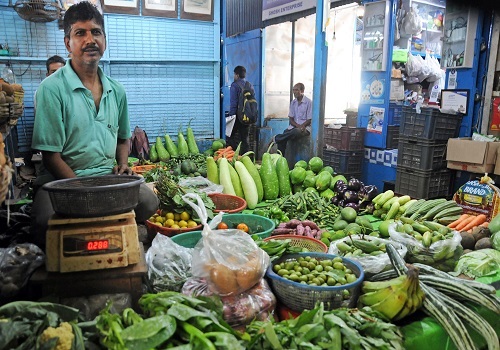
Food and beverages inflation climbed to 7.4% from 5.7% in Aug’26 and 2.1% in Jan’26, the dominant driver of the headline move, and the acceleration is visible across staples rather than in a single category. Cereal inflation extended its climb to 3.9%, from 1.7% two months earlier, as firm paddy and wheat prices fed through. Sugar inflation surged to 13.8%, while protein items and milk stayed elevated. Most strikingly, vegetable prices turned sharply higher at the wholesale level, led by onion, underscoring how quickly perishables can swing the index. With ready-made and packaged food inflation reaching a fresh series high of 9.9%, the food shock is now feeding processed products as well as unprocessed staples, a sign of growing pricing power in the consumer-staples supply chain.
El Niño, weak monsoon and low reservoirs cloud the crop outlook
The near-term food outlook is dominated by weather. A south-west monsoon that finished around 13% below its long-period average, alongside the strong El Niño conditions flagged by the RBI, raises the risk of weaker and more erratic rainfall through the crucial sowing windows. The problem is compounded by reservoir storage that has tracked well below year-earlier levels through the season, leaving irrigation reserves thin going into winter. Low reservoirs matter most for the rabi crop now being sown from October, as wheat, gram, mustard and other pulses and oilseeds depend heavily on residual soil moisture and stored irrigation water, both of which are constrained this year. A poor rabi would keep cereal, pulses and edible-oil inflation sticky well into 2027. Should El Niño persist into next year, the risk extends to the next kharif season sown around June and July 2027, making the current configuration a multi-season inflation risk rather than a one-off. Healthy foodgrain buffers and government interventions provide a cushion, but they limit rather than neutralise the upside.
Core and services keep underlying pressure firm
Beyond food, transport inflation rose to 5.1%, reflecting the pass-through of elevated fuel and vehicle prices, while pan and tobacco at 4.8% and clothing and footwear at 3.9% kept goods inflation firm. Housing at 2.8% and health at 1.4% stayed comparatively contained but are drifting higher. The firmness in core confirms that second-round effects from higher commodity and food costs are now visible well beyond primary articles
Households are braced for still-higher prices
Consumer survey data point to entrenched expectations. Net responses on current price perceptions in urban areas worsened to around 95% reporting rising prices, close to the series high, with rural perceptions similarly stretched. With rural income perceptions still in negative territory, rising prices are squeezing real incomes and disposable spending, a feedback loop that both reflects and reinforces the inflationary impulse.
Corporates signal more price hikes to defend margins
Corporate commentary thus far, corroborates the pipeline pressure. Consumer companies have indicated that price hikes already taken are visible in the data, and that further hikes are likely as firms move to protect margins and profitability against rising input costs. With volume growth slowing, higher realisations are doing much of the work in supporting topline growth. At the same time, elevated raw-material costs, mirrored in the sharp rise in WPI, are weighing on profitability, so only a part of the cost increase has been passed through so far. This leaves meaningful runway for additional hikes in the coming quarters, which would keep upward pressure on packaged-goods and services inflation.
WPI: wholesale pressure runs well ahead of retail
Wholesale inflation surged to 11.4% in September from 9.9%, a multi-year high and a clear signal that cost pressures remain intense upstream. Three insights stand out. First, manufactured products inflation reached an all-time high of 9.8%, led by chemicals at 16.7%, basic metals at 16.9%, textiles at 13.9% and rubber and plastics at 13.5%, confirming that the pressure is core-industrial rather than commodity noise. Second, fuel and power inflation stayed extreme at 25.9%, with mineral oils near 40% and crude petroleum and natural gas up around 57%, as the Indian crude basket averaged USD 116.1/bbl in September against USD 82.0 in July on the continued West Asia escalation, keeping energy a persistent cost push. Third, wholesale food articles jumped to 8.1%, with vegetables at 16.5% and onion rising sharply, echoing the retail food story. The decisive insight is the gap between WPI at 11.4% and CPI at 5.5%: a large share of the wholesale cost build-up has yet to reach consumers, which, combined with corporate pricing intentions, points to continued upward pressure on retail inflation in the months ahead.
September print tests the RBI’s own forecasts
The gap is the whole story. The RBI sees a 6.0% Q3 peak and a full-year 5.2% that bank on an H2 cooling from retreating crude and a fading monsoon. September argues the opposite, with the headline already at 5.54% and accelerating into Q3, food and beverages at 7.4%, core firming, and WPI at 11.4% leaving most of the cost push still to reach the shelf. We therefore hold FY27 inflation at 5.9-6.0%, above the RBI’s 5.2%, and expect a further 25 bps at each of the next two meetings, for now. The 40 bps GDP upgrade to 7.1% is mostly the arithmetic of a 7.8% Q1 print, leaving a stagflationary tilt of firm prices and soft incomes
What it means for the markets
The bond market has already begun to move ahead of the RBI. The 10-year is already at 7.4%, hardened since mid-August on geopolitics, global yields and the crude spike, and the October stance change seals it. By allowing only hikes or holds, the RBI has stripped out the cut optionality that was the main bid for duration, so the short end reprices higher, and the curve flattens. The supply side compounds it: heavy sterilisation and further OMO sales flood the market with paper just as the RBI increases interventions to defend the rupee, draining rupee liquidity, while an India-US differential near its narrowest since before 2008 removes the carry that kept foreign money in. With more hikes in the offing and our inflation call above the RBI’s, we expect term premia to rebuild and the 10- year to grind toward 7.5–7.6% in the near term.
The equity market faces the same squeeze from the other side: a higher discount rate, a softer rupee and sticky input costs, with no rate cut to cushion valuations. The pain concentrates in the rate- and currency-sensitive names, with richly valued growth stocks most exposed to the discount rate and a weaker currency. The one place to hide is pricing power: staples and others passing costs through are letting inflation lift the topline even as record WPI compresses margins. We would favour companies with genuine pricing power and low leverage over longduration, rate-sensitive and highly valued names until the rate cycle peaks.
For Detailed Report With Disclaimer Visit. https://choicebroking.in/disclaimer
SEBI Registration no.: INZ 000160131