CPI Inflation Rose to Nearly a Two-Year High in September by CareEdge Ratings
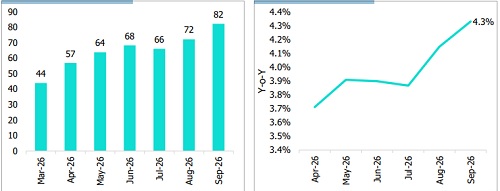
The CPI inflation rose to a 23-month high of 5.5% in September from 4.8% in the previous month, breaching the RBI's 4% target for the fourth consecutive month. Inflation increased across most divisions, with eleven of the twelve major divisions showing an acceleration in inflation in September. The CPI diffusion index, which measures the breadth of price increases across categories, rose further to 82 from 72 in August 2026 (Exhibit 2). A reading above 50 indicates that more components are recording rising inflation than falling. The latest reading of 82 suggests that inflationary pressures have become increasingly broad-based.
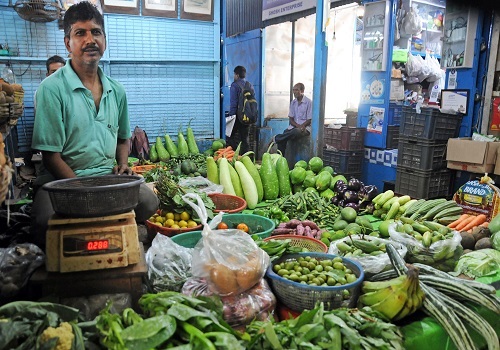
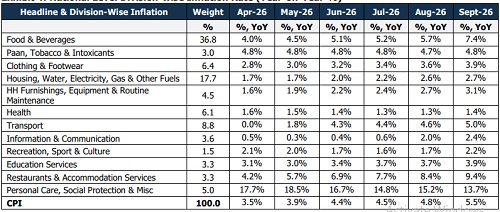
Among the divisions showing major acceleration, inflation in food and beverages increased sharply to 7.4% from 5.7% in the previous month. Within the food basket, inflation remained elevated in vegetables, fruits, rice, pulses, sugar, and edible oils. Vegetable inflation rose sharply to 10.8% YoY from 1.1% in August, driven by persistently high onion prices (108.1% vs 48.8%) amid tight supplies during the transition between the previous rabi harvest and the arrival of the new kharif crop. Meanwhile, sugar inflation inched up to 28% YoY, likely due to expectations of lower sugarcane yield and a shift toward ethanol production, which tightened domestic sugar availability. Edible oil inflation remained elevated at 9.9% and remains a concern given higher global prices (FAO global vegetable oil prices grew 18.3% YoY in September) and India’s import dependency on this product. Global energy prices also remained volatile amid the ongoing conflict in West Asia. Higher energy costs contributed to transport inflation, while elevated cooking fuel and food prices kept inflation high in restaurant and accommodation services. Inflation in the information and communication category also continued to edge higher at 2.4% YoY, with the external hard disk, mobiles and laptops segment witnessing price increases. This reflects robust global demand for memory chips amid the AI boom. Core inflation has also inched up to 4.3% from 4.2%.
Exhibit 1: CPI inflation Inches up to 5.5%
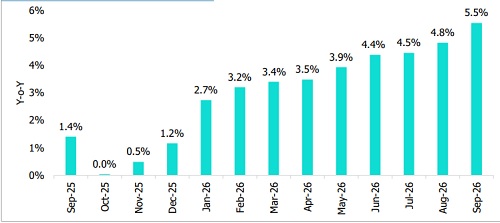
Exhibit 2: Diffusion Index Exhibit 3: Core Inflation
Way Forward
Looking ahead, inflation outlook remains exposed to both external and weather-related risks. Uncertainty around transit through major maritime chokepoints continues to weigh on global energy prices. Domestically, deficient monsoon remains a key concern, with the 2026 southwest monsoon ending 13% below the long-period average both spatially and temporally. Although kharif sowing declined marginally by 1.1% YoY, final production outcomes will largely depend on crop yields. More importantly, the upcoming rabi season is beginning from a weaker base. Reservoir storage levels, at 72% of Full Reservoir Levels (FRL), and soil moisture conditions remain below seasonal norms in several regions. At the same time, El Niño is expected to intensify further through the remainder of the year, increasing the risk of more frequent, prolonged and severe heatwaves. The government has also flagged concerns about the possibility of drought conditions in several states. Thus, concerns over agricultural yields persist, although ample buffer stocks should largely cushion cereal prices. Edible oil prices also remain a key monitorable given India’s large import dependence and high global edible oil prices. Reflecting these emerging risks, the RBI's September Inflation Expectations Survey points towards a sharp rise in household inflation expectations.
The eventual trajectory of food inflation will depend on the progress of the kharif harvest and the evolution of rabi sowing in the coming months. Should food prices emerge as the primary source of inflationary pressures, monetary tightening alone may prove insufficient, necessitating complementary administrative and fiscal measures to augment supplies and contain food-price volatility. The government has already reduced customs duty on imports of crude and refined edible oils ahead of the festive season. We expect food inflation to remain elevated, peaking at 7.7% in Q3 FY27 and averaging around 6.2% for the full fiscal year.
We project CPI inflation to peak in the third quarter of FY27 and average around 5.0% for the full fiscal year. On the monetary policy front, given the rising inflation expectations and broadening price pressures, there is further room for an additional 25-50 bps of rate hikes going forward
Exhibit 4: National Level Division-wise Inflation Rate (Year-on-Year %)
Above views are of the author and not of the website kindly read disclaimer