India Economy & Strategy - India's Poverty Debate: Why Poverty Success Story Needs a Second Look by Systematix

The latest World Bank estimates suggest that India has achieved one of the most dramatic reductions in poverty in recent decades, with hundreds of millions moving above international poverty thresholds. Yet this encouraging narrative sits uneasily alongside evidence of weak real wage growth, stagnant household incomes, slowing labour productivity and increasing dependence on welfare support. This report examines whether the sharp decline in poverty reflects a genuine improvement in livelihoods or is primarily the outcome of methodological changes, fiscal transfers and consumption support that have cushioned vulnerable households despite weak underlying income growth
The debate over India’s rural economic condition refuses to die down. The latest World Bank estimates suggest a significant and sustained decline in poverty across multiple expenditure thresholds, reinforcing the narrative that India has made remarkable progress in reducing deprivation. However, a closer reading of both the data and the broader economic context raises important questions about the quality and sustainability of this decline (see Exhibits 6 and 8). While the headline numbers are impressive, they appear to sit uneasily alongside evidence on employment, wages, household incomes and consumption patterns.
What the World Bank Report Shows
According to the latest World Bank (WB) assessment, poverty has fallen sharply across all major expenditure thresholds. Measured at the international poverty line of $3 per day, the poverty rate declined to 2.6% in 2023-24 from 5.25% in 2022-23, and from as high as 27.1% in 2011-12. At the $4.2 per day threshold, poverty is estimated at 16.1%, down from 23.9% a year earlier and 57.7% in 2011-12. Even at the higher threshold of $8.3 per day, poverty fell to around 80% from 82.1% in 2022- 23 and 92.5% in 2011-12 (see Exhibits 6 and 8).
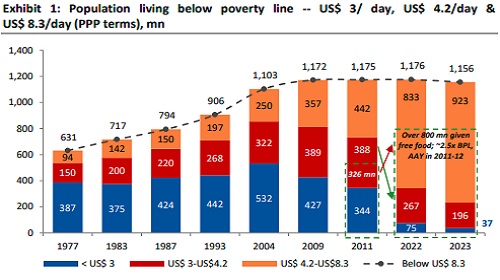
Accordingly, between 2011 and 2023, an estimated 500 million people (or 68%) were lifted above the poverty line ($4.20/day, 2021 PPP) and 307 million (or 89%) out of extreme poverty ($3/day, 2021 PPP). This is 4.1 and 1.6 times higher than the decline during 2004-2012 (Exhibit 1).
The WB report attributes this astounding decline in poverty to strong consumption growth, rising employment, especially among women, and expanded social transfers, including food subsidies. Based on the restarted Periodic Labor Force Surveys (PLFS), the WB report highlights that between 2017 and 2023, employment increased by about 134 million people (even higher than RBI’s KLEMS estimate of 123 million), nearly twice the growth of the working-age population, with much of the gain driven by rural women entering work and rise in labor participation rate. The labor market continues to remain stable between Q1 FY2026 and Q1 FY2027.
The Utopian conundrum!!!
On the face of it, the WB report is significantly reassuring with a confluence of abundant employment and precipitous decline in poverty; read along with the robust official real GDP growth, this combination would seemingly characterise utopian growth model that India has never experienced before.
But the less highlighted aspect of WB reports are the caveats: First, pronounced inequality reflects in the median earnings among the top 10% of workers being about 13 times those of the bottom 10% in 2023. The actual inequality may be even starker given that survey-based data underrepresents the richest households. And secondly, youth unemployment remains elevated at 15.9% and rising even as real earnings remain stagnant due to increasing dependence on low-productivity jobs. Consequently, even as the poverty headcounts under the poverty lines of $3 and $4.2/day have declined, the broader poverty headcount (less than $8.3/day) has remained unchanged at over 1.1 billion for the past two decades (see Exhibit 1). That is about 80% of population living below INR 4,985 per month (conversion at ? 20.02 for $8.3/day PPP); WB notes that only 22% of Indian adults could sustain themselves for more than two months of expenses without income (Global Findex 2025 survey). These are telling data for an economy that boasts of being the sixth largest economy that is also the fastest growing.
The litmus test of the claimed eradication of poverty came during the pandemic lockdown, which exposed the extreme vulnerability of millions of households to economic shocks. This prompted the launch of the Pradhan Mantri Garib Kalyan Anna Yojana (PMGKAY), which continues to provide free food support to over 800 million people, nearly 57% of India’s population, alongside several other central and state welfare schemes.
Therefore, while the share of people living below the $4.2/day poverty threshold may have declined between 2011-12 and 2023-24, the dependence of over 800 million people on free food support continues, exceeding the 732 million estimated below this threshold in 2011. It is also 2.5 times higher than an estimated 326 million (65.2 million families) dependent on below poverty line (BPL) and Antyodaya Anna Yojana (AAY) beneficiaries that availed PDS foodgrain distribution in 2011-12 against subsidized prices. These suggest a deterioration in livelihood security rather than genuine improvement in living standards. The reduction in measured poverty appears largely driven by welfare transfers that sustain subsistence consumption. This stands in contrast to the poverty decline witnessed during 2004-2011, which was underpinned by stronger income growth.
Above views are of the author and not of the website kindly read disclaimer


.jpg)