
Diwali Muhurat Picks 2026 : Buy KEC Internation Ltd for the Target Rs. 449 by Sushil Finance

ROBUST ORDER BOOK PROVIDING STRONG REVENUE VISIBILITY
KEC’s sizeable order book provides visibility into revenue, with firm orders of Rs. 40,000 crore equivalent to about 1.7x FY26 sales and the total exceeding Rs. 43,500 crore when L1 positions are included. Order intake outpaced revenue in both FY26 and Q1 FY27, while the recent Rs. 2,872 crore PGCIL award reinforces momentum in T&D, its largest business. Management’s Rs. 30,000 crore annual intake target is supported by a tender pipeline exceeding Rs. 2 lakh crore, although awards and execution remain subject to timing risks. With Q1 revenue broadly flat, meeting FY27 growth guidance requires stronger delivery over the remaining quarters. The backlog therefore supports our revenue outlook but does not guarantee earnings or cash generation: margin recovery and collections from delayed projects remain essential to translating that opportunity into shareholder returns.
INDIA’S T&D INVESTMENT CYCLE GIVES KEC A LONG RUNWAY, WITH HVDC AS THE UPSIDE
India’s transmission investment cycle gives KEC a long runway for growth. The National Electricity Plan envisages investment exceeding Rs. 9.15 lakh crore through FY2032, while ICRA separately estimates Rs. 5–6 trillion of capex over FY2027–FY2032. KEC already has substantial exposure: T&D contributed 68% of FY26 revenue, with revenue growing 24% during the year. Its manufacturing footprint and experience across conventional transmission, HVDC lines and terminal stations position it to compete for further work. HVDC offers additional opportunities, supported by recent private-sector wins and participation in Barmer tender packages, although participation does not guarantee awards.
MARGIN RECOVERY AND BETTER CASH CONVERSION DRIVING THE NEXT LEG OF EARNINGS GROWTH
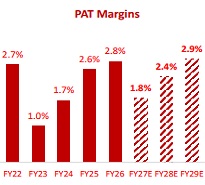
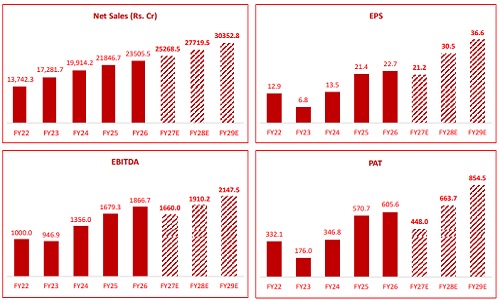
KEC’s earnings recovery hinges on better execution and stronger cash conversion, rather than order-book growth alone. We forecast a gradual improvement in project profitability and lower financing costs, lifting PAT from Rs. 448 crore in FY27E to Rs. 854 crore in FY29E and net margin from 1.8% to 2.9%. Collections from overdue water projects and Afghanistan receivables could release cash and reduce funding needs, but we remain cautious on timing: our FY27E net-debt estimate of Rs. 6,111 crore sits above management’s Rs. 6,000 crore target. With FY27E profit still below FY26, our recovery is weighted toward FY28–FY29. Delayed collections or further working-capital absorption remain the key risks to translating stronger execution into earnings and debt reduction.
OUTLOOK & VALUATION
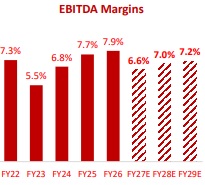
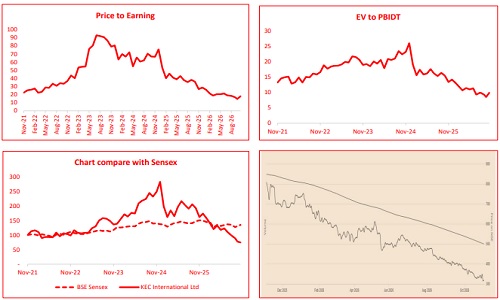
We expect KEC to deliver 27% growth in Revenues to Rs. 29,826.6 crore in FY29E from Rs. 23505.5 crore in FY26. This growth is majorly driven by the structural tailwinds of the Indian T&D industry and HVDC opportunity. Furthermore, the company’s robust order book provides further revenue visibility and a way for growth. The recovery in margins and better cash conversion cycle compared to the first half of FY27 will help in earnings growth. We estimate the EBITDA and PAT margins to be 7.2% and 2.9% respectively by FY29E. Our estimated EPS is Rs. 16.8, Rs. 24.9 and Rs 32.1 for FY27E, FY28E and FY29E respectively. We assign a P/E multiple of 14x to arrive at the target price of Rs. 449, which is an upside of ~40% from its last closing price at Rs. 321. We initiate coverage on KEC International with a BUY rating, over an investment horizon of 24-30 months.
KEY RISK
• COMPRESSED MARGINS: With pressure in the Middle East due to the prevailing war tensions and increased freight and transportation charges, it has caused significant pressure on the company’s margins. We shall see if they can have a sustained recovery of margins
• T&D EXECUTION CONSTRAINTS: Industry-wide delays from right of way and equipment shortages. ICRA found that only 12% of competitively bid transmission projects were commissioned on time.
KEC International Ltd. is a global EPC (Engineering, Procurement and Construction) company and the flagship company of the RPG Group. It is headquartered in Mumbai, Maharashtra and operates in Transmission and Distribution (T&D), Civil, Transportation, Renewables, Oil & Gas pipelines, and Cables. It has a footprint in over 110 countries covering EPC, supply of towers and cables. It was incorporated on 7 th May 1945 as Kamani Engineering Company and was renamed to KEC International in June 1984. KEC also makes its own towers. Tower capacity grew 15% in FY26 to over 4.8 lakh tonnes a year, across plants in Jaipur, Jabalpur, Nagpur and Dubai.
T&D carries the business. FY26 T&D revenue was Rs. 15,883 crore, up 24%, which lifted its share of total revenue to about 68% from 59%. It also took approximately 70% of FY26 order intake. The other verticals are far smaller. Civil, which includes water projects, reported revenue of Rs. 3,823 crore. Cables & Conductors brought in Rs. 2,217 crore, up 23%, Transportation Rs. 1,555 crore and Oil & Gas Pipelines Rs. 258 crore. Cables moved into a wholly owned subsidiary, KEC Asian Cables, in January 2025. Renewables is the newest push, and the company has recently entered wind EPC. KEC disclosed two orders for 100+ MW wind projects in its FY26 presentation. Renewables reported FY26 revenue of Rs. 516 crore
FY26 was a record year that ended weakly. Consolidated revenue grew 8% to Rs. 23,506 crore, EBITDA reached Rs. 1,659 crore (about 7.1% of revenue) and PAT by rose 6% to Rs. 606 crore, after a Rs. 59 crore provision for the new labour code. Then Q4 slipped. Revenue fell 7% to Rs. 6,390 crore and the EBITDA margin dropped to 7.0% from 7.8%. The company points to Middle East disruption, labour shortages and slow payments in water projects. Q1 and Q2 FY27 looked much the same. Revenue was flat at Rs. 5,024 crore, EBITDA was Rs. 291 crore (5.8% against 7.0%) and PAT fell to Rs. 73 crore from Rs. 125 crore in Q1. Management now guides to 8-10% revenue growth for FY27.
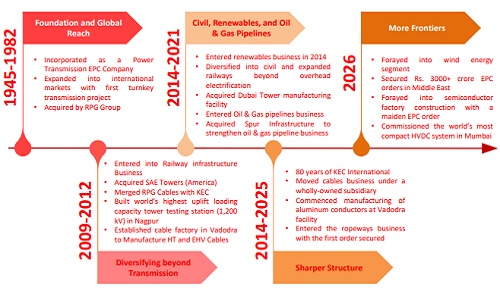
KEC INTERNATIONAL’S JOURNEY
Power Transmission and Distribution (T&D)
The highest share in their revenue belongs to the T&D business line. Their T&D products include:
• Transmission Lines
• Substations
• HVDC
• STATCOM
• Underground Cabling
• Tower, Poles and Hardware supplies
Civil
Their Civil business line delivers a diverse portfolio of EPC projects across industrial facilities, high rise buildings, public spaces, water infrastructure and data centers Their Civil business include:
• Manufacturing & Process Plants
• Residential Buildings
• Airports & Hospitals
• Water & Public Infrastructure
• Commercial Buildings & Data Centres
• Warehouse & Logistics
Transportation
Providing EPC solutions across conventional railways, urban transit systems and ropeways Their Transportation business include:
• Overhead Electrification
• Track Laying & Tunnel Ventilation
• Signalling (ABS & Telecom)
• TCAS Kavach
• Railway Bridges, Stations & Platforms
• Speed Upgradations
• Metro Viaduct, Station, Power
• Supply & Traction
• Ropeways
Renewables
By leveraging advanced analytics and predictive planning, they deliver the complex, multi-technology hybrid energy projects required to power grids. Their Renewable business include:
• Solar
• Wind
• Green Hydrogen
• BES
Oil & Gas Pipelines
They focus on the end-to-end execution of cross-country pipelines for crude oil, natural gas and petroleum products. This business includes:
• Oil & Gas Pipelines
• Slurry Pipelines
• Composite Station Work
Cables and Conductors
Operating through our wholly-owned subsidiary, KEC Asian Cables Limited, they manufacture and supply a comprehensive range of cables to over 95 countries. Their Cables business include:
• Power Cables
• Control & Instrumentation Cables
• Railway Cables
• Conductors
• Telecom Cables
• Special Cables
INVESTMENT RATIONALE- ROBUST ORDER BOOK PROVIDING STRONG REVENUE VISIBILITY
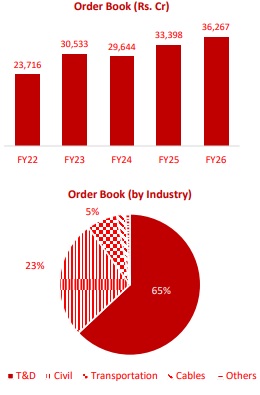
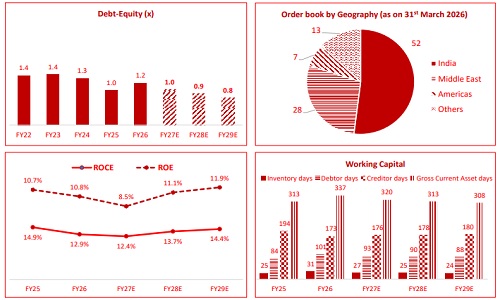
KEC started FY27 with a large pile of work already won. The order book stood at Rs. 36,267 crore on 31 March 2026, up from Rs. 33,398 crore a year earlier, and the unexecuted book was Rs. 40,000 crore at the end of September. Adding projects where KEC is the lowest bidder takes the total above Rs. 43,500 crore. Against FY26 revenue of Rs. 23,506 crore, that is about 1.7x for firm orders and 1.8x with L1 positions, or roughly 19-20 months of work.
The book is being refilled faster than it is used up. FY26 order intake was a record Rs. 25,280 crore, about 1.08x revenue. Q1 FY27 intake was Rs. 6,303 crore, or 1.25x the quarter’s revenue. KEC also recently received an order of Rs. 2,872 crore from PGCIL for T&D. Orders have since passed Rs. 9,600 crore in FY27 so far, and management is targeting about Rs. 30,000 crore for the year, with a tender pipeline above Rs. 2 lakh crore behind that.
The mix favours KEC’s strongest business. T&D makes up about 63% of the book and was 57% of Q1 intake, and the market behind it is large. India’s National Electricity Plan puts transmission investment at over Rs. 9.15 lakh crore by 2032. International orders were 35% of Q1 intake, which spreads the book beyond Indian utilities, although the Middle East exposure is worth watching.
In FY26 KEC converted about 70% of its opening order book into revenue. Applying the same ratio to the March 2026 book gives roughly Rs. 25,500 crore, about 8.6% above FY26. That looks achievable for short-cycle T&D work. But Q1 revenue was flat at Rs. 5,024 crore and Q2 was negative YoY at Rs. 5,468 crore, so the second half has to carry the load.
Visibility on revenue is not visibility on profit or cash. Q1 EBITDA margin fell to 5.8% from 7.0%, and working capital is still 134 days. About Rs. 300 crore of Q1 revenue was deferred, and overdue water-project receivables are still being collected. We therefore treat the order book as a floor under revenue and leave margins and cash conversion to the recovery and balance sheet arguments
INVESTMENT RATIONALE- INDIA’S T&D INVESTMENT CYCLE GIVES KEC A LONG RUNWAY, WITH HVDC AS THE UPSIDE
India’s transmission sector has a substantial multi-year investment pipeline. The National Electricity Plan puts investment at over Rs. 9.15 lakh crore, including more than 1.91 lakh circuit km of new lines, for FY2023 to FY2032. ICRA’s more conservative estimate is Rs. 5-6 trillion of transmission capex over FY2027 to FY2032. The two differ in scope and period, but even the lower figure points to new awards arriving while KEC works through its backlog. KEC’s own pipeline supports this. The company puts tenders under evaluation and in its pipeline at over Rs. 2 lakh crore. Approvals, bidding and construction each run on their own timelines, so the pipeline is not a forecast of orders.
KEC is already heavily exposed to this cycle. T&D revenue grew 24% to Rs. 15,883 crore in FY26 and rose to about 68% of consolidated revenue from 59%. T&D took over 70% of FY26 order intake. In FY27 to date (to around 10 August 2026) it was 57% of Rs. 6,303 crore of new orders, but about 47% of that T&D inflow was tower supply booked by the overseas subsidiary SAE Towers, so the EPC share is smaller than the headline suggests. Management expects T&D margins to stay at or near double digits, against a group EBITDA margin of 5.8% in Q1. Capacity is in place. After the Butibori expansion finished in Q1, global manufacturing capacity stands at 483,800 tonnes a year.
KEC has been building a record here, working on both lines and terminal stations. In May 2025 it took a ±800 kV HVDC line and a 765 kV GIS substation from PGCIL, a private developer awarded it an HVDC mandate in October 2025, and in May 2026 it announced a ±500 kV HVDC line order from an unnamed private developer in western India. On the Q1 call, management said it had secured a significant HVDC order from repeat private developers, had taken part in multiple packages of the Barmer HVDC scheme in Rajasthan, and expects more schemes to be floated this year. The company’s own timeline says it commissioned the world’s most compact HVDC system in Mumbai in 2026.
INVESTMENT RATIONALE- MARGIN RECOVERY AND BETTER CASH CONVERSION DRIVING THE NEXT LEG OF EARNINGS GROWTH
KEC’s next leg of earnings growth depends on getting more out of the work it already has—not simply adding to the order book. Q1 FY27 showed the pressure clearly: revenue was broadly flat, but EBITDA margin fell to 5.8% from 7.0%, while PAT declined 42% to Rs. 73 crore. Management expects execution conditions to improve from Q3, although it has not provided formal FY27 margin guidance. We therefore build in a gradual recovery rather than an immediate return to normal profitability.
There are two parts to this recovery. First, steadier execution should improve cost absorption, while lower drag from difficult projects would allow more of T&D’s profitability to flow through to consolidated earnings. Second, collecting overdue payments would release cash tied up in projects and reduce the need for short-term funding. The benefits are connected, but distinct: better execution supports operating margins; better collections reduce financing costs. Neither follows automatically from a larger order book.
Our forecasts reflect that measured improvement. We estimate revenue rising from Rs. 25,151 crore in FY27E to Rs. 29,827 crore in FY29E, while finance costs decline from Rs. 894 crore to Rs. 821 crore. Together with operating recovery, this lifts PAT from Rs. 448 crore to Rs. 854 crore and net margin from 1.8% to 2.9%. The starting year remains cautious: FY27E PAT is below FY26’s reported Rs. 606 crore, meaning our earnings recovery is weighted toward FY28 and FY29 rather than assumed to be already underway.
Cash conversion is the more important test. Management has identified specific collection opportunities, including Afghanistan receivables and overdue water-project payments, alongside a target to bring working capital down to 125 days and net debt toward Rs. 6,000 crore by March 2027. These are management expectations, not receipts already secured. Our model retains a haircut, implying net debt of approximately Rs. 6,111 crore in FY27E, Rs. 5,945 crore in FY28E and Rs. 5,703 crore in FY29E, calculated as modelled borrowingsless cash and bank balances.
The principal risk is that collections slip while fresh execution absorbs more working capital. In that case, revenue could grow without a corresponding improvement in cash generation, leaving debt and financing costs elevated. We therefore look for evidence of both stronger project profitability and sustained collections before assigning full credit to the recovery. The investment case is not just that KEC executes more work, but that it convertsthat work into cash and retains more of the resulting profit.
POWER T&D INDUSTRY
GLOBAL INDUSTRY DYNAMICS
Grids are the fastest-growing part of global energy investment. The IEA expects grid spending of around $550 billion in 2026, up nearly 20% from 2025, with battery spending above $100 billion. Equipment supply is the bottleneck. A Wood Mackenzie report put the US power transformer supply deficit at about 30%. The Gulf, KEC’s main overseas market, is building interconnections and HVDC links. The GCC Interconnection Authority plans over $3.5 billion of investment over the next decade, began a $700 million Oman link in February 2026, and the UAE and Saudi Arabia signed an interconnection MoU on 8 October 2026. Saudi Electricity awarded a SR20 billion ($5.3 billion) HVDC project to Alfanar and China Energy Equipment. Competition includes regional contractors and international EPC groups. Omexom won the 400 kV UAE-Saudi line, and L&T won a 400 kV substation in the UAE.
INDIAN INDUSTRY DYNAMICS
India’s power demand is outrunning its grid. Peak demand reached a record 270.8 GW on 21 May 2026, almost double the 135.9 GW of 2013-14, and the CEA projects 289 GW in FY27 and 388 GW by FY32. The plan takes the network from 5.09 lakh circuit km to 6.48 lakh by 2032, transformation capacity from 1,478 GVA to 2,345 GVA and inter-regional capacity from 120 GW to 168 GW. The National Electricity Plan puts transmission investment at over rs 9.15 lakh crore by 2032, ICRA at Rs 5-6 lakh crore over FY27 to FY32, and the IEA expects India’s T&D investment to reach $26 billion in 2026 after growing 15% a year for five years. 154 inter-state projects with 39,792 circuit km of lines are under construction.
KEY DRIVERS AND TRENDS
• Renewable evacuation and long lead times. Transmission takes 36 to 48 months to build against 12 to 18 for generation, so awards have to run ahead of demand. HVDC corridors and data-centre load add to the pipeline.
• Execution is the constraint. Only 12% of competitively bid transmission projects were commissioned on time, with a median delay of over 10 months. Right-of-way problems appear in about 60% of active projects.
• Supply chain. Shortages cover transformers, relay panels, tower parts, insulators and GIS. A developer reported conductors costing 15% more than two months earlier in early 2026. Delays and cost swings favour contractors with in-house towers and cables, such as KEC.
CIVIL INDUSTRY
INDIAN INDUSTRY DYNAMICS
Public capex is the base of the civil opportunity. The FY27 Budget raised central capex to a record Rs 12.2 lakh crore from Rs 11.2 lakh crore, with Rs2 lakh crore of support for state capital investment. Capital outlay is Rs 2.78 lakh crore on railways and rs 2.76 lakh crore on roads. Public capex has grown from about Rs 2 lakh crore in FY15. Water is the largest civil category for KEC. The Cabinet extended the Jal Jeevan Mission to December 2028 on 10 March 2026, with a total outlay of Rs 8.69 trillion. Rural tap coverage rose from 17% in 2019 to over 81% by early 2026, leaving about 4 crore households. The weak spot is payment.
States pay many of the bills: Tamil Nadu has asked the Centre for Rs 3,112 crore of pending dues, and contractors are steering new bids toward central agencies, and some refuse state risk entirely. Buildings, factories and data centres give private-sector demand. India’s data-centre capacity is projected to rise from 2.2 GW in 2025 to 12 GW by 2030. Large integrated players dominate. L&T’s buildings and factories arm won seven highrise residential towersfrom Oberoi Realty, a float glass plant in Gujarat, and Tata Projects is active in data-centre construction.
KEY DRIVERS AND TRENDS
• Central money, state payment risk. Budget support is strong, but states pay many contractors. Receivables and working capital matter as much as order wins, and KEC’s management is chasing overdue water-project payments.
• From building to quality. JJM 2.0 moves from connecting households toward service quality and monitoring, so new work may be smaller and more selective.
• Scale advantages. Competition in buildings and data centres comes from firms with far larger order books, so smaller contractors tend to win on niche scope and relationships.
Please refer disclaimer at https://www.sushilfinance.com/Disclamier/disclaimer
Member : BSE/ NSE/ MSEI. SEBI Registration No.-INZ000165135