Demand Destruction to Rebalance Global Oil Markets; Positive Outlook for OMCs: PL Capital
PL Capital, one of India’s most trusted financial services organizations, in its latest report titled “Oil & Gas Sector Update” highlighted that due to the West Asia war, there has been severe disruption in global oil supply, causing high volatility and giving way to demand destruction. According to the report, although there is still much disruption in the supply, but through strategic reserves and reduction in demand, the imbalance can be solved in near term.
Due to the closure of the Strait of Hormuz, which forms one of the vital passages and accounts for close to 20 percent of the world’s oil trade, the resultant disruption in supplies amounts to about 20 million barrels per day (mbpd) (15mbpd for oil and 5mbpd products) With measures such as rerouting of some of the supplies via other pipeline routes, the release of stock by the International Energy Agency, and allowing transit selectively, there still remains a shortfall of about 4.8 mbpd. This gap will probably be corrected through demand destruction by high fuel costs.
Amnish Aggarwal, Co-Head, Institutional Equities, PL Capital, “We are already observing the initial indications of demand destruction due to the high cost of crude impacting global consumption. This will be important in helping restore market balance and reduce prices going forward. From the perspective of oil marketers, this will create a good margin backdrop for them, even as their volumes will remain moderate.”
Higher prices for crude oil have led to increased prices at the pump, leading to signs of moderating demand early on in critical markets. The study reveals that the IEA forecasts a substantial fall in global oil demand in the April-June 2026 quarter by around 1.5 mbpd, which is the sharpest drop seen since the pandemic era. Industry analysts project a more significant impact on demand in the short run.
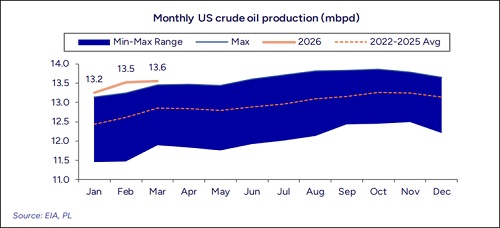
The report highlights that for the near term, the United States and China will be less affected as they possess ample supplies. United States, benefits from oil production rates, which is more than 13 million barrels of oil per day. In addition to that, the US has sufficient inventory stock and refining capacity as well. Likewise, the situation in China is not different either. The country has moved into the disruption stage with high levels of oil imports, production of oil, and accumulation of stock piles in recent years.
In contrast, countries importing crude oil are finding themselves increasingly under pressure due to supply constraints, higher cost of transportation, and the inability to procure from alternate sources. Many governments have already introduced policies that focus on conserving energy by means of working from home, reducing travel, using public transport, and rationing fuel.
PL Capital notes, supply modifications at a global level through alternate shipping channels and reserve stocks will partly make up for these disruptions. The SAUDI and UAE are not increasing production. The pipeline throughput is increasing to bypass the Hormuz, basically what should have gone through Hormuz is now going through the pipeline. There is no increase in production. This is emergency stock release of 400 million barrels and not sales. Nevertheless, this is still not enough to fill the entire supply gap.
With demand slowing down and supply-demand dynamics slowly getting into balance, PL Capital expects the prices of crude to normalize from their current high levels. With this expectation, PL Capital is bullish on oil marketing companies (OMCs), including IOCL, BPCL, and HPCL. The drop in crude oil prices due to destruction in demand will help in improving the margins in marketing, even if there is a little effect on volumes.
Under this viewpoint, PL Capital maintains an “Accumulate” rating on Indian Oil Corporation, Bharat Petroleum Corporation, and Hindustan Petroleum Corporation. The organization has also increased its target price range, taking into account improved margin visibility due to changing dynamics globally.
Going Ahead, PL Capital believes that the movement of crude oil prices will largely be contingent on the speed and magnitude of demand destruction as well as any political events that may occur in West Asia. Although short-term volatility can be anticipated, a steady rebalancing of supply and demand should contribute to the stability of energy markets in the long run.
Above views are of the author and not of the website kindly read disclaimer