Buy Mphasis Ltd for the Target Rs. 3100 by Motilal Oswal Financial Services Ltd
Platform-led AI services: the next phase takes shape
We attended the Mphasis Analyst Day, where management laid out its transition from a services-led model toward a platform-led, outcome-based AI model. The core message across sessions was that Mphasis is transitioning toward a ‘platform + people’ operating model, where reusable IP, AI orchestration, and transformation-led delivery are expected to improve pricing power and client stickiness over time. As seen in Exhibit 1, the launch of Mphasis TriaTM – positioned as an Enterprise Agency platform – was the centerpiece of the event, alongside new commercial constructs around modernization and outcome-led transformation. Management emphasized that the next phase of growth will be driven less by linear headcount addition and more by platform attachment and reusable solution archetypes. Importantly, the company framed ARR as a lagging metric, while “platform attach rate” would become the leading indicator to watch over the next few years. Overall, we came away with the view that Mphasis is attempting to reposition itself early for an AI-led services cycle and is trying to structurally reshape its business model rather than merely add AI wrappers around existing services.
Platform-led transformation becoming the default operating model
* Management described the company’s evolution as a gradual shift from bespoke IT services toward a “reuse + bespoke” operating model, where platform-led delivery increasingly becomes the default layer across engagements.
* Mphasis formally launched its enterprise-agency platform, Mphasis Tria, positioned across three layers: insight, foresight, and execution. Rather than building foundational models internally, the company plans to integrate external LLM ecosystems (GPT, Claude, Gemini, Bedrock, etc.) while owning the orchestration, governance, workflow, and decisioning layers.
* As seen in Exhibit 2, alongside Tria, management introduced two marketfacing offerings: 1) Mphasis Modernize and 2) Mphasis Optimize. Modernize focuses on application, infrastructure, and operations modernization, while Optimize targets decision-led use cases such as demand forecasting, underwriting, revenue optimization, and supply-chain planning.
* We believe the broader positioning is important. Companies may increasingly shift from effort-based execution toward reusable AI-enabled operating models. Mphasis appears to be positioning itself early around this trend.
Outcome-based pricing and fixed-price deals becoming more important
* Management indicated that clients increasingly expect commercial structures with "skin in the game." Fixed-price work already accounts for ~48% of revenues, and management expects outcome-linked pricing to rise over time as platform reuse improves execution visibility.
* Importantly, management differentiated between traditional milestone-based fixed-price work and true outcome-based pricing tied directly to business KPIs.
* As we mentioned in our note dated 4th May, 2026: Thoughts from the disruptors, outcome-tied pricing: scope and price are defined around a business output and delivery milestones — not headcount. Outcome-contingent/gainshare pricing: fee as a function of actual performance improvement achieved (e.g., “improve collections by X%, share Y% of the upside”).
* We believe this is an important shift in commercial positioning. Management also suggested that AI-led productivity gains are increasingly being used to fund modernization and expanded transformation scope rather than being passed back entirely as pricing deflation.
Consolidation-led tuck-in vendor acquisitions remain a strategic lever
* Mphasis said its tuck-in acquisitions and consolidation deals are largely clientdriven rather than financially engineered.
* As seen in Exhibit 3, the strategy largely involves acquiring smaller niche vendors embedded within large enterprise clients, particularly when customers are consolidating vendor ecosystems. Management highlighted cases where relationships scaled from sub-USD10m to USD75m+ over a relatively short period after consolidation-led acquisitions.
* Management emphasized that the rationale is not valuation arbitrage but rather gaining strategic positioning, institutional knowledge, and a larger wallet share within key clients. The company prefers niche, founder-led assets with differentiated capabilities rather than broad-based scale acquisitions.
* The company also suggested that these acquired entities often operate at strong margins due to specialized capabilities and premium pricing structures. Areas discussed included cybersecurity, testing automation, and AI-related managed services.
Large deals engine seeing structural improvement
* We believe the large-deal engine today looks materially stronger vs. 2–3 years ago, supported by investments in the Strategic Engagement Team (SET), proactive deal origination, and platform-led transformation conversations. FY26 large-deal TCV reached ~USD2.1b, up ~68% YoY, while average large-deal size increased from ~USD54m to ~USD75m.
* The company highlighted that ~63% of FY26 TCV came from large deals, while the fixed-price revenue mix increased to ~48% of revenues. Management also indicated that top-of-funnel pipeline creation nearly doubled YoY, with overall pipeline growth of ~38% YoY.
* In our view, the interesting part was not just the deal size growth but the change in the nature of conversations. Management highlighted that clients increasingly want fewer strategic vendors capable of driving end-to-end transformation rather than siloed execution work.
Investments may keep near-term margin expansion in check
* We believe reported margins currently understate the underlying earnings potential of the business given elevated investments across AI platforms, GTM expansion, and large-deal capabilities.
* Management disclosed that ~1.5% of revenues are currently being invested into AI platforms and related capabilities, while additional spending is going toward SETs, client coverage, and engineering talent. According to the management, operating margins could have been roughly ~200bp higher without these investments.
* Despite these investments, the company is still guided toward gradual margin expansion over time, especially as platform-led revenues and reusable delivery models scale further.
* We believe margins could remain somewhat range-bound in the near term given continued investments in platform capabilities, GTM, and engineering talent. However, if reusable AI-led transformation programs scale successfully, delivery leverage could improve structurally over time.
Valuation and View
* We believe Mphasis is attempting a relatively early and structural repositioning toward a platform-led AI services model.
* We are positive on the BFSI exposure as it remains relatively resilient with strong deal momentum, which provides reasonable visibility on growth over the next few quarters. With strong TCV growth in FY26 (up 68% YoY) and large client issues now normalized, we see improving visibility on revenue growth over the next few quarters.
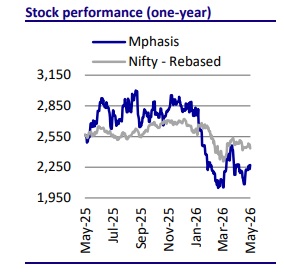
* Over FY26-28, we forecast a USD revenue CAGR of ~10% and an INR PAT CAGR of ~15%. We value the stock at 24x FY28E EPS, arriving at a TP of INR3,100. We reiterate our BUY rating on the stock.
For More Research Reports : Click Here
For More Motilal Oswal Securities Ltd Disclaimer
http://www.motilaloswal.com/MOSLdisclaimer/disclaimer.html
SEBI Registration number is INH000000412











.jpg)