
Bank Profits Rise 20% to Rs 1.16 Lakh Crore in Q2FY27 by CareEdge Ratings
Synopsis
• Net profit of scheduled commercial banks (SCBs) rose 20% y-o-y to Rs 1.16 lakh crore in Q2FY27, led by higher net interest income. Strong loan growth and a weak base a year ago also helped.
• Stake-sale and NSE IPO gains at large public sector banks (PSBs) added about Rs 10,000 crore to the profit in Q2FY27. Excluding one-time items in both years, profit grew about 16% y-o-y and was also lower than in Q1FY27.
• Return on assets (RoA) rose 7 bps y-o-y to 1.39%, the highest since Q2FY25, mostly because of one-time gains. Excluding one-time items, it was broadly unchanged from a year ago.
• Median return on equity (RoE) rose 79 bps y-o-y to 13.6%. Other private banks gained the most, as lower provisions lifted their profit.
• Median Common Equity Tier 1 (CET-1) ratio rose 87 bps y-o-y to 15.8%, though it eased from Q1FY27 in the usual second-quarter dip. Every bank is well above the regulatory requirement.
• Profit growth is likely to moderate in H2FY27. One-time gains are likely to fade, treasury income may stay weak, and banks are likely to build provisions ahead of the move to expected credit loss (ECL) rules.
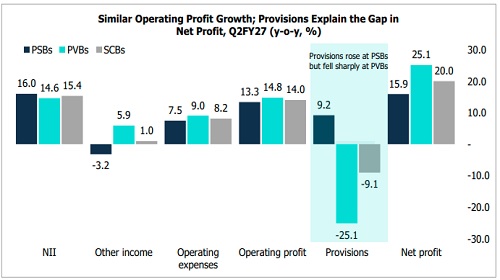
“Core lending drove bank earnings this quarter. Operating profit grew 13-15% y-o-y in both bank groups, so provisions explain the gap in their profit growth. Other private banks are catching up as credit costs ease. Their return on assets now trails the large private banks by about 50 bps, half the gap a year ago. Large private banks expect margins to improve after Q3FY27 as they lend out the FCNR(B) deposits. Higher provisions ahead of the ECL rules may lower returns.” - Vineet Jain, Senior Director, CareEdge Ratings
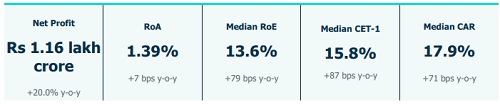
Bank Net Profit Rises 20% to Rs 1.16 Lakh Crore as Net Interest Income Grows 15.4%
SCBs’ net profit rose 20.0% y-o-y to Rs 1.16 lakh crore in Q2FY27, staying above Rs 1 lakh crore for the fourth consecutive quarter. The growth came mainly from higher net interest income (NII), as bank credit grew about 19%. In Q1FY27, by contrast, a 12.8% fall in provisions was a key driver of profit growth. Treasury income fell sharply as bond yields rose during the quarter. Part of the 20% growth also reflects a weak base, as profit had grown only 4.2% y-o-y in Q2FY26.
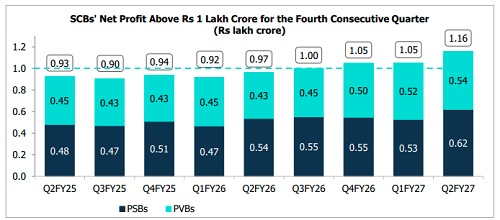
Source: Bank filings, Ace Equity, CareEdge Ratings Calculations. Note: Includes 14 PSBs (5 Large + 9 Others) and 16 PVBs (3 Large + 13 Others).
PSBs and private sector banks (PVBs) grew operating profit at a similar pace, and the gap in their net profit growth came from provisions. PSBs’ net profit rose 15.9% y-o-y. FCNR(B) inflows helped them replace costlier bulk deposits, but provisions rose as some banks began setting aside money ahead of ECL. PVBs’ net profit rose 25.1% y-o-y, as provisions fell sharply at other PVBs after stress in microfinance and unsecured loans eased. The PVB figure is also helped by a weak base, as their profit had fallen 4.0% y-o-y in Q2FY26.
One-Time Items Add About Rs 10,000 Crore; Net Profit Up 15.7% y-o-y Excluding Them
One-time items affected all three quarters compared in this report. In Q2FY27, large PSBs booked gains from a stake sale in an asset management subsidiary and from the NSE IPO. Q1FY27 carried a legal settlement charge at a large PSB, and Q2FY26 had stake-sale gains at two PSBs and a one-time provision at a large PVB. Excluding these items, net profit rose 15.7% y-o-y and fell 4.5% q-o-q, so the entire sequential rise in reported profit came from one-time items.
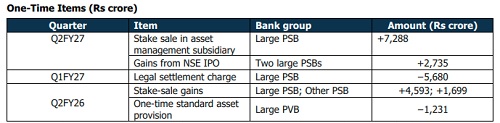
Source: Bank filings, CareEdge Ratings Calculations. Note: Amounts are before tax and are removed in full from net profit to arrive at figures excluding one-time items.
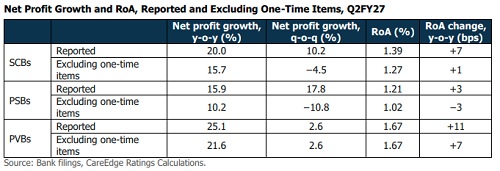
Banks’ Return on Assets Rises 7 bps y-o-y to 1.39%; Up 1 bp Excluding One-Time Items
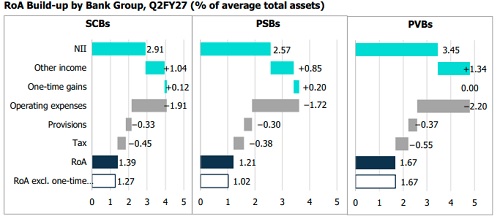
SCBs’ RoA rose to 1.39% in Q2FY27, the highest since Q2FY25, though almost all of the y-o-y gain came from onetime items. NII and lower costs and provisions relative to assets supported RoA, while lower treasury income held it back. The fall in the cost ratio reflects faster asset growth, as operating expenses still rose 8.2% y-o-y. Banks mobilised about USD 133 billion under the RBI’s FCNR(B) swap window between June 8 and August 31, 2026, which enlarged balance sheets before the funds could be fully lent out.
Above views are of the author and not of the website kindly read disclaimer