Asset Quality Improvement Continues for 20 Consecutive Quarters in Q1FY27 by CareEdge Ratings

Synopsis
• Asset quality across SCBs continued to improve for 20 consecutive quarters in Q1FY27, with GNPA declining to 1.71% and NNPA remaining at a historic low of 0.40%. PSBs continued to lead the improvement, while PVBs remained broadly stable. The decline in NNPA stock, along with contained fresh slippages and strong provision coverage, indicates that new stress remains manageable even as recoveries moderate and the pool of legacy NPAs shrinks.
• Divergent Trend in Slippages. Fresh slippages remained 8.5% lower y-o-y for PSBs. In comparison, PVBs saw a 15.4% q-o-q increase compared with a 13.4% q-o-q increase in the corresponding quarter last year, largely reflecting seasonal movement in vehicle finance. However, PVB slippage remained substantially lower at 22.1% y-o-y. Management commentary from major lenders was broadly constructive, with banks attributing some sequential movements to normal seasonality rather than deteriorating underlying asset quality.
• Credit costs remained contained, with annualised SCB credit costs declining to 0.31%, supported by lower provisioning needs. PSBs stood at 0.27%, while PVBs moderated to 0.39%. Select banks continued to maintain prudential and standard-asset provisions, including management overlays, ECL transition buffers and contingent provisions against potential stress from West Asia-related exposures. While no material stress is visible currently, the impact of geopolitical and trade disruptions remains a key monitorable.
• Outstanding Security Receipts (SRs) remained broadly stable during the quarter, while the SRs-togross advances ratio moderated further, indicating continued resolution and recovery of legacy stressed assets across the banking sector.
• Going forward, overall asset quality remains a key strength for the banking sector in FY27. The pace of improvement may moderate as legacy clean-up benefits diminish, while PVB slippages, unsecured retail, vehicle finance, and vulnerable MSME borrowers remain key areas to monitor. However, strong provision buffers, continued recoveries despite moderation and healthier borrower balance sheets should help keep system-wide asset quality broadly stable through FY27. Consequently, SCB GNPA ratios are likely to remain broadly range-bound at around 1.8%–2.0% in FY27.
Asset Quality Remains Strong, While Fresh Stress Stays Contained in Q1FY27
Figure 1: SCBs – Gross NPAs and Net NPAs Ratio Trend (%)
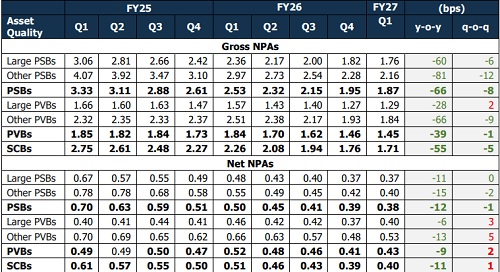
• Asset quality of SCBs improved further in Q1FY27, with the GNPA stock declining 11.5% y-o-y to Rs 3.69 lakh crore and the GNPA ratio moderating to a multi-year low of 1.71%, compared to 2.26% in Q1FY26 and 1.76% in Q4FY26. The improvement was driven by contained fresh slippages; recoveries/upgrades and write-offs continue to offset additions to bad loans; and ongoing resolution of legacy stressed assets.
• PVBs continue to maintain better headline asset quality vis-à-vis PSBs. However, PSBs continued to outperform PVBs, with the GNPA ratio declining 66 bps y-o-y and 8 bps q-o-q, supported by lower stress formation and recoveries from legacy accounts. Within large PVBs, GNPA deteriorated marginally by 2 bps to 1.29%, reflecting quarterly movements in fresh slippages and recoveries rather than a broad deterioration.
Figure 2: SCBs’ NNPA Ratio (%)
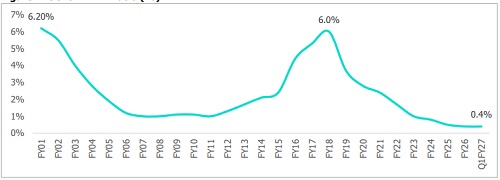
The SCB NNPA ratio has improved sharply from 6.0% in March 2018 to 0.4% in Q1FY27 and has remained around this historic low for the past six quarters. The sustained improvement reflects the resolution of legacy stressed accounts, steady recoveries, adequate provisioning and calibrated write-offs, including sales to ARCs. With the stock of legacy NPAs now significantly lower, recoveries have moderated. However, contained fresh slippages and continued resolution kept asset quality resilient in Q1FY27.
PSBs Continue to Drive Sector Improvement
• By Q1FY27, select PSBs continued to lead the improvement in asset quality, with GNPA ratios declining across retail, MSME, corporate and agriculture portfolios. Retail GNPA remained stable at 2.1% in Q1FY27, compared with 2.1% in Q4FY26 and 2.5% in Q1FY26, while MSME GNPA moderated to 4.1% from 4.4% in Q4FY26 and 5.4% in Q1FY26. Corporate GNPA declined to 0.6% from 0.7% in Q4FY26 and 1.2% in Q1FY26, while agriculture GNPA moderated to 5.7% from 5.8% and 6.9%, respectively. The improvement was supported by sustained recoveries, lower fresh stress, prudent underwriting and resolution of legacy stressed accounts. While MSME remains a key area to monitor, PSBs have relatively greater exposure to smaller-ticket borrowers, limiting the impact of stress compared with PVBs, which have a larger share of higher-ticket MSME exposures. Despite global geopolitical uncertainties, including tensions in the Middle East, domestic asset quality remains resilient, supported by healthy corporate balance sheets and the continued strength of secured portfolios.
Figure 3: PSBs: Recoveries, Upgrades, Write-Offs and Fresh Slippages (Rs. lakh Cr.)

PVB Slippages Rise Sequentially but Remain Manageable
Figure 4: PVBs: Recoveries, Upgrades, Write-Offs and Fresh Slippages (Rs lakh Cr.)

Net NPAs of SCBs declined 9.4% y-o-y to Rs 0.84 lakh crore in Q1FY27, led by PSBs, where NNPA fell 10.6% to Rs 0.50 lakh crore, supported by resolution of older stressed accounts and contained fresh stress. PVBs also saw NNPA decline 7.6% to Rs 0.34 lakh crore, aided by stable trends in unsecured retail asset quality reported by major lenders, which further support this trend. Although fresh slippages increased 7.9% q-o-q, mainly due to a seasonal rise in PVB slippages, particularly in commercial vehicle and tractor finance, they remained lower y-o-y. PSB slippages were broadly unchanged sequentially, while recoveries and write-offs moderated. Overall, asset quality remains comfortable, with the seasonal rise in slippages largely in line with expectations.
Above views are of the author and not of the website kindly read disclaimer












More News

Capital Small Finance Bank Appoints Banking Veteran Conrad D?Souza as Independent Director