Yen weakness no longer just a Japan problem by CareEdge Ratings
Recently, the yen experienced a pronounced depreciation, prompting coordinated foreign exchange intervention by Japan and the United States to support the currency. While Japan’s (CareEdge AA- /Stable) substantial foreign exchange reserves and external asset position provide ample capacity to intervene, the greater concern is that persistent yen weakness could trigger broader and more structural global market spillovers.
These spillovers could materialise through three main transmission channels: the immediate impact on US Treasury markets, more gradual structural effects through the yen-funded carry trade, and changes in the asset allocation of Japanese institutional investors. Given Japan's position as one of the world's largest external creditors, changes in the yen, Japanese interest rates, and the country's policy response can have significant implications for global financial conditions
Impact on the US Treasury markets Japan is one of the largest holders of US Treasuries, with more than USD1.14 trillion (~12% of total US treasuries as of May 2026). This makes the mechanics of yen intervention particularly important for global fixed-income markets.
Track record of coordinated intervention in Japan currency stabilisation
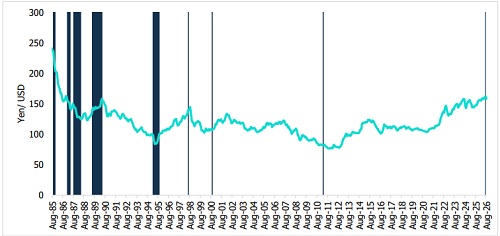
Under conventional foreign exchange intervention, supporting the yen would typically involve selling foreign currency assets, predominantly dollar assets, and purchasing yen. If a significant portion of the intervention is financed through sales of US Treasuries, the resulting increase in Treasury supply could place upward pressure on US yields
This comes at a time when US Treasury yields are already facing upward pressure from elevated fiscal deficits, large issuance requirements, and persistent inflation risks. Higher yields also have direct fiscal implications for the US, as rising interest payments have significantly raised the government’s debtservicing burden.
The potential increase in US Treasury yields also has broader implications for the global financial system. Treasury yields serve as a benchmark for pricing sovereign and corporate debt worldwide. A rise in US yields can, therefore, increase global borrowing costs, tighten financial conditions, and heighten refinancing pressures across emerging and developed markets. This transmission is particularly relevant at a time when long-term yields in both the US and Japan are already high.
However, Japan does have an alternative to outright liquidation of its foreign assets. The Federal Reserve’s Foreign and International Monetary Authorities (FIMA) Repo Facility allows foreign official institutions to obtain dollar liquidity against their holdings of US Treasuries without having to immediately sell those securities in the market. This can help mitigate the immediate market impact of intervention by reducing the need for Treasury sales
However, financing mechanisms and temporary interventions can provide liquidity and near-term relief but do not address the underlying cause of yen weakness. If the yen remains under persistent pressure, repeated intervention could increase market volatility and eventually require a broader monetary policy response
Risk to the yen-funded carry trade
Decades of near-zero Japanese interest rates encouraged Japanese and international investors to borrow cheaply in yen and invest in higher-yielding assets overseas. This yen-funded carry trade supported the outward flow of Japanese savings and, over time, contributed to the build-up of Japan’s large external asset position.
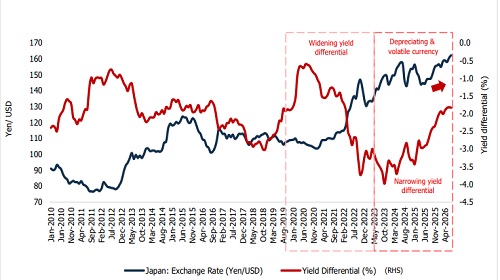
However, we believe persistent yen weakness could increase pressure on the Bank of Japan (BoJ) to accelerate policy normalisation, leading to faster increase in interest rates. As Japanese interest rates rise and the Japan-US yield differential gradually narrows, the relative attractiveness of yen-funded borrowing is beginning to diminish.
Although the US-Japan yield differential is wide as of now, its direction and volatility are important for the carry trade. A faster-than-expected increase in Japanese interest rates, with sharper narrowing of the yield differential, could trigger a rapid unwinding of yen-funded carry positions. Given the carry trade’s role in supporting investment in a wide range of higher-yielding assets globally, an abrupt unwinding could have spillover effects beyond the foreign exchange market, affecting global financial markets.
Yield differential between Japan and the US along with depreciating currency
Changes in the asset allocation of Japanese institutional investors
Another risk arises from changes in the composition and asset allocation of Japanese investors. The scale of Japan’s institutional investor base means that even modest portfolio reallocation can have global consequences. Japanese insurers, pension funds, and other institutional investors have historically invested heavily in overseas fixed-income markets. A sustained increase in domestic JGB yields could reduce the relative attractiveness of foreign bonds, potentially lowering Japanese demand for overseas fixed-income assets and altering global bond-market demand.
Credit implications
Though the recent intervention has provided temporary relief, the persistence of yen weakness suggests that the underlying adjustment is likely to be more prolonged. Beyond its broader implications for global markets, this development may have a bearing on Japan’s sovereign credit profile, particularly given its elevated public debt burden. From a credit perspective, the pace of monetary policy normalisation, the trajectory of fiscal adjustment, and the strength of nominal growth will be key to maintaining debt affordability and preserving fiscal buffers.
Above views are of the author and not of the website kindly read disclaimer