Turmeric Report 05th Feb 2025 by Amit Gupta, Kedia Advisory

Volatility Returns as Yield Losses Offset Higher Acreage
Key Highlights
* Sharp volatility driven by flood-led yield losses despite a large increase in sowing area.
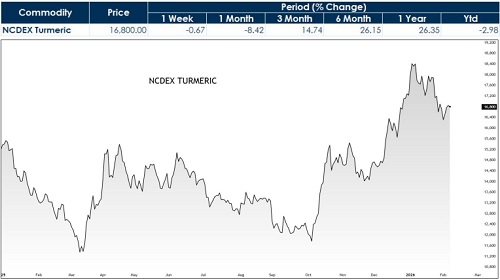
* Prices rebounded strongly from sub-Rs.12,000 levels to January highs near Rs.19,050.
* New crop arrivals from February may cap rallies in the short term.
* Tight stock-to-use ratio and strong export outlook support prices on dips.
* Technically bullish structure intact, but corrective phase likely post-spike.
Turmeric has once again proven to be one of the most volatile commodities in the agri space over the last few months. The current price behaviour reflects a complex tug-of-war between higher acreage and lower yields, coupled with shifting demand dynamics. If we revisit the broader price history, turmeric was trading around Rs.12,500 at the start of the 2020–25 cycle and rallied sharply to Rs.15,800 by January.
The supply narrative changed materially during June, July, and August, when sowing for the current season increased sharply. This surge in acreage kept prices under pressure through September, when the market again tested lows near Rs.11,900. However, the second spell of monsoon rains altered the equation. Flood-like conditions in key turmeric belts, particularly in Maharashtra, led to significant crop stress. Despite an estimated 25–30% rise in sowing area, yield losses are now projected at 25–30%, dramatically tightening effective supply.
This shift triggered a strong rally from October onwards, with prices climbing from lows near Rs.11,600 to a peak of around Rs.19,050 in January. Currently, turmeric futures are trading near Rs.16,700, reflecting some profit-booking and the anticipation of fresh arrivals. While higher acreage remains a structural overhang, availability of the new crop from February is expected to exert near-term pressure.
From a production standpoint, the numbers tell an important story. Two seasons ago, production was around 56 lakh bags. Last year, output improved to an estimated 75–78 lakh bags. At the time of sowing this season, expectations were extremely optimistic, with projections of 1.02–1.05 crore bags. However, due to yield losses, production is now estimated closer to 90–92 lakh bags—still higher than last year, but well below early expectations. Against this, domestic consumption stands near 72 lakh bags, while exports account for another 30–35 lakh bags, keeping the stock-to-use balance tight.
Technical View
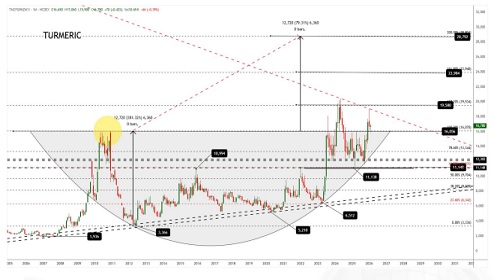
Technically, turmeric continues to display a strong recovery structure. Weekly charts show a clear rounding-bottom breakout, with prices having crossed key retracement levels before facing resistance. Momentum indicators remain positive, though some cooling is visible, suggesting consolidation rather than trend reversal. The Rs.20,000–Rs.22,000 zone emerges as a potential final spike area in the ongoing uptrend.
Outlook
Over the next 15–20 days, turmeric may attempt one more upside move towards Rs.20,000– Rs.21,500, supported by Ramzan demand, marriage season buying, a weaker rupee near 90.40, and improved export prospects following the US–India trade deal and Europe’s FTA. However, post-arrival pressure could drag prices back towards Rs.15,000–Rs.14,500. For February, key support lies near Rs.15,500, while resistance is seen around Rs.20,500. The medium-term tone remains volatile, with sharp swings likely on both side
Above views are of the author and not of the website kindly read disclaimer