Smart Charging 2026 How Nano Tech Redefines Speed
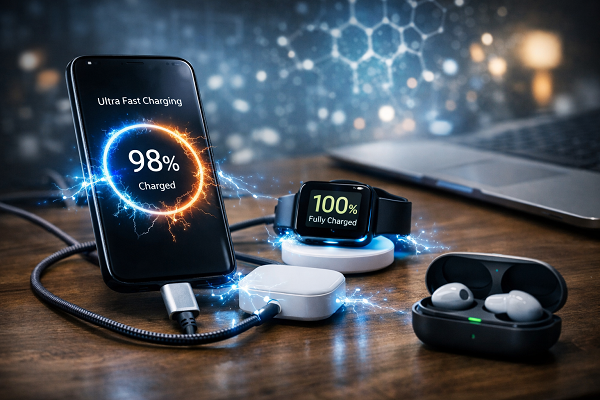
In 2026 nano charging technology has become a mainstream innovation transforming how smartphones laptops tablets and wearables recharge The concept that once seemed futuristic is now a daily convenience driven by breakthroughs from leading tech companies The most talked about development this year came from Samsung which introduced its NanoBoost Charger capable of powering a Galaxy device from ten percent to full in less than two minutes using advanced graphene based nano conductors This technology not only speeds up charging but also reduces heat generation ensuring longer battery life and improved energy efficiency
Apple followed with its MagCharge Pro system integrated into the iPhone sixteen series delivering a complete charge in under three minutes while maintaining battery health through adaptive nano current control The company has also extended this technology to its MacBook and Apple Watch lineup allowing users to recharge multiple devices simultaneously with minimal power loss
In China Xiaomi unveiled its HyperNano Adapter designed for ultra fast charging across smartphones tablets and smartwatches achieving ninety percent charge in just ninety seconds The adapter uses nano structured electrodes and liquid cooling micro channels to prevent overheating making it ideal for high performance devices used in gaming and content creation
Japan based Sony launched its NanoCell Power Dock for portable gadgets using carbon nanotube technology to minimize energy loss and heat buildup This innovation has been praised for its compact design and ability to charge cameras headphones and handheld consoles in record time
In India OnePlus partnered with Lohum Cleantech to develop compact nano chargers that can power smartphones and earbuds simultaneously within seconds aligning with the governments digital sustainability initiative The collaboration aims to make fast charging accessible and eco friendly by using recyclable materials and low voltage nano circuits
Startups are also shaping the future of nano charging StoreDot in Israel and Enevate in the United States are commercializing silicon dominant nano anode batteries promising laptops and tablets that can fully recharge in under five minutes These companies are focusing on integrating nano materials that allow higher energy density and faster ion transfer without compromising battery safety
Governments worldwide are supporting these advancements The European Union has introduced fast charge efficiency standards under its Battery Regulation 2026 ensuring that all new devices meet sustainability and safety benchmarks The US Department of Energy has launched grants for nano material research encouraging startups to develop next generation charging solutions Meanwhile the China Ministry of Industry and Information Technology has mandated that all new smart devices support ultra fast charging compatibility promoting global standardization
Together these developments mark the dawn of a new charging era where waiting for power is obsolete Nano chargers are now powering a truly connected efficient and sustainable digital world redefining convenience for billions of users across the globe