Robust FCNR Inflows to Support BoP and Liquidity by CareEdge Ratings

FCNR (B) Inflows Likely to Touch USD 80 Billion
The concessional swap windows for FCNR(B) deposits, External Commercial Borrowings (ECBs) and Overseas Foreign Currency Borrowings (OFCBs), amongst other policy measures announced on June 5, 2026, have seen a strong response. Between June 5 and July 31, 2026, these measures have attracted USD 40.8 billion, with FCNR(B) inflows accounting for USD 36.7 billion, and ECBs and OFCBs together accounting for USD 4.1 billion. Large banks are currently offering deposit rates in the 6.0-6.5% range, while some smaller and newer banks are offering rates close to 7% for FCNR deposits. Additionally, the availability of significant leverage for investors, with some foreign banks reportedly offering leverage as high as 19x – 29x in some cases, appears to have enhanced the attractiveness of the scheme and supported stronger-than-expected participation.
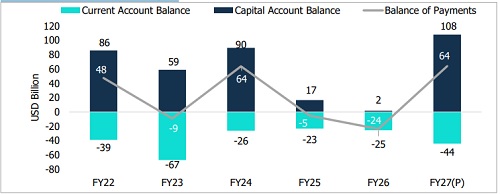
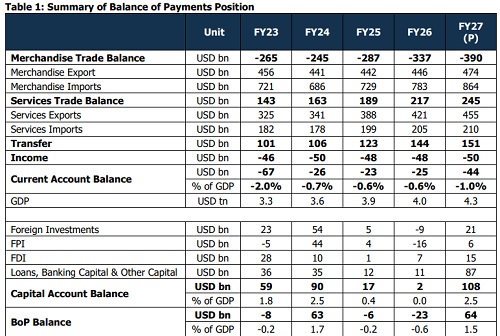
Given the pace of inflows observed so far, we are revising upward our projections of FCNR flows expected this year. We now expect FCNR(B) inflows to reach around USD 80 billion, while ECB and OFCB inflows are projected at USD 10-15 billion. Taken together, the measures are likely to generate USD 90-95 billion of capital inflows in FY27. Consequently, India's capital account surplus is now expected to increase to approximately USD 108 billion, compared with a surplus of just USD 2 billion in the previous year. As a result, India’s Balance of Payments (BoP) is expected to improve to a surplus of USD 64 billion in FY27 compared to deficits of USD 23.6 billion and USD 5 billion in FY26 and FY25, respectively (Exhibit 1). This would represent a substantial strengthening of India's external position and provide an important buffer against global volatility.
Exhibit 1: BoP to Remain in Surplus
Difference in Measures Announced in September 2013 and June 2026
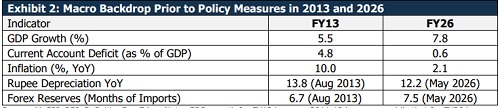
A similar package of measures to attract foreign capital was announced in September 2013. However, the global economic backdrop and the purpose of the measures were markedly different (Exhibit 2). The September 2013 measures were a crisis response to the post-taper tantrum environment. Globally, the US Federal Reserve's indication in May 2013 that it would reduce quantitative easing triggered a sharp reversal of capital flows from emerging markets. India was among the vulnerable economies. The country’s current account deficit had touched
4.8% of GDP in FY13, CPI inflation was elevated at 10%, and the rupee had depreciated sharply by 13.8% in August 2013 compared to a year ago. Against this backdrop, the RBI introduced a special FCNR(B) swap window at a concessional fixed rate of 3.5% and allowed banks to increase overseas borrowings (up to 100% of Tier-I capital) with subsidised swaps. The Central Bank also eased ECB regulations, including permitting eligible corporates to borrow from foreign equity holders for general corporate purposes under specified conditions. The objective was to attract capital flows, stabilise the rupee and reduce external vulnerability. The scheme incentivised FCNR inflows of USD 24.5 billion over its duration (September-November 2013) and helped the rupee appreciate by 7.7% to 61.9/USD by December 2013, from 67/USD on the day of the policy announcement (September 4, 2013).
The June 2026 package was broader than the 2013 package. The RBI expanded the FAR bond universe to include new 15-, 30- and 40-year government securities, removed several FPI investment restrictions in government debt, liberalised equity investment norms for overseas individuals, provided concessional swap facilities for FCNR(B) deposits and certain ECBs and OFCBs, while the government simultaneously exempted foreign investors from tax on interest and capital gains from specified G-Secs. The measures were introduced against a backdrop of relatively healthier macro variables, with GDP growth of 7.8% in FY26, low retail inflation of 2.1% and a low CAD of 0.6% of GDP in FY26. Even with many of the macro indicators looking healthy, capital flows had been weak this year. With lingering global uncertainties and geopolitical conflicts, the rupee had weakened by 12% in May from a year ago. The June 2026 package aimed to build a buffer against the external shock largely arising from geopolitical and supply chain bottlenecks.
The key difference between the packages is therefore one of context and design. In 2013, policy was concentrated on mobilising dollar funding through banks and NRIs to arrest a currency and external financing shock. In 2026, policymakers sought to attract a wider spectrum of foreign capital, including portfolio debt, equity, NRI deposits, and external borrowings, while also deepening India's integration with global bond markets. While both episodes relied on FX-swap incentives for FCNR(B) deposits, the measures in 2013 were a defensive stabilisation exercise, whereas those in 2026 was a largely preventive strategy aimed at bolstering capital inflows, supporting the rupee, and enhancing the attractiveness of Indian financial markets.
Overall, the 2013 measures helped India navigate a period when several external and domestic vulnerabilities had converged simultaneously. The 2026 measures are helping strengthen an external position that has weakened on account of a moderation in capital inflows. Over the previous two years, the BoP remained in a deficit despite a benign CAD due to weak capital inflows
Different Reaction of Forex Market and Debt Market
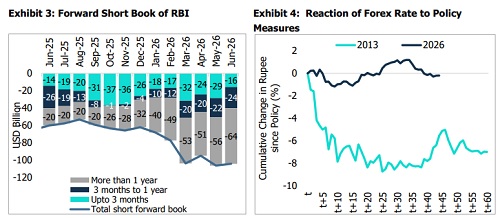
Two months into the measures (as of July 31, 2026), the FCNR swap window has attracted USD 36.8 billion, significantly higher than the USD 11.6 billion mobilised in the first two months of the 2013 swap window. However, the rupee’s response has been relatively muted so far in 2026. A key factor could be the RBI’s forward position. In 2013, its net forward short position was only 3.5% of forex reserves, compared with a much larger USD 106.7 billion (15.5% of reserves) in May 2026. The RBI is likely using part of the swap proceeds to unwind this position. Indeed, its net short-dollar forward position declined to USD 103.3 billion in June (Exhibit 3). This could be limiting the extent of rupee appreciation due to a surge in capital flows. Additionally, the Real Effective Exchange Rate (REER)-implied undervaluation (around 9% as of June 2026) is likely to correct with the expected uptick in domestic inflation in the coming months. This would also limit the extent of rupee appreciation
This response of the rupee to the June 2026 package contrasts with its trajectory after the September 2013 package. The rupee had appreciated by around 7% within 60 working days of the 2013 measures, while remaining relatively flat in 2026 (Exhibit 4). As the geopolitical situation stabilises, we expect some appreciation of the rupee. With the projected capital inflows, we expect the USD/INR to average between 93-94 during FY27
The difference shows up in the reaction of G-sec yields as well. The decline in the 2Y G-sec yield segments in 2026 has been noticeably more muted than during the 2013 episode. While FCNR(B) deposits do not directly influence government bond yields, they can affect them indirectly by altering expectations around RBI policy and reducing external-sector stress. Unlike the 2013 episode, 10Y G-sec yields reacted more closely to the volatility in oil prices so far this year (Exhibit 6).
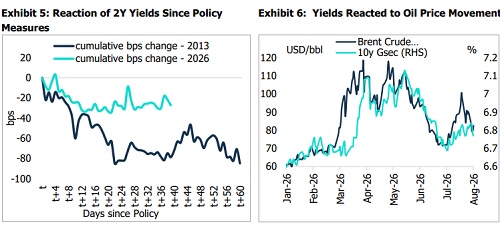
Going ahead, if the RBI conducts OMO sales as a liquidity-tightening measure amid significant foreign inflows, it could add upward pressure on G-sec yields. However, progress towards Bloomberg Index Inclusion remains a key monitorable. Some recent debt-market measures also address key hurdles to India’s inclusion in the Bloomberg Global Aggregate Index, which could be reviewed again in November 2026 following the recent deferral. Inclusion could give India a ~1% index weight, potentially attracting USD 20–30 bn of passive inflows over 10–12 months. While passive flows may begin only toward the end of FY27 and spill into FY28, active investors could front-run these flows in anticipation of inclusion. With concerns around high government borrowing and rising inflation, we expect the 10Y G-sec yield to average 6.8 – 6.9% over FY27.
FCNR Inflows to Further Ease Liquidity
Amid external concerns, strong capital inflows could result in further easing in domestic liquidity conditions. Banking system liquidity averaged around Rs 1.1 trillion in July and has risen to Rs 3 trillion so far in August, supported by month-end inflows (Core Liquidity, which includes cash balances with the RBI, stands at Rs 5.4 trillion as of midJuly). The government’s comfortable cash balance with the RBI, strengthened by the Rs 2.9 trillion dividend transfer in Q1, should provide additional support as government spending picks up.
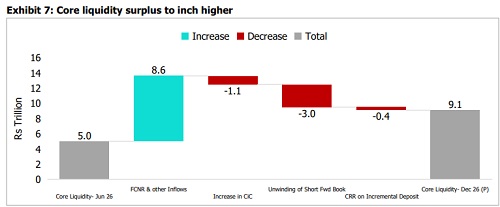
Going ahead, FCNR and ECB inflows could provide a significant boost to core liquidity, potentially adding around Rs 8.6 trillion (Exhibit 8). However, this could be partly offset by a seasonal rise in currency demand and the maturity of RBI’s short forward book. We estimate that currency in circulation (CiC) could rise by around Rs 1.1 trillion in December from levels in June amid a seasonal uptick in festive periods. Assuming maturity of around USD 30 billion in RBI’s forward position (RBI short-forward book maturing in 3 months and within 1 year stands at USD 16 billion and USD 40 billion, respectively), this could create a drag of roughly Rs 3 trillion. After accounting for the incremental CRR requirement on deposit growth, we estimate core liquidity could still reach a surplus of around Rs 9 trillion. Thus, even after accounting for these leakages - CiC increase, higher CRR on deposit growth and maturing of the forward book of the RBI - excess core liquidity is likely to remain substantial. Any increase in government spending would reduce core liquidity but simultaneously translate into an increase in banking-system liquidity.
Higher-than-expected capital inflows from recent policy measures could create a liquidity glut in the system in the second half of FY27. In such a scenario, the RBI may use liquidity management tools such as long-tenor VRRR or OMO sales to absorb excess liquidity. That said, if the liquidity glut persists, a CRR hike could also be considered later in the year.
Above views are of the author and not of the website kindly read disclaimer