Research report on Manthan- Oil & gas by Swarnendu Bhushan, Research Analyst, PLcapital

The Pike Syndrome & MRPL Time to invest?
The Pike Syndrome is a psychological study which shows how forced helplessness can be manifested in human behaviour. A pike fish in a fish tank is separated from prey fish by placing a glass barrier. Initially, the pike fish tries to reach the prey but after repeatedly hitting the glass, learns that it can never reach the food. Even after the glass barrier is removed, the pike fish does not try to reach the prey and starts starving to death.
We see similar instances in investments too where repeated disappointments often lead to investors staying away from certain stocks even if there is a drastic change in the fundamentals. A classic example is that of MRPL. While nameplate capacity addition completed by Mar’12 to avail the sunset clause benefits, issues related to captive power plant delayed commissioning of secondary units for quite some time. The polypropylene unit was commissioned in Q1FY16. However, water issues continued during summer each year till the company commissioned its desalination plant in Q3FY21. As a result, the investors have been left high and dry several times, although not entirely due to fault of the company.
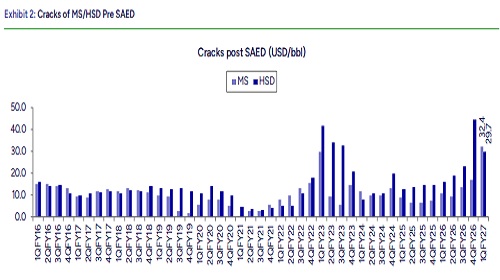
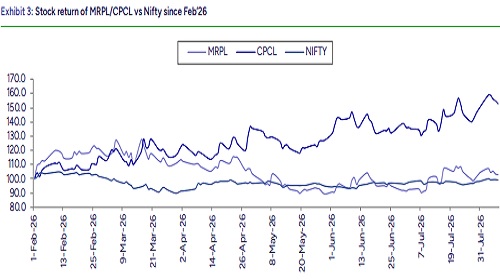
In the recent past, as the Middle East crisis combined with Russia-Ukraine war limited availability of refined products, we have seen petrol and diesel cracks (post SAED) rising to USD32.4/29.7/bbl in Q1FY27 compared to 10-year average of USD10.0/14.4/bbl. While Chennai Petroleum has given a return of 53.2% since start of Feb’26, MRPL has lagged with 2.6% only. The crack spreads are likely to remain higher for longer considering the damage to refineries in the Middle East and Russia. However, investors do not appear flocking to MRPL.
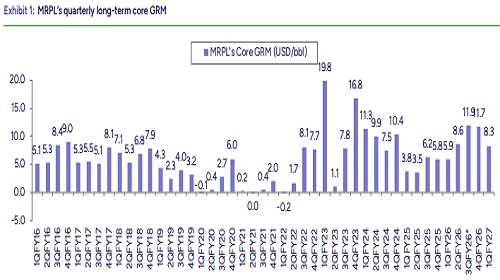
Will MRPL prove them wrong this time? We believe that at USD10/bbl, the company could easily throw an EBITDA of Rs~80bn in FY27E and Rs96bn in FY28E. With no major capex planned (maintenance capex of Rs10bn), the debt could come down to Rs93.5bn by FY28-end from Rs143.3bn in FY26. Even at 6x EV/EBITDA and not including any valuation for the upcoming IBB plant, the target price could reach Rs258/share
Please refer disclaimer at https://www.plindia.com/disclaimer/
SEBI Registration No. INH000000271