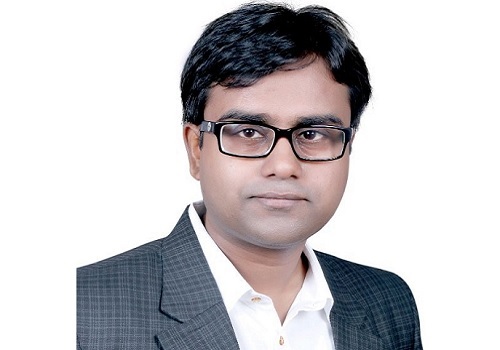
Note on AIBI annual summit today by Shri Ashishkumar Chauhan, MD, NSE

India’s Capital Markets Moment
Since April 2020, cumulative household wealth creation in equities has been estimated at about Rs 53 lakh crore. The market capitalisation of listed companies stands at about Rs 466 lakh crore—about US$ 5.2 trillion—and the market cap-to-GDP ratio is about 130-135%. When market cap moves well beyond GDP—as it already has in India and the US—it also tells us that
valuation and liquidity are rising faster than physical output. That is a sign of financial maturity—but it also increases the responsibility on disclosures, governance, and intermediaries.
Fund Mobilisation: Strong Year, Clear Direction
Since FY22, NSE has enabled about Rs 76 lakh crore of fund mobilisation— showing how strongly India’s markets are supporting economic growth. In 2025 alone, NSE mobilised about Rs 20 lakh crore, with equity fund mobilisation of about Rs 4.2 lakh crore and debt fund raising of about Rs 15 lakh crore. Notably, market-based fund mobilisation through NSE was much
higher than the incremental bank credit to industry and services.
On the primary market side, NSE continues to stand out globally. In 2025, NSE facilitated 220 IPOs, raising about Rs 1.78 lakh crore in total—one of the strongest years on record. This included 103 Main Board IPOs raising about Rs 1.72 lakh crore, and 117 SME IPOs raising about Rs 5,784 crore.
India has consistently ranked among the top IPO markets globally, even when several international markets were subdued. In 2025, India was a global leader by number of IPOs, followed by the US and Mainland China. In proceeds, India raised about US$ 22.9 billion—third after the US (US$ 45.5 billion) and Hong Kong (US$ 34.9 billion).
NSE Main Board: Engine of Capital Formation
In 2025, 16 startups raised about Rs 41,000 crore through IPOs on the NSE Main Board—up from about Rs 29,000 crore raised by 10 startups in 2024—showing that public markets are becoming a serious pathway for new-age businesses to fund scale with transparency.
In 2025, the Financials sector saw the highest fundraising, Industrials saw the highest number of IPOs, and Real Estate recorded the sharpest jump—about a 575% increase in fundraising versus 2024.
SME IPOs: A Maturing Market With Higher Responsibility
The SME segment is maturing—and it is moving from exuberance to discernment. In 2025, 117 SME IPOs raised about Rs 5,784 crore and the average SME IPO size rose to about Rs 49 crore. In fact, 4 SME issues crossed Rs 100 crore—signalling that the platform is maturing in Non-Confidential both quality and scale. We also see a powerful democratisation of entrepreneurship: more listings are coming from Tier-2 and Tier-3 cities.
Importantly, subscription behaviour is also becoming more discerning— stronger issues are being rewarded more clearly than weaker ones.
This is why NSE has tightened the SME framework in a calibrated way, including strengthened eligibility filters such as the Free Cash Flow to Equity criterion. The outcome is visible: improved listing quality, reduced downside tail risk, and SME investing that is better aligned with long-term household wealth creation.
One data point captures this clearly: after the FCFE-based tightening (applicable for DRHPs filed on/after 1 Sep 2024), the share of companies trading more than 60% below issue price fell from 10.6% to just 2%. We are also seeing stronger institutional participation—with about 38.8% of SME issue size allocated to QIBs in recent periods—another marker of improving quality. And let me underline this: the exchange can set frameworks, but quality is finally delivered by intermediaries.
Equity Has the Upper Edge, Debt Is the Next Frontier
From FY22 to FY25, equity fund mobilisation rose from about Rs 2.4 lakh crore to about Rs 4.2 lakh crore—growing at about a 21% CAGR—while debt grew at a slower pace, at about a 6% CAGR.
The high equity-to-listed-bond ratio underlines a clear reality: debt funding is still largely bank-centric, while equity often becomes the liquidity and exit mechanism.
Since FY22, over Rs 60 lakh crore has been mobilised through NSE’s debt platforms. And within CY2025 debt mobilisation, the mix is very clear: out of Rs 15.1 lakh crore raised, about Rs 9.2 lakh crore came through commercial paper and about Rs 5.9 lakh crore through privately placed NCDs—while public NCD issuances were only Rs 2,257 crore, i.e., barely ~0.15% of total debt raised.
REITs and InvITs: Policy Is Ready, Product-Market Fit Must Scale
SEBI has created an enabling policy environment for REITs and InvITs, and the market has begun responding. Since FY22, Business Trusts have raised about Rs. 1 lakh crore through NSE. In 2025, business trusts raised about Rs 33,860 crore.
Investment Bankers: From Deal Execution to Market Stewardship
The next phase of Indian capital markets is not just about more deals—it is about better deals.
Social Media, Memes, and the Discipline of Public Markets
We live in an age where social media can turn investing into entertainment, and memes can distort how businesses are judged—sometimes celebrating noise over numbers, and narratives over profitability. Public markets must be a place where disclosures matter, governance matters, cash flows matter, and long term value creation matters.
Closing
That is how we support sustainable growth—and that is how we contribute to Viksit Bharat: by funding good businesses, protecting investors, and deepening long-term participation.
Above views are of the author and not of the website kindly read disclaimer