Mutual fund AUM declines despite stronger equity inflows: ICRA Analytics

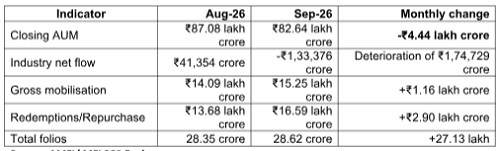
The mutual fund industry’s closing AUM declined sharply by Rs.4.44 lakh crore, or 5.1% month on month, to Rs. 82.64 lakh crore in September 2026 from Rs.87.09 lakh crore in August. The contraction reflected two simultaneous pressures, namely industry-wide net outflows of Rs.1.33 lakh crore, largely from short-duration debt categories, and an estimated Rs.3.10 lakh crore adverse valuation and other residual impact. Thus, nearly 70% of the fall in AUM cannot be explained by net flows alone and was primarily associated with changes in portfolio valuations and other reconciliation effects.
The headline decline, however, masks continued strength in retail-oriented segments. Equity schemes received net inflows of Rs.38,294 crore, up 30.6% from Rs.29,314 crore in August, while equity folios increased by 17.69 lakh during the month. Nevertheless, equity AUM fell by Rs.1.67 lakh crore, indicating that positive investor mobilisation was more than offset by adverse market movements. Overall folios increased by 27.13 lakh to 28.62 crore, reinforcing the view that the decline in AUM was not driven by a broad-based retreat in investor participation.
Source: AMFI/ MFI 360 Explorer
Gross mobilisation increased by 8.2% month on month to Rs.15.25 lakh crore, but redemptions rose much faster, by 21.2% to Rs.16.59 lakh crore. Consequently, the industry moved from a net inflow of Rs.41,354 crore in August to an outflow of Rs.1.33 lakh crore in September. This shows that the deterioration was driven less by weak fresh mobilisation and more by a sharp increase in withdrawals, particularly from liquidity-management products.
A simple reconciliation indicates that the Rs.4.44 lakh crore-decline in AUM exceeded the Rs.1.33 lakh crore net outflow by approximately Rs.3.10 lakh crore. This residual represents the combined influence of market movements, valuation changes and other timing or reconciliation effects. Therefore, September’s decline should not be interpreted solely as investor withdrawal from mutual funds.
Income and debt-oriented schemes recorded net outflows of Rs.1.83 lakh crore, compared with Rs.9,225 crore of outflows in August. This category alone accounted for more than the industry’s overall net outflow because equity, ETFs and other categories continued to receive subscriptions. Debt AUM consequently declined by Rs.1.70 lakh crore to Rs.17.75 lakh crore.
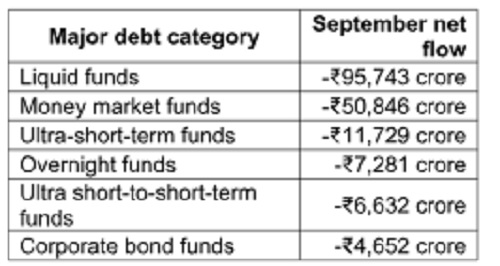
The withdrawals were highly concentrated:
Source: AMFI/MFI 360 Explorer
Liquid and money market funds together registered withdrawals of approximately Rs.1.47 lakh crore, accounting for about 80% of debt-category outflows. This concentration indicates that the weakness was principally associated with treasury and short-term cash-management activity, rather than a uniform withdrawal from longer-duration debt products.
The divergence was also visible within debt. Banking and PSU debt funds and gilt funds ended September with modestly higher AUM, whereas liquid, money market and ultra-short-term funds recorded substantial reductions. Gilt categories collectively received net inflows of Rs.436 crore after outflows of Rs.1,826 crore in August.
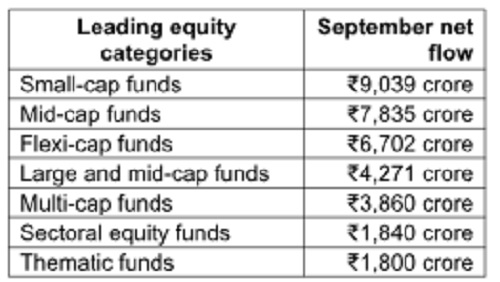
Equity-oriented schemes recorded net inflows of Rs.38,294 crore in September, rising by Rs.8,979 crore, or 30.6%, from August. The strongest mobilisation was seen in categories associated with diversified and growth-oriented investing.
Despite these inflows, equity AUM fell by Rs.1.67 lakh crore, or 4.3%, to Rs.37.58 lakh crore. Major AUM declines were recorded in mid-cap, large-cap, flexi-cap, large and mid-cap, thematic and ELSS categories.
Source: AMFI/MFI 360 Explorer
This is the clearest illustration of September’s divergence: investor demand for equity funds strengthened, but market depreciation outweighed fresh investments. Equity folios nevertheless increased by 17.69 lakh to 19.12 crore, confirming that underlying investor participation remained resilient. Compared with September 2025, equity AUM was still higher by approximately 11.4%.
Hybrid schemes moved from net inflows of Rs.10,045 crore in August to a marginal net outflow of Rs.457 crore in September. The weakness was primarily attributable to arbitrage funds, which recorded outflows of Rs.3,956 crore. In contrast, multi-asset allocation and aggressive hybrid funds received inflows of Rs.3,667 crore and Rs.1,864 crore, respectively. Hybrid AUM declined by Rs.33,808 crore to Rs.11.52 lakh crore. The decline in such AUM can be attributed to net outflow and adverse market movements.
ETFs continued to attract funds, with aggregate net inflows rising to Rs.15,501 crore. Equity ETFs led with Rs.9,960 crore, followed by gold ETFs at Rs.4,451 crore and silver ETFs at Rs.1,974 crore. However, total ETF AUM fell by Rs.46,865 crore to Rs.11.50 lakh crore, implying that positive mobilisation was outweighed by adverse underlying asset-price movements. ETF folios still increased by 4.03 lakh during the month.
September’s data do not point to a broad weakening in the mutual fund industry’s structural growth. Instead, they reflect a combination of large but concentrated withdrawals from liquid and money market funds, adverse valuation movements across equity and passive assets, and continued retail participation through equity-oriented products. The increase in total folios, stronger equity inflows and continued ETF mobilisation indicate that investors remained engaged despite the fall in headline AUM.
Outlook
The immediate direction of industry assets will remain sensitive to equity-market performance and the reversal of institutional cash withdrawals from short-duration debt funds. A recovery in market valuations or normalisation of liquid-fund flows could produce a relatively quick rebound in AUM. For assessing the industry’s underlying health, folio growth, equity mobilisation and the composition of redemptions provide a more balanced signal than the monthly AUM movement in isolation.
Above views are of the author and not of the website kindly read disclaimer