Mauritius Economy Update by CareEdge Ratings

Strong Performance of Tourism Sector, but Outlook Clouded by Geopolitical Risks
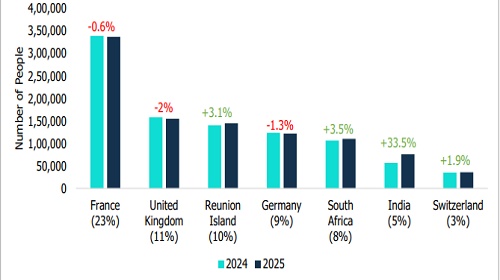
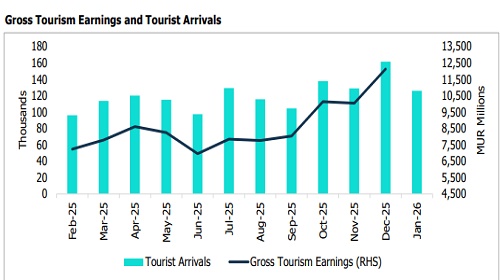
Mauritius’ tourism sector began the year with a strong performance, continuing the positive momentum seen throughout 2025. In January 2026, tourist arrivals rose by 8% YoY to 125,871. The growth was driven by better air connectivity, especially additional capacity from Emirates Airlines, along with ongoing promotional activities by the Mauritius Tourism Promotion Authority (MTPA). Tourist arrivals in 2025 remain largely concentrated from Europe, with France (23%) and the United Kingdom (11%) experiencing slight YoY declines of 0.6% and 2.0%, respectively, compared to 2024. Germany (9%) also decreased marginally by 1.3%. Meanwhile, India (5%) saw a significant 33.5 YoY increase in 2025 to 75,808 visitors, underscoring ongoing diversification of source markets and increasing traction in Asia, even as Europe continues to underpin Mauritius’ tourism base.
Tourism earnings also remained strong. Gross receipts stood at MUR 12.1 billion in December 2025, 18% higher than in December 2024. For 2025 as a whole, cumulative gross tourism earnings reached MUR 103 billion, representing a 10.4% YoY increase. Looking ahead, the outlook has become more uncertain amid escalating geopolitical tensions in the Middle East. Recent airspace disruptions have caused Emirates to temporarily suspend some operations to and from Dubai, a key transit hub for Mauritius’s long-haul markets. If these disruptions continue, the sector may face weaker forward bookings, reduced connectivity, and slower growth in tourist arrivals. Although the scale and duration of the impact remain uncertain, increased geopolitical instability presents emerging downside risks to tourism activity in the coming months ahead.
External Shocks Cloud Moderate Economic Expansion
The Bank of Mauritius (BoM) estimates real GDP growth at 3.1% in 2025 from 4.9% in 2024. GDP growth is projected to increase to 3.3% in 2026. In an upside scenario, the BoM expects growth to reach 3.5% should the planned capital projects accelerate more decisively. In addition, the potential renewal of the African Growth and Opportunity Act (AGOA) could further support export performance and provide a modest boost to overall economic activity. This uplift is not currently factored into the upside scenario. While earlier global growth expectations were seen as supportive for key sectors, such as tourism, recent geopolitical developments have shifted the outlook. The balance of risks remains tilted to the downside. Increased instability in the Middle East and related travel disruptions could impact tourism and external demand, thereby slowing growth momentum. Overall, Mauritius’ growth prospects will remain vulnerable to external factors shocks
Disinflation Underway but External Risks Loom
Headline inflation moderated to 3.9% YoY in January 2026, down from 4.5% in December 2025, signalling a renewed easing in price pressures. The moderation was largely driven by a slowdown in inflation within “insurance and financial services”, where its inflation rate eased to 6.8% YoY, after being a key contributor throughout 2025. Additional disinflationary pressure came from furnishings, “household equipment and routine household maintenance” (-3.4%) and “restaurants and accommodation” (-2.0%), indicating some softening in both imported goods and services-related components. Core inflation also decelerated markedly, dropping to 5.6% in January from 7.2% in December. The sharp correction suggests that underlying inflationary pressures, particularly from services and wage-related components, have begun to ease, narrowing the gap between headline and core inflation. The BoM forecasts headline inflation to average around 3.6% in 2026 from 3.7% in 2025, assuming no major economic or weather-related shocks. While seasonal increases in domestic vegetable prices may occur in H1 2026, the BoM expects these to remain temporary.
However, this baseline scenario is challenged by the recent escalating geopolitical tensions and rising global uncertainty. A further intensification of conflict, particularly in energy-producing regions, could trigger higher oil prices, increased shipping and insurance costs, and renewed supply chain disruptions. For Mauritius, as a highly import-dependent economy, such developments would likely feed into higher imported inflation and potentially exert pressure on the exchange rate
Trade Deficit Narrows in December 2025 In December 2025,
Mauritius recorded a narrower merchandise trade deficit of MUR 20.2 billion, compared to MUR 22.0 billion in December 2024. This improvement reflects a 5.5% YoY increase in exports alongside a 4.1% contraction in imports. Export growth was primarily driven by a 32% YoY rise in ships’ stores and bunkers1 supported by the peak tourism and travel season and stronger maritime activity, which boosted jet fuel and marine fuel supplies for foreign aircraft and vessels. On the import side, the overall decline was largely attributed to lower purchases of total manufacturing goods2 (- 10.5%), food and live animals (-11.3%), and machinery and transport equipment (-9.2%). However, this moderation was partly offset by a 22% increase in imports of mineral fuels, lubricants, and related materials, pointing to elevated energy import demand during the period.
Overall, for 2025, Mauritius’ cumulative trade position slightly deteriorated, with the merchandise trade deficit widening to MUR 211.3 billion from MUR 207.8 billion in 2024. Export earnings for the year declined by 2.1% to MUR 107.7 billion. The contraction was mainly caused by weaker performance in manufactured goods, primarily due to decreases in classified categories such as material (-8.5%), food and live animals (-7.4%), and miscellaneous manufactured articles (-7.1%). These declines were partly offset by stronger exports from ships’ stores and bunkers, which rose by 10.1% over the year. On the import side, total purchases rose marginally by 0.4% to MUR 319.0 billion. The uptick was due to higher imports of food and live animals (+6.2%), miscellaneous manufactured articles (+1.2%), and mineral fuels, lubricants and related products (+0.9%). This was partly offset by reduced imports of manufactured goods classified chiefly by material (-6.8%), chemicals and related products (-2.9%), and machinery and transport equipment (-0.1%).
The government projects Mauritius’ trade position to remain broadly stable in 2026. Total exports are forecast to increase modestly to around MUR 110 billion, representing a 1.9% increase. Imports are expected to edge up marginally by 0.3% to about MUR 320 billion. As a result, the merchandise trade deficit is projected to narrow slightly to around MUR 210 billion in 2026, from about MUR 211 billion in 2025, reflecting moderate export growth alongside largely contained import growth. However, the outlook is subject to downside risks. Heightened geopolitical tensions and potential trade disruptions could push energy prices higher and widen the import bill. Export performance will depend on demand conditions in key partner markets, particularly in Europe and the United States (US). Nonetheless, the renewal of AGOA until December 2026 should support textile exports to the US market throughout the year. Overall, the external position remains vulnerable to commodity price volatility, trade policy shifts, and broader global uncertainty.
Reserves Position Remains
Resilient Mauritius’ gross official international reserves decreased slightly to MUR 465.7 billion (USD 10.2 billion) in January 2026, from MUR 478.3 billion (USD 10.3 billion) in December 2025. As a result, import cover eased moderately to 13.9 months in January, from 14.3 months in December. Despite the moderation, reserve buffers remain strong. In February 2026, the Mauritian Rupee (MUR) averaged 46.8 against the US Dollar (USD), unchanged from January. Over the past six months (September to February), the MUR depreciated by about 1% against the dollar, reflecting a generally firm USD earlier in the period. However, looking at a shorter horizon (December to February), the MUR appreciated by 0.7%. The narrowing US-Mauritius interest rate differentials have driven the recent appreciation. Late-2025 rate cuts in the US pushed the US fed funds rate below Mauritius's key rate, enhancing the currency’s relative attractiveness and supporting capital inflows. Looking ahead, the MUR remains exposed to external developments. Escalating geopolitical tensions would translate into risk-off sentiment in financial markets as investors flock to safe-haven assets such as the Dollar and keep emerging market currencies, such as the MUR, on the back foot, thereby reversing recent gains.
Above views are of the author and not of the website kindly read disclaimer