Indian REITs continues to remain resilient, backed by long-term leases, stable rental income and diversified tenants: CareEdge Ratings
According to CareEdge Ratings, Indian REITs have remained resilient despite the ongoing geopolitical crisis, supported by long-term lease contracts, contracted rental income and a diversified tenant portfolio.
As of May 2026, the six listed REITs have a combined GAV of ~Rs 3.13 lakh crore and a market capitalisation of more than Rs 2.00 lakh crore. Combined debt level increased to Rs 68,000 crore, largely for portfolio acquisitions and expansions. However, rental income growth of nearly 20% CAGR kept leverage under control with Net Debt/EBITDA below 4.8 times and Net Debt/GAV below 30%.
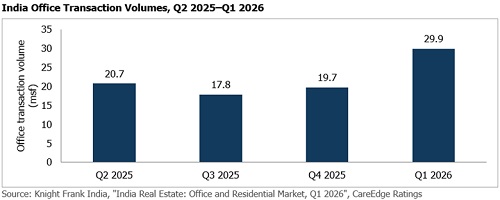
CareEdge Ratings highlights that office leasing remained strong despite the impact of the ongoing geopolitical crisis, with transactions reaching a record 29.9 million sq. ft. in Q1 2026, up 6% year-on-year. Grade A buildings accounted for majority of the deals. As GCCs were the main growth driver, contributing 48% of total transactions, up from 44% a year earlier, with Bengaluru recording the highest volume.
It notes that flex space operators added further momentum in office leasing, with India’s flex stock at ~100 million sq. ft. in 2026. Despite recent rent gains, Indian offices remain far cheaper than global hubs, keeping India attractive for occupiers.
Rajashree Murkute, Senior Director, CareEdge Ratings said, “While the geopolitical situation in West Asia remains a key monitorable, the near-term impact on the Indian real estate sector is expected to remain limited. Healthy demand, and stable leasing activity across commercial real estate should support the sector's overall performance. As demand continued to outpace supply, vacancy declined over the period while rent escalation supported healthy rental income in the sector. Moving ahead the continued GCC expansion and India’s growing role in global supply chains are expected to support a positive medium-term outlook despite ongoing global uncertainty.”
CareEdge Ratings highlights that occupancy trends across India's listed office REITs exceeded 90%. Despite heightened geopolitical tensions and a spike in crude oil prices, occupancy levels have remained broadly stable, indicating that demand for Grade A office space has been largely unfazed.
Average occupancy across India’s listed office REITs climbed steadily from ~ 84% in FY24 to 89% in FY25, to about 92% in FY26.
It notes that between FY25 and FY26, rental income across the listed office REITs increased by an average of around 20%, with each REIT reporting stronger growth than in the previous year. The improvement was driven by contractual rental escalations, lease renewals at higher-than-prevailing market rates, and healthy leasing activity, reflecting sustained demand for Grade A office assets. At the same time, balance sheets remained healthy, with net debt/GAV at less than 30% and net debt/PBILDT below 4.8 times, lowest since FY20, supported by healthy rental income and improved occupancy over the period.
Divyesh Shah, Director, CareEdge Ratings said, “While ongoing geopolitical uncertainty may temporarily delay leasing decisions among multinational occupiers, it is unlikely to materially affect occupancy levels at India's listed office REITs. The sector remains supported by long-term lease contracts with healthy Weighted Average Lease Expiry (WALE), diversified tenant portfolios, and sustained demand from GCCs, providing strong visibility into rental cash flows and limiting the impact of short-term disruptions. Consequently, occupancy is expected to remain above 90% in FY27, supported by stable rental income, healthy leasing momentum, and the contractual nature of lease agreements despite the uncertain geopolitical environment.”
CareEdge Ratings notes that India’s REIT sector has substantial room to grow, with over 150 msf of office space expected to become REIT-eligible by CY2031. This could increase the sector’s asset value from approximately $33 billion to more than $50 billion. Growth is likely to be supported by robust office demand, improved access to funding, and continued asset additions, while stable cash flows and prudent leverage strengthen the sector’s credit profile.
Above views are of the author and not of the website kindly read disclaimer












More News

Capital Small Finance Bank Appoints Banking Veteran Conrad D?Souza as Independent Director