India's Textile Sector Poised for Global Scale-Up as Trade Tailwinds and Supply-Chain Diversification Create New Opportunities: PL Capital

India accounts for only ~4% of global textile and apparel exports, while FTAs, China+1 sourcing and investments in scale, technology and vertical integration could strengthen its competitive position
PL Capital’s research team, in its latest report on the Indian textile sector, highlights a significant opportunity for India to expand its presence in the global textile and apparel market, supported by favorable trade-policy developments, supply-chain diversification and the growing preference of global brands for scaled, resilient and traceable manufacturing partners.
The global apparel market stood at approximately US$1.9 trillion in 2025 and is expected to grow at a 4.1% CAGR between 2026 and 2034. Against this backdrop, India’s textile and apparel exports stood at around US$37 billion in FY26, yet the country accounted for only ~4% of global textile and apparel exports in CY25. India’s apparel export share was approximately 3% in 2025, compared with 27.3% for China, 6.8% for Bangladesh and 6.5% for Vietnam, highlighting the headroom for India to increase its participation in global sourcing.
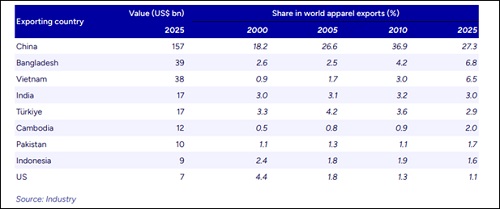
The report notes that the ongoing China+1 strategy is reshaping the global apparel sourcing landscape. China’s share of global apparel exports has declined from 36.9% in 2010 to 27.3% in 2025, while Bangladesh and Vietnam have emerged as major beneficiaries. India’s share, however, has remained broadly stable. PL Capital believes the evolving global sourcing environment, together with changing tariff structures, could provide Indian manufacturers with an opportunity to strengthen their position, provided they address existing gaps in scale, technology, infrastructure and supply-chain efficiency.
Trade agreements strengthen India’s competitive positioning
Three significant trade-policy developments in 2026 have improved the competitive landscape for Indian exporters. The US reciprocal tariff was reduced from a 50% peak to 10% in February 2026, while the India-UK CETA came into force in July 2026, providing approximately 99% tariff-line duty-free access. India-EU FTA negotiations have also concluded and are pending ratification. Alongside the PLI scheme for MMF and technical textiles and the PM MITRA programme, these developments could help address some of the structural disadvantages faced by Indian exporters.
However, PL Capital believes market access alone will not be sufficient. Global buyers are increasingly prioritising scale, resilience, traceability, speed to market and consistent quality. The report highlights that international retailers are consolidating their supplier base, creating an environment where larger, vertically integrated manufacturers could have an advantage over smaller and fragmented players.
Moving beyond cotton-led exports
Another structural opportunity lies in India's gradual shift toward synthetic and man-made fibre-based apparel. Synthetic garments accounted for around 32% of India's garment exports in 2025, with exports growing at a 9% CAGR between FY20 and FY25. PL Capital believes the country's historically lower exposure to MMF compared with global demand patterns provides room for Indian manufacturers to expand into synthetic and technical-textile segments.
The report also highlights the need for continued investment in manufacturing technology, logistics and integrated production ecosystems. India currently has only one operational PM MITRA park out of seven as of mid-2026, while Indian shipments to Europe and the US can take longer than those from Southeast Asia. Improving infrastructure, shortening lead times and increasing automation will therefore remain important for enhancing India's global competitiveness.
Amnish Aggarwal, Co-Head of Institutional Research, PL Capital, said:
"India's textile industry is entering an important phase of opportunity as global apparel sourcing continues to diversify and India's trade access improves. The opportunity is significant, but capturing it will require more than favourable tariffs. Scale, vertical integration, technology adoption, speed to market and traceability will increasingly determine which manufacturers can build durable relationships with global brands. We believe the next phase of growth for Indian textiles will be driven by companies that can combine manufacturing scale with operational efficiency and a broader product mix, particularly in man-made fibre and higher-value apparel."
The report identifies capacity expansion, vertical integration, greater adoption of MMF and technical textiles, technology upgrades and supply-chain diversification as key levers for the sector. With global brands reassessing sourcing strategies and India gaining improved access to major markets, PL Capital sees the potential for Indian apparel manufacturers to strengthen their role in the global textile and apparel value chain, subject to successful execution and continued investment in competitiveness.
Above views are of the author and not of the website kindly read disclaimer