India`s Growth Momentum Holds Firm as FPI Flows Return and Monsoon Recovers: PL Wealth

Elevated crude prices, geopolitical tensions and global rate uncertainty keep markets selective, favouring quality and staggered equity deployment
Mumbai, 27th August 2026: PL Wealth’s latest Market Outlook – August 2026 report finds that India’s domestic growth momentum remains resilient, supported by the return of foreign portfolio investors (FPIs) as net buyers, improving monsoon conditions and a broadly steady start to the Q1FY27 earnings season. However, elevated crude prices, persistent geopolitical risks and uncertainty around global interest rates are likely to keep markets selective in the near term, reinforcing the case for a staggered, quality-focused approach to equities.
India’s provisional FY26 GDP growth stands at 7.7%, while the RBI projects FY27 growth at 6.7%. July manufacturing and services activity remained in expansion territory, with PMI readings of 53.9 and 53.1 respectively. Bank credit growth strengthened to 18.6% YoY, taking outstanding credit to ?219.3 trillion as of June 2026, while capacity utilisation remained healthy at 75.2%, above its long-term average.
The report notes that inflation remains a key watch point. July CPI rose to 4.45%, above the RBI’s 4% target, driven primarily by higher food inflation, while the RBI has retained its FY27 CPI projection at 5.1%, with a potential Q3 peak of 5.9%. Brent crude rebounded sharply to around US$92 per barrel by End-July amid renewed tensions around the Strait of Hormuz. The rupee also remained structurally weak at around ?95.4 to the US dollar, keeping inflation and external risks firmly in focus.
Foreign investor flows, however, provided a positive signal. After sustained equity outflows through the first half of the year, FPIs turned net buyers in July, recording equity inflows of around ?20,200 crores — the first positive month since February. The report also highlights a strong recovery in monsoon conditions, with July rainfall around 1% above normal, narrowing the cumulative June-July deficit to approximately 13% below the long-period average. The IMD has forecast August rainfall at 97% of LPA.
Speaking on the findings, Inderbir Jolly, CEO, PL Wealth, said:
“India enters the second half of the year with several encouraging signals — foreign investors have returned as buyers, the monsoon has recovered and the domestic growth and earnings backdrop remains resilient. At the same time, elevated crude prices, geopolitical developments and an uncertain global rate environment mean that markets are unlikely to move in a broad-based manner. We believe this is a phase for investors to remain selective, focus on quality and deploy capital in a staggered manner. Our long-term conviction in India remains intact, supported by domestic investment, financial deepening, demographics and the country’s structural growth opportunity.”
Macro Environment
India’s macroeconomic backdrop remains relatively resilient despite external pressures. GST collections for June 2026 rose 15.4% YoY to ?2.11 lakh crore, recording the fastest growth in 14 months, supported by strong domestic collections and imports. Cumulative GST collections for April-July FY27 stood at ?8.43 lakh crore, up 10.1% YoY. India’s foreign exchange reserves remained comfortable at around US$667 billion, equivalent to approximately 10.5 months of import cover.
The monsoon has also emerged as a constructive development after a weak start to the season. June rainfall was around 40% below normal, but July rainfall recovered strongly to approximately 1% above normal. While the cumulative deficit remains around 13% below LPA, the improvement reduces some of the earlier concerns around food inflation and rural demand.
On the external front, trade developments remain an important medium-term support. The EU FTA has been concluded and is awaiting ratification, while the UK CETA and EFTA TEPA are effective. The New Zealand FTA has been signed, while the Oman CEPA awaits implementation. At the same time, negotiations on the India-US bilateral trade agreement remain ongoing, with a 10% Section 301 tariff currently in place.
Market Valuation & Positioning
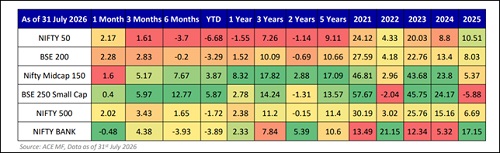
The domestic equity market staged a recovery in July after the weakness seen in June. The Nifty 50 gained 2.17% during the month to close at 24,384 as of July 31, 2026, while market breadth improved. Midcaps and smallcaps gained 1.6% and 0.4% respectively during the month, although both continued to outperform the Nifty over longer three- and six-month periods. Sector leadership remained selective, with IT, consumer durables and realty among the stronger-performing segments.
Q1FY27 earnings have started on a relatively firm footing, with Nifty 50 PAT growth at approximately 12% YoY mid-season and BSE 500 PAT growth at around 21% YoY. The report expects improving demand commentary to moderate the pace of earnings downgrades, while FY28 estimates remain largely intact.
PL Wealth maintains a selective approach to equities across investment horizons. Over the short term, it recommends staggered deployment into quality large-cap and large & mid-cap stocks, given elevated crude prices and global rate uncertainty. Over the medium term, improving domestic growth conditions could support greater exposure to large private banks, capital goods and consumer durables, alongside selective exposure to quality small-cap, flexi-cap and multi-cap strategies. Over the long term, the structural case for India remains intact, supported by demographics, domestic capital expenditure, financial deepening, defence indigenisation and energy security.
Equity Markets – An Overview and Approach
Short Term (0 to 6 months): PL Wealth remains selectively constructive, with FPIs returning as buyers and the Nifty recovering in July. However, crude at around US$92 per barrel and continued global rate uncertainty could limit near-term upside. The report favours staggered deployment into quality large-cap and large & mid-cap names.
Medium Term (6 to 24 months): With the monsoon deficit narrowing and domestic credit growth at 18.6% YoY, the focus can gradually shift towards domestic growth drivers. Large private banks, capital goods and consumer durables are among the preferred areas, alongside selective quality small-cap, flexi-cap and multi-cap exposure.
Long Term (24 to 60 months): PL Wealth retains its overweight view on India, supported by demographics, domestic capex, financial deepening, defence indigenisation and energy security. For long-term investors, the report favours SIP-led investing with a bias towards quality large-caps, compounding franchises, mid- and small-caps and infrastructure-linked themes.
Fixed Income Outlook
On fixed income, the report describes the outlook as one of cautious stability. The RBI has retained the repo rate at 5.25% with a neutral stance, while July CPI rose to 4.45%. The 10-year government bond yield eased to around 6.69% in July before moving back towards 6.73% by month-end as crude prices recovered and geopolitical risks resurfaced. FPI debt flows remained supportive, with CYTD inflows of approximately ?93,000 crores.
PL Wealth favours the short end of the curve, particularly the 3-month to 3-year segment, where surplus system liquidity and attractive accrual provide favourable risk-adjusted returns. The 5–8 year segment remains a tactical opportunity for investors seeking to lock in real rates ahead of potential easing in H2FY27. The long end, however, remains vulnerable to crude volatility and global rate movements, and the report recommends adding duration selectively on yield spikes rather than maintaining an outright overweight position.
The overall fixed-income strategy remains focused on maintaining an overweight position in the short end and a tactical allocation to the belly of the curve, while maintaining strict credit discipline and favouring AAA and sovereign exposure.
Outlook for Commodities
Gold recovered during July, moving back above US$4,100 per ounce by month-end after falling sharply in June. PL Wealth expects gold to remain range-bound in the near term, with a projected range of US$3,900–4,400 per ounce. Continued central-bank buying is expected to provide a structural floor, while expectations around US monetary policy and geopolitical developments could drive short-term volatility.
Silver remained range-bound around US$58–59 per ounce at the end of July after a sharp correction from its January peak. While the physical market deficit and green-technology demand remain supportive, the report notes that a sustained recovery would require a revival in ETF flows. A breakout towards US$65–70 per ounce could emerge if investment demand strengthens.
Above views are of the author and not of the website kindly read disclaimer