India commits over 7 million euros to Elettra 2.0 project in Italy: Dr Jitendra Singh
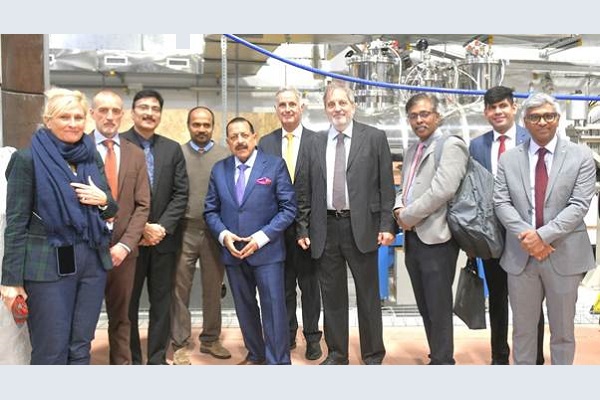
Union Minister of State, Science & Technology and Earth Sciences, Dr. Jitendra Singh, said that India has committed over 7 million euros as a co-partner in the Elettra 2.0 programme in Italy for development of next-generation synchrotron beamlines, it was announced on Saturday.
India has reaffirmed its commitment to advanced international scientific collaboration through its investment plan to be made over the next five years beginning 2026-27, an official statement said.
The minister made the announcement during his visit to Elettra Sincrotrone Trieste on November 13. India's participation will support the development of research infrastructure and human resource capacity, marking a significant new phase in the longstanding scientific partnership between India and Italy, the statement from the Ministry of Science & Technology said.
The upgraded facilities will open new avenues for research in chemistry, physics, advanced materials, structural biology and other scientific areas, benefiting researchers worldwide.
India is currently the second-largest user of Elettra after Italy, reflecting the sustained engagement of its scientific community with the facility.
“India's participation in Elettra 2.0 builds on more than 25 years of scientific collaboration between Indian research groups and the Italian facility. Indian scientists have been conducting research experiments at Elettra since 1998 and continue to utilise its facilities,” the statement noted.
Over 1,100 experimental proposals were received by Elettra from Indian research groups. India ranks second in the number of proposals submitted, after Italy, which submitted 54,140 proposals, and ahead of France, with 1,098 proposals.
Under the Elettra 2.0 programme, the existing India-centric XRD2 and Xpress beamlines will be decommissioned and replaced by two new beamlines with enhanced capabilities.
The Department of Science and Technology (DST) had jointly supported the construction of the two existing sophisticated diffraction beamlines, XRD2 and XPRESS, with a contribution of approximately Rs 22 crore, alongside the Italian side.
Since their commissioning, these beamlines have been effectively utilised by Indian researchers, with approximately 50-60 Indian scientists visiting Trieste every year to conduct research experiments at the facility.
The EPOC 2025-2027 also includes a proposal to support Indian researchers in conducting experiments at the facility, with a proposed allocation of Rs. 1.5 crore over three years.
DST had already conveyed its agreement to participate in the redevelopment of the India-centric beamlines under Elettra 2.0, and a Letter of Intent (LoI) had been signed in this regard.


.jpg)