Gadget Trends That Will Shape 2026 and Beyond
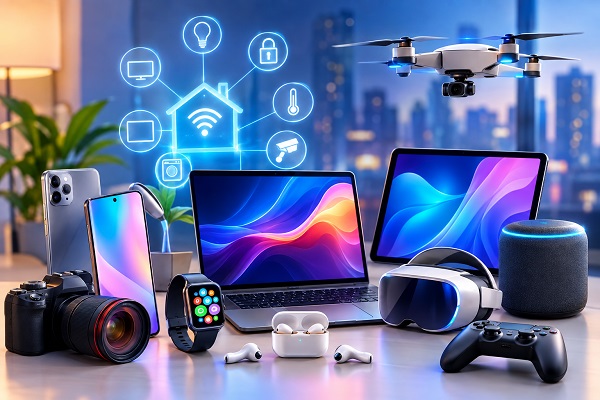
Technology is evolving faster than ever, and gadgets are becoming smarter, more connected, and more personalised. From AI-powered devices to advanced wearables and smart home technology, the gadgets of 2026 are moving beyond basic convenience.
Here are some of the major gadget trends that could shape the technology landscape in 2026 and beyond.
1. AI-Powered Gadgets
Artificial intelligence is becoming a major part of everyday technology. Smartphones, laptops, earbuds, cameras, and smart home devices are increasingly using AI to provide personalised features.
Instead of simply responding to commands, future gadgets are expected to understand user preferences, automate routine tasks, and provide more intelligent assistance.
2. Smarter Smartphones
Smartphones are evolving beyond improvements in cameras and processors. AI-powered features, better battery management, improved displays, enhanced security, and on-device processing are becoming increasingly important.
Future smartphones are likely to focus more on personalised experiences and seamless integration with other devices.
3. AI PCs and Laptops
Laptops are also becoming more intelligent with dedicated hardware designed to handle AI tasks. AI-enabled PCs can assist with productivity, content creation, communication, and other everyday activities.
As AI software becomes more capable, these features could become a standard part of mainstream laptops.
4. Wearable Technology
Smartwatches, fitness bands, smart rings, and other wearable devices continue to become more sophisticated.
Future wearables are expected to focus on activity tracking, personalised insights, communication, payments, and seamless connectivity while becoming smaller and more comfortable to wear.
5. Smart Rings
Smart rings are gaining attention as a compact alternative to larger wearable devices. They can offer features such as activity tracking, sleep monitoring, and other personalised insights.
Their small size makes them attractive to users who want smart features without wearing a traditional smartwatch.
6. Smarter Home Devices
Smart home technology is becoming more integrated. Smart lights, security cameras, speakers, thermostats, appliances, and entertainment systems can increasingly communicate with one another.
The future of smart homes will likely focus on automation, allowing multiple devices to work together instead of being controlled individually.
7. More Powerful Wireless Connectivity
Faster and more reliable wireless connectivity will continue to influence gadget development. Improved networks can enable smoother streaming, cloud services, gaming, connected devices, and real-time communication.
As connectivity improves, gadgets can become more dependent on seamless communication between devices and services.
8. Foldable and Flexible Displays
Foldable smartphones have already introduced a new category of device design. As display technology improves, manufacturers may continue experimenting with foldable, flexible, and rollable screens.
These designs could allow larger displays without requiring significantly larger devices.
9. Better Battery Technology
Battery life remains one of the biggest concerns for gadget users. Future improvements could focus on faster charging, better energy efficiency, and longer-lasting batteries.
More efficient processors and smarter power management may also help devices deliver longer usage without significantly increasing battery size.
10. Advanced Audio Devices
Wireless earbuds and headphones are becoming more than simple music accessories. Features such as adaptive noise cancellation, improved microphones, spatial audio, and AI-powered voice processing are making audio devices increasingly versatile.
Future earbuds could also become more closely integrated with smartphones, computers, and other wearable devices.
11. More Accessible Smart Home Security
Home security gadgets are becoming increasingly accessible to everyday consumers. Smart cameras, video doorbells, sensors, and connected locks can provide users with more control over their homes.
AI-powered detection may also help these devices distinguish between relevant events and ordinary activity.
12. AR and Mixed Reality Devices
Augmented reality and mixed reality could become more practical as hardware becomes lighter and software improves.
Instead of being limited to entertainment, these devices could eventually be used for education, professional training, navigation, communication, design, and productivity.
13. Personalised Technology
The future of gadgets is likely to become increasingly personalised. Devices may learn how users interact with them and automatically adjust settings, recommendations, notifications, and other features.
This could make technology feel more intuitive and reduce the amount of manual configuration required.
14. Sustainable Gadgets
Environmental concerns are also influencing gadget development. Manufacturers are increasingly focusing on energy efficiency, recyclable materials, longer product lifecycles, and more responsible manufacturing.
Consumers may also pay greater attention to repairability, durability, and software support when purchasing new devices.
15. More Connected Ecosystems
Instead of buying completely independent gadgets, consumers are increasingly building connected technology ecosystems.
Smartphones, watches, earbuds, laptops, televisions, cars, and home devices can work together to provide a more seamless experience.
This interconnected approach is likely to become an even bigger part of consumer technology in the coming years.
16. AI-Enhanced Cameras
Smartphone and standalone cameras are expected to benefit significantly from AI. Features such as intelligent image processing, automatic editing, object recognition, and improved low-light photography can make advanced photography easier for everyday users.
The focus may increasingly shift from hardware specifications to the overall quality of the computational photography experience.
17. Smarter Personal Assistants
AI assistants are becoming more capable of understanding natural language and completing multi-step tasks.
Future gadgets could allow users to interact with technology more naturally through voice, text, images, and other forms of input.
18. Gaming Technology
Gaming gadgets are also evolving rapidly. Portable gaming devices, high-refresh-rate displays, advanced controllers, immersive audio, and cloud gaming services are creating more ways to play.
The boundaries between traditional consoles, PCs, smartphones, and handheld gaming devices could continue to become less distinct.
19. Health and Wellness Technology
Wearables and connected devices are increasingly being used to provide users with information about activity, sleep, exercise, and general wellness.
As sensors and software improve, these devices could provide increasingly personalised insights while users remain responsible for interpreting such information appropriately.
20. The Rise of More Personal Technology
The biggest gadget trend may ultimately be the move toward technology that works around the user rather than forcing the user to adapt to it.
Devices are becoming more connected, intelligent, portable, and personalised. In the coming years, gadgets may increasingly work together in the background to simplify everyday tasks.
Final Thoughts
The gadget industry is moving toward a future defined by **AI, connectivity, personalisation, wearable technology, smarter homes, better batteries, and more immersive experiences**.
Not every emerging technology will become mainstream, but the overall direction is clear: future gadgets are likely to become more intelligent while requiring less effort from users.
For consumers, the most important thing will be to look beyond flashy specifications and choose devices that offer useful features, reliable performance, good software support, and genuine value.