Economics : Cultivation income in rural India seeing a collapse by Elara Capital
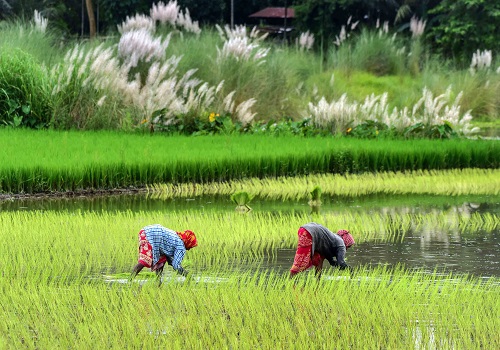
Our pan-India rural checks confirm unseasonal rains led crop damages and depressed Kharif crop prices are shrinking cultivation income and dampening sentiments. Our proprietary model for income realization for paddy farmers across Top 3 paddy-growing States – West Bengal, Uttar Pradesh & Chhattisgarh- suggests net cultivation income fell ~10% in FY26 - the weakest since COVID-19. While cash transfer schemes at the State level along with free power schemes are continuing and real rural wages are holding up, widespread crops losses and unprecedented collapse in prices does not bode well for sustaining strong rural demand. We are closely watching sustenance of two-wheeler sales in December 2025 amid weakening cultivation income. Vahan registration data for two-wheeler sales is contracting 1.8% YoY to date in December vs growth of 19% YoY during September-November. Currently, we prefer playing the rural theme via gold financiers and tractors (owing to structural demand drivers) and prefer fertilizer companies over agrochemicals.
Food price collapse drags farmer cultivation income: During the CY25 Kharif season (harvested primarily during October-November), farmers faced significant challenges with price realization dropping well below minimum support prices (MSP) for most crops. This decline was driven by excess Monsoon, causing crop damage, bunched-up arrivals amid delayed harvest, quality issues, and limited government intervention to support prices. Duty-free imports for key crops, such as cotton, tur and urad, reduction in basic customs duty on crude palm, soy, and sunflower oils from 20% to 10% are acting as an incremental drag on mandi prices. Prices across mandis (wholesale markets) are also lower for crops, such as maize (corn) and soyabean in anticipation of imports from the US under the India-US trade deal. Data of mandi prices suggests prices of black gram, cotton, soyabean and maize were 19%, 8%, 18%, and 27% below their MSP, respectively, as of November 2025. This is the worst deflation in food crops in recent years. Our pan-India rural checks suggest yield of paddy crops has taken a hit in the range of 6-8% this year. This amid depressed mandi prices suggests realization contracted by 8-10% this Kharif crop.
Unprecedented deflation in food prices this year: The current deflationary cycle of food prices in India is unprecedented in its magnitude. The WPI primary food prices have been declining for the past six months and have declined by ~4% FY26 YTD on YoY basis. The only previous episode where prices were in a deflationary spiral was during July-December 2018, however the magnitude was lower at an average: -1.9%. Incidentally, two-wheeler sales contracted continually between December 2018 until February 2020 post which covid-19 dynamics dominated the demand sentiment. Analysis of long-term data of wholesale food prices shows during episodes of positive percentage YoY WPI food and negative percentage YoY WPI food, spread between two-wheeler sales is higher by 120bps and that for tractor sales is 700bp.
Central Government’s rural spending in the slow lane: The Central government’s rural spending has been in the slow lane lately with execution of key rural schemes witnessing moderation. During April-October, the government spent 45% of rural development Budget vs 52% during the same time last year. Separately, approvals of key schemes, such as the PM Awas Yojana (Grameen) and the Har Ghar Jal, have failed to pick up pace after a decent start. Until October 2025, the government had spent a mere 2% of the budgetary allocation under the Department of Drinking Water & Sanitation, which runs the Har Ghar Jal scheme. Likewise, sanctions under the PM Awas Yojana (Grameen) until mid-November 2025 were a mere 2.0mn units vs 6.8mn in FY25. Amid moderating tax revenue and lower nominal GDP growth vs budgeted, we do not expect rural spending to pick up pace materially hereafter.
Specifically, spending in six departments of government (wherein expenditure eventually flows into the rural economy) – Agriculture & Farmers Welfare, Chemicals & Fertilizers, Consumer Affairs & Public Distribution, Panchayati Raj, Rural Development and Tribal Affairs – has eased to 2.4% in October 2025 vs 16.6% in October 2024.
Please refer disclaimer at Report
SEBI Registration number is INH000000933