2026-01-14 12:20:14 pm | Source: SBI Capital Markets
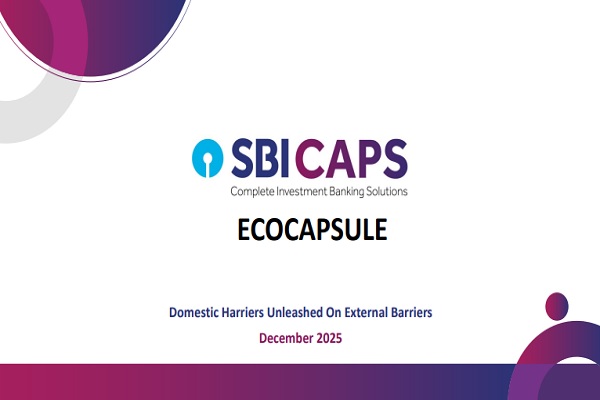
EcoCapsule Jan'26 : (Y)earning For A Less Volatile Year - Hopes For 2026 by SBI Capital Markets
Executive Summary
Much ado about nothing? Global growth was resilient albeit low, even as tariffs turned from threat to truth
The aftermath of the announcement of tariffs by the US was the expectation of a collapse in global trade. These shockwaves led to sharp downward revisions to global growth estimates by mid-CY25. However, in a matter of months, expectations were corrected, and a 3.2% y/y real output growth is projected for CY25 – temperate but tolerable. Fair growth in US, China, and India offset weakness in select countries in Europe. Backing this change was the understanding that tariffs are as much to be seen as bargaining chips for trade deals as modes of revenue. This led to many countries chalking out agreements with the US and has meant that the trade balance of major countries is yet to go off-kilter. CY26 will remain volatile as may be exemplified by actions in Venezuela in the first week itself, though uncertainty is off highs seen in the past few years.
Policy paradox: easing inflation concerns effected lower rates even as long-term yields remained indifferent
Benign crude prices and base effects effected a downward drift in inflation. This helped global Central Banks cut rates even though inflation remained above target in most cases. Curiously, while the short-term rates have responded to the call of the Central Banks, long-term yields remain inertial. This paradox may be explained by a combination of factors. First, markets do not perceive inflationary threats to be behind us – and a sudden pivot to a hike cycle remains possible. Second, and more grimly, the increasing debt/GDP of countries in the post-pandemic era is resetting expectations of default risk for sovereigns. Finally, long-term bond investors are gradually diversifying their portfolios as there is a growing realisation that the days of base zero (ultra low policy rates in the aftermath of the GFC) are gone.
Domestic deliverance: storm of local activity backed by Government initiatives needs some gusts of private capex next year
India is set to deliver stunning real growth in FY26 (FAE: 7.4% y/y) fired by the twin cylinders – consumption and capex. A set of tax reforms during the year redoubled consumption intensity which was on a high helped by monsoon-driven rural prosperity. Government capex is up 28% y/y in 8MFY26 with traction being seen in Roads and Railways, even as revex remained in check. Union and State capex have been the drivers of growth for some fiscals now, and both are faced with fiscal constraints in FY27 as tax collections shrink for the former, and the latter no longer has access to GST compensation cess. Thus, in FY27, even as the Governments bear a chunk of the developmental capex, it would be welcome if private players, with their light and shiny balance sheets, pick up the onus of capex, especially in the new age sectors.
Goldilocks vs. Global Shocks: RBI chooses to cut rates as prices seek the nadir
With inflation tending below the lower band of RBI’s tolerance zone, a surprise rate cut in Dec’25 capped off an year which saw a deep dip in the repo rate. The bulk of the work in lowering inflation came from sinking food prices, with their outlook for CY26 also remaining benign owing to bountiful sowing in the current year, subject to possible supply-shocks in vegetable and fruit prices due to short-term weather disturbances. Energy prices also remained unenergetic on global cues. Core prices remained above trends, though it is important to note that much of this comes from precious metals, as gold glittered and silver sparkled during the year due to a global flight to safety away from the USD. The broader outlook for inflation in CY26 will also be subject to the change in the CPI base, though it is not expected to exert any upward pressure.
A fluid situation: turbulent liquidity and laminar policy balanced by fiscal fizz keeps yields stagnant
Despite the RBI plunging its repo rate by 125bps in CY25, mirroring global trends, the year saw only ~17bps drop in 10Y benchmark Union G-sec yield. This has led to a steepening of the curve as short term rates have tugged southwards. This means that the Central Bank has diversified its toolkit and made liquidity as a tool front and centre. Net OMO purchases of close to Rs. 6.5 trn in CY25 are amongst the highest on record. Fx swaps were also carried out to infuse liquidity. Amidst generous credit growth, the RBI remains fully focussed in providing enough liquidity for effective transmission. In this endeavour it has met with success as the WALR (fresh) dipped 54 bps between Dec’23 and Nov’25, with WADTDR (fresh) seeing almost complete transmission. The RBI will continue to use these policy tools in CY26.
External flows or external blows? Currents felt in the currency market as INR sees sharp depreciation
CY25 saw total FPI outflows of USD 11.8 bn as FAR debt inflows of USD 6.5 bn were unable to compensate for heavy equity outflows. This was owing to a combination of high perceived valuation vs. comparable EMs and concerns over differentially high tariffs on India by USA. Net FDI flows were muted at USD 7.2 bn in 10MCY25. This meant that the INR saw the worst annual drop in 3 years, dropping by ~5% against the USD in a year where the latter did not perform too well. Nevertheless, concerns over balance of payments are diminished with CAD expected to remain in check for FY26. The trajectory of the INR in CY26 will remain subject to investment flows and an early trade deal with the US.
Regulatory rejig and DII confidence: a host of reforms see a good year for capital markets
CY25 was a year of big bang regulatory shifts. The RBI amended the large exposure framework, eased ECB registrations, changed risk weights, and consolidated its circulars – all jewels in the clockwork of credit. The SEBI eased the procedure for capital raises, cleaned up mutual fund regulations, and classified REITs as “equity related instruments”. These measures meant that In a volatile year, capital market activity was a silver lining. Main board equity IPOs saw an 8% y/y jump in quantum raised in CY25 to Rs. 1.72 trn across 103 IPOs. The victory was enabled by the rise of the domestic investors as DIIs pumped in USD 89.6 bn in a year where FPIs succumbed. Bond issuances maintained a steady pace in CY25, with increasing depth (more issuances below AAA were seen compared to previous years) and breadth (share of private manufacturing jumped). Hybrids stole the show with InvITs and REITs raking in Rs. 338 bn, up 33%. These factors are structural and expected to give benefits in CY26, with momentum in alternate asset classes and GIFT City investments expected.
Above views are of the author and not of the website kindly read disclaimer
Disclaimer:
The content of this article is for informational purposes only and should not be considered financial or
investment advice. Investments in financial markets are subject to market risks, and past performance is
not indicative of future results. Readers are strongly advised to consult a licensed financial expert or
advisor for tailored advice before making any investment decisions. The data and information presented
in this article may not be accurate, comprehensive, or up-to-date. Readers should not rely solely on the
content of this article for any current or future financial references.
To Read Complete Disclaimer Click Here
Latest News

Masoor Report As On 21st September 2026 by Amit Gupt...

India needs 'whole-of-industry' approach to build gl...

Banks to remain open on coming Sunday ahead of 3-day...

India-New Zealand partnership gets big boost with FT...
Indian Railways rolls out KAVACH 4.0 safety system f...

MDR rollout should be deferred briefly for awareness...

India-Germany submarine deal awaits final Indian app...

Accumulate Voltas Ltd For Target 1,258 by Prabhudas ...

Silver Diwali 2027 Report As On 22nd Sept 2026 by Am...

Aditya Birla SL AMC announces acceptance of fresh su...