
Diwali Picks 2026 by ARETE Securities Ltd

Indian Equities: Is the Tide Turning?
The market capitulation that began in September appears to have culminated in a much sharper sell-off in October, resulting in the unwinding of someof the excessive leverage that had built up in the system.
We believe the market is now much better positioned for a sustained recovery, with crude oil prices remaining the principal headwind. However, crudeappears to have formed a lower top in the broader cycle. We believe the market is now much better positioned for a sustained recovery, with crude oil prices remaining the principal headwind. However, crudeappears to have formed a lower top in the broader cycle. Meanwhile, healthy corrections, making valuations more attractive. We believe the stage may now be set for a reversal of these trends. While writing this note, we have not factored in the outcome of the Israeli election held on 27 October (official results are due on 4
November) or theUS midterm elections. Our view is that, if crude prices continue to recede and the rupee strengthens, these events may have a limited bearing on thebroader Indian equity outlook. After all, the market impact of political outcomes is notoriously difficult to predict with any degree of accuracy.Meanwhile, healthy corrections, making valuations more attractive. We believe the stage may now be set for a reversal of these trends.
Another factor that could work in India’s favour is the unwinding of the concentrated AI trade in some of the world’s major markets. In recent times,capital has chased momentum rather than value. The key question, however, is whether this unwinding will lead to a reallocation of capital towardsIndia.
With valuations becoming more reasonable, corporate earnings providing support, crude prices easing and most commodity prices softening (copperbeing a notable exception), the fundamental backdrop for Indian equities appears increasingly favourable. What remains missing is a meaningfulpolicy catalyst from the Government.
One such catalyst could be the abolition of Long-Term Capital Gains (LTCG) tax on equities, or at least a meaningful rationalisation of the tax regime.At present, post-tax returns from Indian equities may not be sufficiently attractive relative to US bond yields, particularly for foreign investorsevaluating alternative destinations for their capital.
However, with US bond yields having recently begun to recede, the relative attractiveness of Indian equities could improve further. If the Governmentcomplements this trend with capital-market tax reforms, it could provide a significant incentive for FIIs to return to direct equity investments. We wouldnot be surprised to see some action on this front even before the Union Budget.
Against this backdrop, we have identified a selection of stock ideas spanning sectors and market capitalisations. We believe a bottom-up approachwill increasingly define the market’s next phase, with rapid sectoral rotations making broad-based bets less effective and individual stock selectionmore important.
We believe the ingredients for a recovery are gradually falling into place. The next phase may well reward selectivity, valuation disciplineand the ability to identify businesses where earnings potential is not yet fully reflected in market prices.
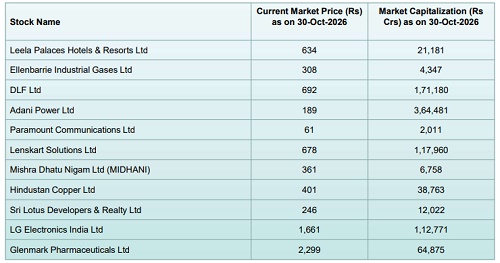
Leela Palaces Hotels & Resorts Ltd.
(formerly Schloss Bangalore)
Leela Palaces Hotels & Resorts Ltd (THELEELA) is India's only listed pure-play luxury hospitality company, owning and managing palace hotels and resorts under The Leela brand across key metros and leisure destinations. Backed by Brookfield, the company combines an owned-asset core with an asset-light management platform, and is in its fastest expansion phase since inception, including a flagship entry into Mumbai's BKC.
Investment Rationale
* Pricing Power in an Undersupplied Luxury Segment: FY26 was a breakout year. Consolidated operating revenue rose 15% YoY to Rs1,527 crore and operating EBITDA grew 19% to Rs743 crore, taking margins to a best-in-class ~49%. Same-store RevPAR grew 14% YoY to Rs17,460, led by rate rather than occupancy, and The Leela gained 11 points of market share, with its RevPAR index rising to 150. Net profit rose to Rs403 crore from Rs48 crore in FY25, helped by a sharp fall in finance costs after IPO-led deleveraging
* Visible Key Growth and a Cleaner Balance Sheet: FY26 marked the company's fastest ever expansion, with 966 keys added (+23%) and a pipeline of 1,065 more keys. The pipeline includes a 250-key Leela Palace in BKC, serviced residences near Mumbai airport, a Coorg resort acquired for ~Rs559 crore, and new managed properties such as Jaisalmer. Net debt halved during FY26, and net debt-to-EBITDA stands at a conservative 1.6x, leaving room to fund the build-out without stretching leverage.
Valuation & Outlook
The premium pricing environment favours luxury hospitality, where customers pay for the property and experience rather than price alone. With occupancy at around 70%, growth is likely to be driven primarily by room rates and premiumisation. Following 38% H1 EBITDA growth, management expects FY27 performance to be materially better than initially guided. The company targets over 5,200 keys by FY30, including 2,600 owned keys, while its asset-light management business supports incremental profitability. Key monitorables include Coorg's ramp-up, Dubai JV losses and the Rs1,432 crore capex planned for five owned properties, alongside execution of the BKC project.
Ellenbarrie Industrial Gases Ltd.
Ellenbarrie Industrial Gases Ltd (ELLEN) is the largest 100% Indian-ownedindustrial gases company by installed capacity, with over 50 years of operations. Itsupplies oxygen, nitrogen, argon, hydrogen, CO?, medical and specialty gasesthrough merchant, packaged and on-site models to the steel, pharma, healthcare,defence and energy sectors. The company is using its June 2025 IPO proceeds toscale air separation capacity across eastern and southern India.
Investment Rationale
* Capacity-Led Volume Compounding: FY26 total revenue rose to ~Rs342 crore from~Rs312 crore, and PAT increased to ~Rs104 crore from ~Rs83 crore, aided by treasuryincome on unutilised IPO funds. The company targeted ~1,910 TPD of capacity by endFY26. Upcoming on-site and merchant plants, including the East on-site project whoserevenue contribution has slipped, give the merchant business a multi-year volumerunway.
* Mix Shift Toward Higher-Margin Gases: EBITDA margins held in the mid-30s throughFY26 despite softer argon prices. Management now guides to sustained margins of 40%or higher as operating efficiencies and the share of argon and value-added specialty gasesrise. In an oligopolistic market dominated by global majors, a domestic player withcaptive distribution and medical-gas credentials carries meaningful pricing and contractrenewal leverage.
Valuation & Outlook
The stock has corrected sharply from its post-listing peak, which in our view resetsexpectations for a business entering its strongest capacity-addition phase. Key risks are argonprice volatility, delays in commissioning on-site plants, and the fall-off in treasury income asIPO cash is deployed. As steel, pharma and electronics capacity build out in India, Ellenbarrieoffers a clean, domestic way to play rising industrial gas demand over coming years.
DLF Ltd
DLF Ltd (DLF) is India's largest listed real estate company, with a land bank of ~188 msf of development potential, the bulk of it in Gurugram. It runs a two-engine model: a premium and luxury residential development business, and a rental annuity portfolio of offices and malls held mainly through DLF Cyber City Developers (DCCDL). The company has expanded beyond NCR into Mumbai and Goa.
Investment Rationale
* Luxury Residential at Scale with a Net-Cash Balance Sheet: DLF delivered FY26 sales bookings of Rs20,143 crore, in line with guidance, after launches such as The Dahlias,
Privana and Westpark (Mumbai). Total income rose 13% to Rs10,174 crore, and adjusted PAT grew 16% to Rs4,256 crore. The development business ended FY26 with net cash of ~Rs14,155 crore, after Rs7,746 crore of net surplus cash generation. Over four years, collections, surplus cash and PAT have compounded at roughly 31?34%.
* Annuity Engine Scaling Toward Rs10,000 Crore: Rental income is expected to reach ~Rs8,200 crore in FY27, with a medium-term target of ~Rs10,000 crore. Three new malls (Midtown Plaza, Summit Plaza and DLF Promenade Goa) are due for completion, while new office space is being leased. Management guides to mid-teens NOI growth and 20-25% PAT CAGR for the rental business over four to five years, giving DLF a growing, REIT-able cash flow base that cushions the cyclicality of residential sales.
* Annuity Engine Scaling Toward Rs10,000 Crore: Rental income is expected to reach ~Rs8,200 crore in FY27, with a medium-term target of ~Rs10,000 crore. Three new malls (Midtown Plaza, Summit Plaza and DLF Promenade Goa) are due for completion, while new office space is being leased. Management guides to mid-teens NOI growth and 20-25% PAT CAGR for the rental business over four to five years, giving DLF a growing, REIT-able cash flow base that cushions the cyclicality of residential sales.
Valuation & Outlook
Management has retained FY27 sales guidance of ~Rs20,000 crore, backed by a launch pipeline of similar size. The pipeline includes an Rs8,000-9,000 crore Gurugram (DLF City) project, Arbour Senior Living, Westpark Phase 2 and Goa, and is weighted toward H2FY27. Beyond FY27, a medium-term launch pipeline of over Rs60,000 crore on fully paid-up land supports ~Rs9,000 crore of annual margin creation. The main risk is launch timing, as approval delays push bookings between quarters. With the stock having de-rated over the past year, a debt-free development arm and an expanding annuity book make DLF a quality compounder on India's premium housing and Grade-A office cycle.
Adani Power Ltd Adani
Power Ltd (ADANIPOWER) is India's largest private-sector thermal powerproducer, with ~18.2 GW of operating capacity across western, central and easternIndia. It has built this platform organically and through stressed-asset acquisitions,and is now in a ~Rs2 lakh crore programme to more than double capacity toby FY32.
Investment Rationale
• Contracted Baseload Cash Flows: FY26 continuing revenue from operations stood atRs53,781 crore and continuing EBITDA at Rs21,285 crore, a ~40% margin that excludes~Rs2,146 crore of one-time prior-period income. PAT came in at Rs12,971 crore. About95% of operating capacity is tied up under long-term PPAs, and plant availability stood at~89%, giving earnings a regulated, annuity-like quality even when merchant tariffs soften.
* Contracted Capacity Pipeline: The 23.7 GW expansion pipeline has ~62% of capacity tied up under long-term PPAs (as of Q2 FY27), and boilers and turbines have been ordered in advance. Near-term additions include Korba Phase-II (first unit synchronised) and the 1,600 MW Mahan Phase-II (due early FY28). Planned capex of ~Rs25,000 crore in FY27 and ~Rs33,000 crore in FY28 is to be funded primarily from internal accruals, per management. Management targets EBITDA of ~Rs50,000 crore by FY31.
Valuation & Outlook
With India's peak power demand expected to rise from ~250 GW toward ~366 GW by FY32(CEA, 20th Electric Power Survey) and a policy push for ~100 GW of new thermal capacity by 2035, baseload thermal remains essential for grid stability during non?solar hours. EBITDA rose 18.5% YoY in Q2FY27, and a further step?up should follow as Korba Phase?II (FY27) and Mahan Phase?II (early FY28) commission. Key risks are execution and cost overruns on a capex programme of this scale, coal price volatility, and group?level governance and regulatory overhangs. Still, Adani Power offers the most direct listed exposure to India's thermal capacity cycle, with earnings visibility that few peers can match.
Paramount Communications Ltd
Paramount Communications Ltd (PARACABLES), which sells under the Paramount Cables brand, is one of India's oldest wire and cable makers, with roots going back to 1955. It manufactures power, railway, telecom, solar, fire-survival and specialty cables at plants in Khushkhera (Rajasthan) and Dharuhera (Haryana), and exports to 35+ countries. A third, greenfield EHV cable plant is under construction at Narmadapuram, Madhya Pradesh.
Investment Rationale
* Domestic Power Cable Demand Offsetting Export Disruption: FY26 revenue from operations grew 22.8% YoY to Rs1,912 crore, and metal throughput rose 12% to 29,664 MT. Domestic revenue rose ~27% to Rs1,362 crore (71% of sales), led by a 37% jump in B2B institutional sales driven by power cables. Exports still grew ~14% to Rs550 crore despite US tariff disruption. PAT fell 30% to Rs60 crore on tariff-related margin pressure, but export conditions have since eased after the IEEPA tariffs were struck down, though a 10% Section 301 duty has replaced the temporary Section 122 tariff.
* Narmadapuram Greenfield to Step Up Scale and Mix: The new plant will add EHV cables, specialised transmission conductors and E-beam cables. It is expected to partly start in FY28, with management estimating ~Rs500 crore of revenue in FY28, scaling to ~Rs1,200 crore in FY29. The order book closed FY26 at Rs583 crore. A ~Rs122 crore preferential issue (~Rs100 crore received on allotment, with the balance of ~Rs23 crore due from promoter warrants within 18 months) has kept leverage low, at ~0.15x debt-to-equity, and management targets ~Rs5,000 crore of revenue within five years.
Valuation & Outlook
FY27 should be a margin-recovery year, as tariff headwinds fade and the Pipes business, divested in November 2025, no longer weighs on the portfolio. FY28-FY29 then bring a capacity-led step-up from Narmadapuram. Structural drivers are strong: transmission and RDSS distribution capex, renewable energy evacuation, metro and railway electrification, and data centre build-outs. Key risks are thin margins relative to larger peers, copper and aluminium price volatility, and working capital intensity, which is currently ~101 days. As a small-cap entry into India's wires and cables upcycle, Paramount offers high operating leverage to the EHV and export opportunity.
Lenskart Solutions Ltd
Lenskart Solutions Ltd (LENSKART) is India's largest omnichannel eyewear company.It designs, manufactures, brands and retails prescription glasses, sunglasses, contactlenses and, more recently, smart eyewear. As of March 2026, it operated 3,327stores (2,609 in India and 718 overseas across Asia and the Middle East), backed byin-house manufacturing and a technology-led eye-testing and supply chain stack.Lenskart listed in November 2025.
Investment Rationale
* Scale with Operating Leverage: FY26 revenue grew 32% YoY to Rs9,002 crore. EBITDArose 55% to Rs1,789 crore, with pre-Ind AS EBITDA crossing Rs1,000 crore, and adjustedPAT rose ~148% to Rs530 crore. Operating cash flow of ~Rs887 crore, about 91% of preInd AS EBITDA, funded a record 603 net new stores (542 in India) without cannibalisingexisting outlets. India saw 24% same-store growth in Q4, and orders above Rs10,000made up ~20% of India revenue.
* Long Runway in an Under-Penetrated Category: Over 6,100 Indian PIN codes remainunserved, and management sees potential for 10,000+ stores in India alone. Thecompany has entered 157 new cities, largely in Tier-2 and smaller markets. Internationaloperations are scaling profitably, with FY26 revenue up 30% and margins at ~7% pre-IndAS in FY26. New categories, including the Meller sunglasses range and AI-powered B byLenskart smart glasses, add optionality on ASP and frequency of purchase.
Valuation & Outlook
For FY27, management expects net store additions similar to FY26 and asks investors to track~25% annual volume growth as the core yardstick. It maintains a long-term steady-state preInd AS EBITDA margin target of ~25%, against ~15% in India and ~10.6% internationally inQ1FY27, implying substantial margin expansion headroom. Valuation is demanding on nearterm multiples, and risks include execution on rapid store roll-out, overseas currency andgeopolitical exposure, and competition from organised and online players. Even so, Lenskartis a rare consumer compounder combining 30%+ growth with sharply rising profitability, andit should be owned on a multi-year view.
Mishra Dhatu Nigam Ltd (MIDHANI)
Mishra Dhatu Nigam Ltd (MIDHANI) is a Mini-Ratna defence PSU under the Ministry of Defence, Hyderabad-based and ~74% government-owned. It manufactures superalloys, titanium alloys, special steels, and soft and hard magnetic materials for defence, space, energy and aerospace applications. It is India's strategic source for critical alloys used in missiles, aero-engines, launch vehicles and nuclear programmes.
Investment Rationale
* Record Year and Strong Order Visibility: MIDHANI posted its highest?ever turnover of Rs1,209 crore in FY26, up 12.5% YoY, with EBITDA up ~11% to Rs276 crore and PAT at ~Rs131 crore. The order book stood at Rs2,290 crore at the start of FY27, ~1.9x FY26 revenue. It is weighted ~66% to defence and ~21% to space, with energy and others making up the rest. For FY27, management targets ~Rs1,500 crore of order inflow, ~15% top?line growth and EBITDA margins of 23?25%.
* Titanium and Aerospace Certification as Growth Levers: The new melting facility enabled ~700 tonnes of titanium melting in FY26, backed by ~Rs600 crore of titanium orders. The company has qualified new superalloy and titanium grades for FY27, secured its first commercial 7000-series aluminium rolling order, and received NADCAP accreditation for its heat treatment facility in March 2026, with NADCAP for non-destructive testing targeted by FY27-end, which would further open global aerospace supply chains. Exports are targeted to grow 10-15% annually over the next three to four years, and rare-earth magnet development adds strategic optionality.
Valuation & Outlook
MIDHANI is a structural beneficiary of India's defence indigenisation push, with growing demand from missile programmes, aero-engines, naval platforms and ISRO's launch cadence. Key risks are lumpy, back-ended execution (Q4 typically carries the year), input-cost inflation, working capital intensity and PSU-style execution timelines. With a near-monopoly position in strategic alloys and a widening product basket, MIDHANI offers long-duration exposure to India's defence and space materials ecosystem.
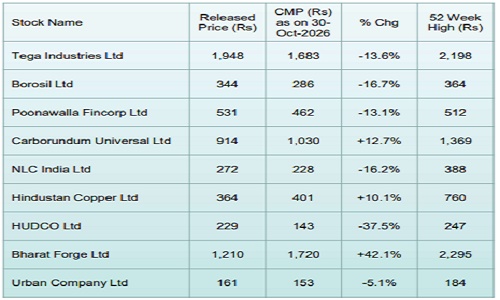
Hindustan Copper Ltd
Hindustan Copper Ltd (HINDCOPPER) is a Miniratna Category-I CPSE under theMinistry of Mines. It is India's only copper miner and its only vertically integratedproducer of refined copper, with operations spanning mining, beneficiation,smelting, refining and rod extrusion. It holds all of India's active copper miningleases and access to ~45% of the country's copper ore reserves and resources, acrossMalanjkhand (MP), Khetri (Rajasthan) and the Indian Copper Complex (Jharkhand).
Investment Rationale
* Record Year on Volume and Price Leverage: FY26 was HCL's strongest year on record.Revenue from operations rose 49% YoY to Rs3,078 crore, PBT jumped ~95% to Rs1,233crore and PAT nearly doubled to Rs921 crore, with EBITDA margins at 48.7%. Oreproduction grew 6% to 3.67 million tonnes, with metal-in-concentrate output at a sevenyear high of ~27,400 tonnes. With LME copper above US$14,000/t, a largely fixed costbase gives HCL exceptional operating leverage to price.
* Tripling Ore Capacity by FY30: Management plans to scale ore capacity from ~4 MTPA to12.2 MTPA by FY30, with over Rs7,000 crore of capex over five to six years. Key projectsare the Malanjkhand underground expansion (2.5 to 5.0 MTPA), the ICC ramp-up (0.4 to4.2 MTPA), Khetri and Kolihan expansions, and the revival of legacy mines. The oreproduction roadmap steps up from 3.67 MT in FY26 to ~4.7 MT in FY27, ~5.2 MT in FY28and ~5.9 MT in FY29, before the larger jump in FY30.
Valuation & Outlook
Copper is the backbone of electrification. Demand from power transmission, renewables, EVsand AI data centres is structurally outpacing mine supply globally, and India remains heavilyimport-dependent for concentrate. FY27 should see ~28% ore volume growth on top of firmprices, along with diversification into critical minerals and rare-earth exploration. Key risksare copper price volatility, slippage on underground mine projects, and the stock's highsensitivity to the LME cycle. As India's sole domestic copper mining platform, HindustanCopper is a strategic, high-beta play on the global copper upcycle and national mineralsecurity.
Sri Lotus Developers & Realty Ltd
Sri Lotus Developers & Realty Ltd (LOTUSDEV) is a Mumbai-based developer focused on luxury and ultra-luxury residential and commercial projects in prime Mumbai micro-markets, mainly the western suburbs (Bandra, Juhu, Versova and Andheri) and Prabhadevi in central Mumbai. It follows an asset-light, society-redevelopmentled model, with in-house construction, sales and business development. Promoted by Anand Pandit, it listed in August 2025.
Investment Rationale
* Breakout Pre-Sales at Premium Realisations: FY26 pre-sales rose 137% YoY to a record Rs1,157 crore, meeting guidance, with Q4 alone contributing Rs462 crore as new launches gained traction. Revenue grew ~40% to Rs769 crore, EBITDA came in at Rs281 crore, and PAT stood at Rs243 crore, a ~32% PAT margin. PAT rose ~7% YoY, below the 30?35% the company had guided at the start of the year. The company is net debt?free and earns industry?leading realisations of ~Rs69,000 per sq ft.
* Redevelopment Pipeline Doubling the Business: Lotus added nine projects in FY26 with a cumulative GDV of ~Rs8,500-9,000 crore. Six launches are planned for FY27 (Lotus Aquaria, Trident, Aurelia, Sky Plaza, Portofino and Odyssey), with an estimated GDV of ~Rs5,000-5,500 crore, three of them in H1. Mumbai's society redevelopment wave offers capital-light land access in micro-markets where new supply is otherwise scarce, which supports pricing.
Valuation & Outlook
For FY27, management guides to pre-sales of Rs1,800-2,000 crore (~56-73% growth) and 55- 60% growth in both revenue and PAT. Unrecognised FY26 bookings and new launches should flow into revenue over FY27-FY29. Key risks include concentration in a few Mumbai micromarkets, approval and redevelopment consent delays, collections lagging pre-sales (FY26 collections were ~Rs376 crore), and lumpy revenue recognition. The FY26 PAT shortfall also makes delivery against FY27 guidance a key credibility test. If delivered, Lotus offers a highgrowth, net-cash small-cap route into Mumbai's ultra-luxury redevelopment cycle.
LG Electronics India Ltd
LG Electronics India Ltd (LGEINDIA) is the Indian subsidiary of South Korea's LGElectronics and the country's leading home appliances and consumer electronicsbrand. Its portfolio spans air conditioners, refrigerators, washing machines, TVs andB2B solutions, manufactured at Greater Noida and Pune with a third plant underconstruction at Sri City, Andhra Pradesh. The company listed in October 2025 andexports to ~65 countries.
Investment Rationale
* Market Leadership with a Margin Reset Behind It: FY26 was a consolidation year.Revenue was broadly flat at ~Rs24,605 crore, as a delayed summer, rupee depreciation,raw material inflation and elevated channel investment compressed EBITDA ~23% toRs2,408 crore (9.8% margin), with PAT at ~Rs1,685 crore. Momentum has since turned: allmajor categories returned to double-digit growth, and price increases, premiumisationand operating leverage are restoring margins. The balance sheet is strong, with ~Rs4,476crore of cash against minimal debt at FY26-end.
* Sri City, Localisation and Exports as Multi-Year Levers: The ~Rs5,000 crore Sri City plant,fully funded from internal accruals, will start compressor production in Q3FY27 and roomAC lines in Q4FY27, adding ~2 million compressors and RAC capacity, including for export.Localisation stood at 55% in FY26, with a target of ~65% over three to four years.Management aims to double exports in FY27 from ~7% of revenue toward mid-teens overthe medium term. B2B is expected to compound at ~20%, with data-centre cooling as alonger-term option.
Valuation & Outlook
Management guides to mid-teen revenue growth and early double-digit EBITDA margins inFY27, broadly restoring FY25 profitability, with Sri City becoming earnings-accretive throughFY28. Key risks are commodity and currency volatility, competitive intensity in ACs and TVs,weather-dependent summer demand, and royalty payments to the parent. With a dominantbrand, a net-cash balance sheet and a clear localisation and export roadmap, LG ElectronicsIndia is a quality way to play India's under-penetrated consumer durables market.
Glenmark Pharmaceuticals Ltd
Glenmark Pharmaceuticals Ltd (GLENMARK) is a research-led global pharmaceutical company with a presence across branded, generic and OTC segments in India, North America, Europe and emerging markets. Its focus areas are respiratory, dermatology and oncology. Through its innovation arm, Ichnos Glenmark Innovation (IGI), it is developing novel biologics on its BEAT multispecific antibody platform, which has been validated by a landmark out-licensing deal with AbbVie.
Investment Rationale
* Innovation Validated and the Balance Sheet Strengthened: FY26 consolidated revenue rose 27.5% YoY to Rs16,983 crore. This includes recognition from the AbbVie licensing deal for ISB 2001, which carried a US$700 million upfront and a potential total value of US$1.925 billion. Reported EBITDA margin was 26.9%, flattered by the upfront. More importantly, the deal and the earlier Glenmark Life Sciences stake sale made Glenmark gross debt-free by end-FY26, removing a long-standing overhang. The next oncology asset, ISB 2301, is expected to reach the IND filing stage in late CY2026.
* Core Franchise across Geographies: Glenmark's India business was the second-fastestgrowing company among the top 15 in the Indian Pharmaceutical Market in FY26. North America is scaling on first-to-market respiratory launches, and Ryaltris continues its global rollout. Europe and emerging markets delivered double-digit growth in FY26, giving a diversified, branded-heavy revenue base that is less exposed to US generic price erosion than many peers.
Valuation & Outlook
For FY27, management guides to revenue of Rs17,000-18,000 crore with EBITDA margins of 21-22%. This implies healthy underlying growth once the one-time FY26 upfront is stripped out, while R&D stays at 7-8% of sales. Upside triggers include milestone income from AbbVie, US respiratory approvals and the progress of the ISB pipeline. Key risks are US FDA compliance at manufacturing sites, legal and settlement costs that have hit recent profitability, and pipeline execution. With a debt-free balance sheet, a re-accelerating base business and a validated innovation engine, Glenmark is well placed to re-rate from a leveraged generics player to a specialty and innovation-led pharma company.
Please refer disclaimer at http://www.aretesecurities.com/
SEBI Regn. No.: INM0000127