
Diwali Muhurat Picks 2026 : Buy High Energy Batteries India Ltd for the Target Rs.761 by Sushil Finance
RISING DEFENCE SPENDING, WITH A PUSH TO BUY FROM DOMESTIC SUPPLIERS, SUPPORTS DEMAND FOR NAVAL AND MISSILE BATTERIES
High Energy Batteries (India) Limited (HEB)’s naval, missile and aircraft batteries are life-limited items that are replaced over a platform’s service life, so demand recurs. India’s local-sourcing policy (5,521 items on the Positive Indigenisation Lists) favours a domestic maker of products once imported. Torpedo and missile programmes are active, including contracts of Rs. 1,543 crore (Varunastra) and Rs. 1,896 crore (48 heavy weight torpedoes for the Kalvari-class), and BrahMos units are running at full capacity. The FY27 defence capital outlay is Rs. 2.19 lakh crore (up 21.8%), with about 75% of the Rs. 1.85 lakh crore modernisation budget reserved for domestic industry, and domestic defence production reached Rs. 1.78 lakh crore in FY26. HEB lists the key naval, missile, aircraft and space organisations as customers, and silver-zinc batteries (Rs. 76.60 crore, 92% of product sales) tie it closely to this spending. The benefit has not yet shown in revenue, which was broadly flat from FY22 to FY26, so order inflows and confirmation of HEB’s content on specific platforms are what to watch.
A DEFENCE BATTERY FRANCHISE WITH HIGH ENTRY BARRIERS, WIDENING ITS PRODUCT RANGE ACROSS TORPEDOES, UNDERWATER DEVICES AND RAILWAYS
HEB has built a niche defence battery franchise over 47 years, supported by proprietary technology, specialised manufacturing capabilities and stringent defence approvals that create high entry barriers. Its established relationships with DRDO, Indian Navy and other government agencies provide customer stickiness, while customer-funded development programmes limit upfront capital risk. The successful transition of torpedo, underwater device and railway battery programmes from development to regular supplies is expected to strengthen revenue visibility from FY27 onwards. With opportunities across defence and emerging energy storage applications, HEB is positioned to scale profitability, with PAT projected to grow from Rs. 15.4 crore in FY26 to Rs. 23.5 crore by FY29E.
OUTLOOK & VALUATION
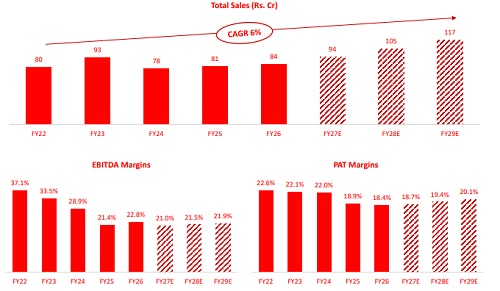
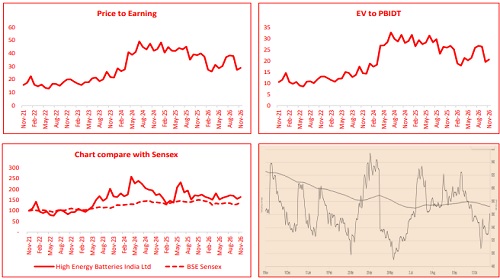
We expect HEB to deliver revenue growth of about 12% a year over FY2026–FY2029E, taking revenue from Rs.83.53 crore to Rs.117.35 crore. The drivers are the conversion of development-cum-supply orders into regular production, sustained silver-zinc demand from naval and missile programmes, and the benefit of platforms already ordered reaching delivery in the later years of the forecast period. We estimate EBITDA margin to remain in the range of 21% - 22% through FY2027E to FY2029E. Our EPS estimates stand at Rs.19.5, Rs.22.7, and Rs.26.3 for FY2027E, FY2028E, and FY2029E, respectively. Assigning a P/E multiple of 29x on FY2029E EPS, we arrive at a target price of Rs.761, implying an upside of ~37.2% from the CMP of Rs.555. We initiate coverage on High Energy Batteries (India) Ltd. with a BUY rating, over an investment horizon of 24-30 months.
Key Risks
* Lumpy, concentrated defence orders: About 92% of product sales come from silver-zinc batteries for a small set of government buyers, so delays in orders, customer approvals or deliveries can swing results sharply, as seen in Q1 FY27 (revenue of Rs.7.88 crore and a loss of Rs.1.82 crore) against Q2 FY27 (revenue of Rs.29.08 crore and PAT of Rs.5.73 crore).
* Heavy working capital and delayed payments: Net working capital of about 685 days and slow payments from defence and government departments tie up cash and require bank support. In case of further delay in payment or order execution can lead to further stretch in working capital.
High Energy Batteries (India) Limited (HEB) is a Chennai-headquartered manufacturer of specialised batteries for India’s defence, aerospace and space programmes. The company was incorporated in September 1961, and manufacturing began in 1979 at Mathur in Pudukkottai District, Tamil Nadu. The Mathur plant was set up to make silver-oxide-zinc batteries for MiG aircraft, in technical collaboration with Yardney Electric Corporation of the USA. Its aircraft battery was approved for bulk manufacture in 1981, and over the following decades in-house R&D widened the range to serve all three armed services. The registered office is at Esvin House, Perungudi, Chennai. The factory and R&D facilities are also located at Pudukkottai District, Tamil Nadu, close to Tiruchirappalli.
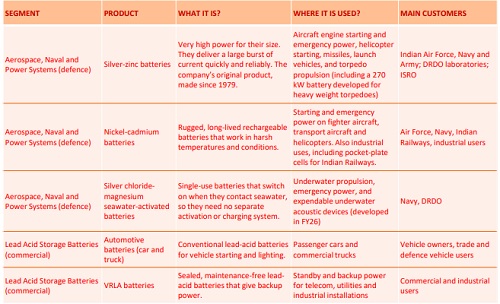
HEB makes batteries that are built to specification for demanding uses, not for the mass market. Its core product is the silver-zinc battery, which delivers very high power for its size and is used in torpedoes, missiles, aircraft and helicopters. It also makes nickel-cadmium batteries, which are rugged, long-lived rechargeables used on aircraft and helicopters and increasingly on Indian Railways locomotives. A third line is the seawateractivated silver chloride-magnesium battery, which switches on when it touches seawater and powers underwater systems. Silver-zinc accounts for more than nine-tenths of product sales, with nickel-cadmium making up the rest. Customers are mainly the Navy, DRDO laboratories and defence public sector units, along with ISRO, BrahMos, BEL and HAL. A small number of overseas buyers and a merchant exporter also purchase from it. The company’s lead-acid battery division, which made car, truck and VRLA batteries, has been suspended since April 2019 because of unremunerative pricing. HEB is therefore effectively a single-segment defence and aerospace business.
HEB received a development-cum-supply order for a silver-zinc battery for heavy weight torpedoes. It also completed development and sea trials of a seawater-activated battery for light weight torpedoes, with regular production expected from FY27. A high-power silver-zinc battery for combat underwater use has been qualified by DRDO, and a seawater battery for expendable acoustic devices is slated for production from FY27 onwards. The company has built a facility for nickel-cadmium pocket-plate batteries for Indian Railways locomotives, with production to start after customer approval. Beyond defence, it is working on a vanadium redox flow battery scaled to 10 kW/50 kWh with IIT Madras, a 2.5 kW hydrogen fuel cell stack, lithium-ion battery packs and storage systems, and hydrogen electrolyser opportunities. These newer areas are still at developmentstage and do not contribute meaningfully to revenue today.
In financial terms, the revenue were at Rs. 79.55 crore in FY22, which rose to Rs. 92.83 crore in FY23 and then dropped to Rs. 78.14 crore in FY24. Revenue was Rs. 81.00 crore in FY25 and Rs. 83.53 crore in FY26, a rise of about 3%. EBITDA has come down over the same period, from Rs. 29.48 crore (a 37.1% margin) in FY22 to Rs. 19.06 crore (22.8%) in FY26. Net profit was Rs. 15.39 crore in FY26, broadly flat on Rs. 15.33 crore in FY25
INVESTMENT RATIONALE (1/2)
RISING DEFENCE SPENDING, WITH A PUSH TO BUY FROM DOMESTIC SUPPLIERS, SUPPORTS DEMAND FOR NAVAL AND MISSILE BATTERIES
HEB makes the batteries that power torpedoes, missiles and aircraft. These are life-limited items that are replaced across a platform’s service life, so demand recurs. India’s policy of sourcing locally, through the Positive Indigenisation Lists that now cover 5,521 items, favours a domestic maker of products that were once imported. Torpedo programmes are active. A Rs. 1,543 crore contract for Varunastra heavy weight torpedoes and a Rs. 1,896 crore contract for 48 heavy weight torpedoes for the Kalvari-class submarines were both signed in the past year. BrahMos production units are running at full capacity against orders from all three services. HEB lists BDL, NSTL, NPOL, NMRL, BrahMos Aerospace and WASS among its customers, so it sits inside this ecosystem.
The numbers support the direction. The FY27 defence capital outlay is Rs. 2.19 lakh crore, up 21.8%. The modernisation budget is Rs. 1.85 lakh crore, of which about 75% (Rs. 1.39 lakh crore) is reserved for domestic industry. Domestic defence production reached a record Rs. 1.78 lakh crore in FY26, up 15.6%, and defence exports reached Rs. 38,424 crore. Silver-zinc batteries brought HEB Rs. 76.60 crore in FY26, which is 92% of its product sales, so the company is closely tied to this spending. The demand has not yet shown up in revenue, which was broadly flat from FY22 to FY26. The Navy’s own capital heads grew only about 4%, and HEB is not named as a supplier on the contracts above. Order inflows and management’s confirmation of content on specific platforms are what to watch.

Demand is not limited to naval weapons. HEB’s FY26 customer list also includes HAL, ADE, ADA, VSSC, ISRO, RCI and ASL, which spans aircraft and helicopter starting and emergency power, launch vehicles and missile systems. The Defence Ministry concluded capital acquisition contracts of Rs. 1.82 lakh crore in FY26, and platforms ordered now generate battery demand later, once they are built and delivered. The Kalvari torpedo deliveries, for example, run from April 2028 to early 2030, which points to the benefit falling in the later years of the model’s forecast period. HEB also has an overseas channel. It names WASS (Italy), Thyssenkrupp (Germany), DASTAN (Kyrgyzstan) and the Sri Lanka Air Force as customers, some of them as offset partners. In FY26, direct exports were Rs. 0.24 crore (Rs. 12.22 crore in FY25), while sales through a merchant exporter were Rs. 10.90 crore (nil in FY25). Together they were about 13% of FY26 product sales, so export demand is real but shifts between channels from year to year.
A DEFENCE BATTERY FRANCHISE WITH HIGH ENTRY BARRIERS, WIDENING ITS PRODUCT RANGE ACROSS TORPEDOES, UNDERWATER DEVICES AND RAILWAYS
HEB’s position rests on 47 years of qualified manufacturing. It began making silver-oxide-zinc aircraft batteries in 1979 with technology from Yardney Electric Corporation of the USA, and its battery was approved for bulk manufacture in 1981. It set up its own R&D laboratory in 1982, and the range now covers silver-zinc, nickel-cadmium and seawater-activated chemistries designed in-house. The company holds ISO 9001, ISO 14001 and ISO 45001 certifications, and its products go through approval by agencies such as CEMILAC, DGAQA, DGNAI and DGQA. For a new entrant, this means a long approval cycle, specialised test infrastructure and a small order size per product, which in our view makes the market unattractive for new competitors. The competitive landscape should be confirmed with management.
The customer base is almost entirely government and defence establishments, with a small overseas component. These are long-standing relationships and sovereign counterparties, so credit risk on receivables is low even though collections can be slow. The relationship also extends to development work. Several of HEB’s newer products began as customer-funded or customer-ordered development programmes, which limits the capital the company puts at risk before a product becomes a supply item.
That conversion is the source of visibility on volumes. In FY26, the company succeeded in development-cum-supply orders for a heavy weight torpedo silver-zinc battery, a combat silver-zinc battery qualified by DRDO, and a nickel-cadmium battery for railway locomotives. It also states that supply orders from DRDO and the Indian Navy are enabling regular production of the 120 kW seawater battery from FY27, with the acousticdevice battery to follow. Each product that moves from development to regular supply adds recurring revenue on a platform where HEB is already qualified. Newer programmes in energy storage, including the vanadium flow battery funded by OECT and the fuel cell stack with IOCL and GAIL, are paid for by partners and are not in the base case.
In H1FY27, revenues were at Rs. 36.36 crore, about 19% above the Rs. 30.53 crore of H1FY26, and net profit was Rs. 3.91 crore against Rs. 2.79 crore. Q1FY27 was a loss (Rs. 1.82 crore on revenue of Rs. 7.88 crore), and Q2 recovered with revenue of Rs. 29.08 crore and profit of Rs. 5.73 crore. Visibility is therefore at the level of the full year and not the quarter.
Being in this industry gives HEB advantages beyond its current products. Defence platforms run for decades, so a qualified battery stays in demand long after the first order. The electrochemistry skills built for silver-zinc and seawater batteries carry over to flow batteries, fuel cells and lithium-ion systems, which gives the company a way into energy storage without starting from scratch. And capital needs are modest. Together, a qualified franchise with few alternatives, a pipeline moving into regular supply, and costs fixed through March 2029 support the model’s path from PAT of Rs. 15.39 crore in FY26 to Rs. 23.54 crore in FY29E.
MARKET INFORMATION
Please refer disclaimer at https://www.sushilfinance.com/Disclamier/disclaimer
Member : BSE/ NSE/ MSEI. SEBI Registration No.-INZ000165135