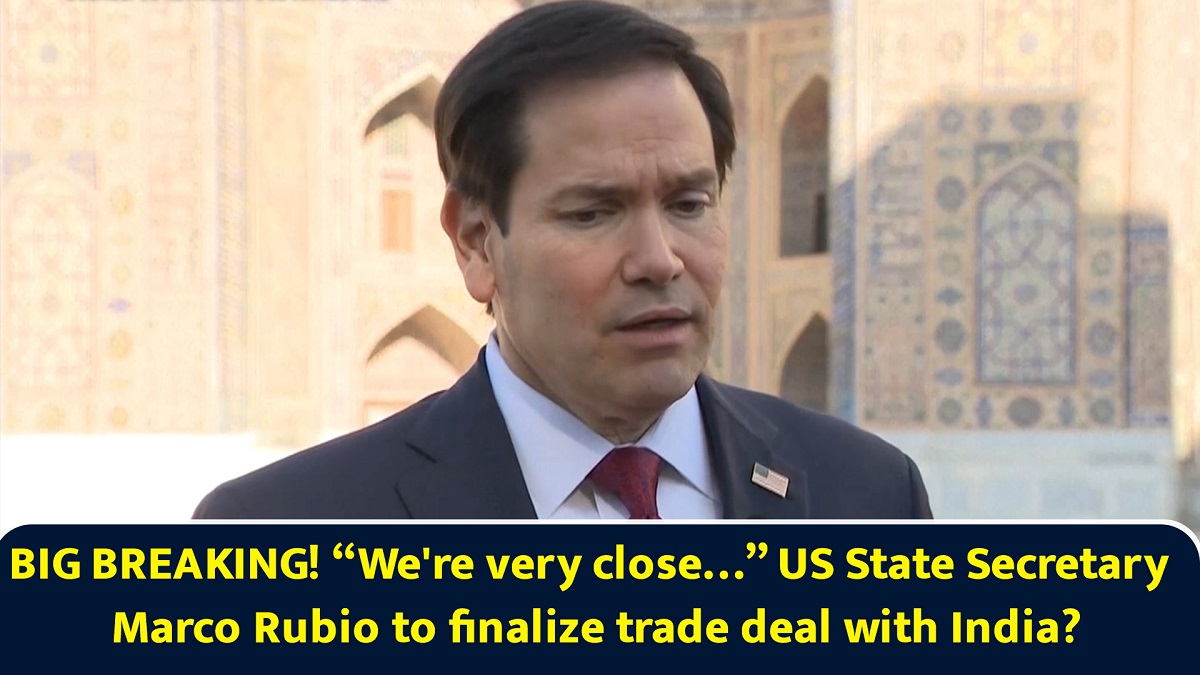
BIG BREAKING! ``We're very close...``US State Secretary Marco Rubio to finalize trade deal with India?
Speaker 1: Hold on one second. I want to say a few words. First of all, and I want to thank the head of the presidential administration for joining us here. She's fantastic. She's an incredible leader and also an incredible spokesperson for the country. We had a chance to interact now numerous times and thank you both. I told you I would come and here I am both.
Speaker 4: I want to say a few words.
Speaker 0: Thank you
Speaker 1: in this beautiful spot, uh, historic. You know, this is for centuries a crossroads of trade and commerce, global trade and commerce came right through here. And this is why we're here now because American companies, many of them are joining us here today, not just to visit here, but also as part of the C5+1 forum that we think is so important. The United States wants to be a strong partner in Central Asia. Obviously rooted in this country, but also all the neighboring countries who want to do more business and trade with us. We have an incredible delegation, almost 300 American
Speaker 1: businesses that are here with us and the opportunity to sign over when it's all said and done billions of dollars of agreements that will both enrich the countries in the region but also benefit the United States economically. So it's an honor to be here and an honor to be a part of it. Thank you for welcoming us. We're so happy to be with you.
Speaker 0: Thank you for welcoming us. We're so happy to be with you. Thank you very much. Thank you for choosing Uzbekistan. Of course. Thank you.
Speaker 1: Of course
Speaker 1: Thank you for welcoming us and allowing us to see this incredible place.
Speaker 0: Yes, thank you very much for being with us here. Thank you. It's an honor. It's important for us.
Speaker 1: Okay
Speaker 1: It's an honor. Okay.
Speaker 4: Secretary, I was going to ask you about your impressions here, but you just gave them, so it's an extraordinary place, I have to say. So straight to substance, what does China is making big inroads in Central Asia, including Uzbekistan. What does the US have to offer specifically to the countries of the C5?
Speaker 0: Yeah
Speaker 1: I mean, look, it's competition, right? We have products, we have companies, they they they make things and we just want fair competition and an opportunity. There's no part of the world in which we feel like America and American business should not be have a fair shot to compete. That's what we seek to do. This is not about coming here to say stop talking to somebody else or stop working with some other country. That's not about that. This is about ensuring that in every part of the world that is opening its doors to American business and American commerce that we're available, that we're that we're showing up and that
Speaker 1: through there and that's what this is all about. I mean, if you look at for a long time people have understood the importance of Central Asia, all 5 countries, Uzbekistan in particular, you see it. You guys have gone through this, it's a beautiful country. It's incredible what they've achieved in just the last decade in terms of economic growth and prosperity. And we just want to identify opportunities on things we can work together on and we're here to do that and that's what we want to do and that's not a negative action against any other country, that's just I mean countries want to have as many relationships as possible. Uzbekistan's been clear, they want to be friends to everybody. They want
Speaker 1: to have a relationship with everybody. They want to have economic relations with everybody and we are saying that we are interested and that's why we've come here with almost 300 American businesses joining us who are looking forward to seeing what opportunities exist and in fact some of whom I've already done agreements that we'll be announcing a little later.
Speaker 8: Yeah
Speaker 7: You see, on that line, the decades old Cold War era, the decades old Cold War era, Jackson Maddock is in place. Why is it not repealed?
Speaker 1: The what? The what?
Speaker 1: Yeah
Speaker 1: Yes
Speaker 1: Well, you'll have to ask Congress. Uh, we are in favor of repealing it. There are a number of strong voices in Congress that are in favor of repealing it. I was actually asked that during my confirmation hearing in the Senate. And I said, you know, I was in favor of repealing it and the administration has asked for that to be done. Congress just hasn't gotten around to it, but we hopefully they will.
Speaker 5: Secretary, in terms of geopolitics and the part of the world that we're in, President Vladimir Putin reportedly has proposed a meeting with President Trump.
Speaker 6: Presently
Speaker 1: Excited, you leave. She left. She's got to go work. I understand. Okay, sorry.
Speaker 5: President Putin, the Russia's reportedly, uh, following the Wall Street Journal, proposed a meeting with President Trump and, uh, with Xi Jinping next month to discuss ending the war in Ukraine. Is that something you can comment on at all? Is that accurate?
Speaker 1: Well, I don't know. I mean, I think there's been talks of a meeting. I don't know if anything's been finalized, but the president's been clear. He'd like the war in Ukraine and Russia to end. He wants that war to end. He has said that when he was a candidate. He said it never would have happened had he been president at the time, but it did happen. And, uh, and now we've done everything we can and we'll continue to do everything we can to help facilitate the end of that war. No one's winning that war. People are dying every day. Things are being blown up every day. Things are being destroyed every day. And he's talked about it. He's talked about the death toll. If you've listened to the president,
Speaker 1: and he repeatedly cites the 25,000 people a month dying in these wars. The amount of destruction that's occurred, the amount of economic damage that's occurring. So as you've seen, we have engaged repeatedly over the last almost 2 years now to try to bring about or facilitate an end to this war. And I think the president is open to anything that he can do to help bring a war to an end if it's possible. And we'll continue to look for opportunities to do that. So far, obviously, we haven't made the kind of progress we would like to have made, but it's not for lack of trying and the president remains very committed to it.
Speaker 1: saw his post overnight or overnight our time, you know, at some point in on the East Coast in the United States, where he once again reiterated, uh, why it is that, uh, he's done the things he's done with suspending the sanctions for 60 days is because he he wants to see if there's an opportunity for the talks that are going on right now with both Ukraine and Russia to lead to something positive and avoid, you know, another disastrous year of war and conflict.
Speaker 3: What what evidence do you actually have that President Putin is open to peace talks to come into negotiating with you?
Speaker 1: What evidence? Well, this is, I mean, I don't know, this is not a criminal case. I mean, what this is, is about diplomacy. And in diplomacy, you continue to try. And sometimes, unfortunately, when these conflicts are the kinds that we're talking about now, these are complicated, they're entrenched, in some cases a deadlock, sort of a stagnated conflict in which neither side is making clear victories, but both sides are inflicting tremendous damage. We're just going to keep trying to the extent we can to see if we can facilitate an end to it. We'll keep testing every opportunity that presents itself.
Speaker 1: In the end, the evidence will be whether we, whether a deal gets done or not, whether both sides are willing to give in order to end this war. You just have to keep trying to do it. Sometimes it works, sometimes it doesn't, but that's the nature of diplomacy.
Speaker 7: Ukraine says last night, Ukraine says it did not receive early warning last night before Russian ballistic missiles hit Kyiv. He was enlightened as what happened there and as an
Speaker 6: Free
Speaker 1: The what?
Speaker 1: Well, I can't. I don't know. I mean, I I if it happened last night, I don't know exactly. I know a few nights ago there was a software problem, uh, involving their early warning system, uh, that I I know Centcom, I'm sorry, I know that Ucom had been involved in looking at it and that's the report they gave us back. I can't comment on what happened last night.
Speaker 7: But as a nation's top diplomat and secretary, are you concerned that American diplomats, Americans, and the people also are at risk?
Speaker 1: That what?
Speaker 7: America
Speaker 1: Well, we're concerned about Americans at risk anywhere in the world. You know, we have a diplomatic presence there, and we do we do meetings on a weekly basis in all of our posts, especially those that are in conflict zones to to determine whether or not we can continue to maintain people there. As of now, we've not changed our posture or our footprint in Kiev. We have our presence there, but of course we're concerned. We're always concerned about the safety and security of our diplomats and our facilities.
Speaker 8: No, no, go ahead, please. Mr. President, welcome to Uzbekistan first of all. How do you assess Uzbekistan's role in the current developments of Central Asia?
Speaker 2: We should be following
Speaker 1: No, no, go ahead, please. No, I'm sorry.
Speaker 1: Thank you
Speaker 1: Well, I think it's the key and the cornerstone. I mean, it's the most populous country. You see the, I mean, we've seen, I've never been here before, I just arrived, but just the the incredible reading up on the incredible economic development. A growth rate now, GDP of almost 8% a year is phenomenal. And we want that courage for that trend to continue. So I think you have tremendous opportunity here. If you can have another decade like you had in the last decade, I think you'll be in an incredible place, you already are. And the I was stunned by the number of tourists that come, stunned meaning surprised.
Speaker 1: that the numbers were that high. I know I inquired about direct flights from the United States. There's actually talks underway potentially for a direct flight from Miami. I know that there's one already from different other places. So, we're always encouraged by coming to places like that and seeing a country that emerged like all of its neighbors from the Soviet area to where they are today in such a short period of time and the incredible opportunities they have to really build on that and transform the country in an incredibly positive way. And that's why we're here. We just want to be a positive part of it.
Speaker 1: And that's why we brought all these businesses with us as well because they want to be a part of it.
Speaker 9: Secretary Rubio, what should people in Uzbekistan expect from this visit and also from the delegation of 200 American companies traveling with you?
Speaker 1: Well, I think we'll have some concrete deals to announce. I mean, companies that are going to be doing business here, that are being welcomed here and that are excited about doing business here. So we'll have those announcements at the end of the forum. I think that's very positive for both countries. And I also think that's just the foundation that we intend to build on. We want to do more. This is not the end, this is the beginning. And so we're excited about it. This is a part of the world that frankly has not gotten a tremendous. Central Asia has just not gotten the level of attention from our policymakers over the last 20 years that it deserves, but that's changed.
Speaker 1: changing, that's why we're here now, that's why we had the meeting with the leaders and the president last year, and that's why I, you know, I encourage, you know, more congressional delegations to come and visit and ultimately why I hope to be able to come back as well and why we wanted to do the C5+1 here in addition to the bilateral visit.
Speaker 3: Secretariat
Speaker 2: Secretary, what are the key issues?
Speaker 3: Key
Speaker 1: Hold on. What?
Speaker 2: Secretary, what are the key issues of today's topic with your colleague and when the President of United States is planning to visit Central Asia, especially Uzbekistan?
Speaker 1: Well, I can't comment on the president's future travel plans. I think I think we would love to see that happen. We would have to work on that in the year to come and see what dates are possible because I I think he would like to come if he can and he has said so. So obviously I I but I'm I I'm not the I can't speak about presidential scheduling. About today, it's the point that I made earlier. And that is we have a lot of bilateral issues to talk about, but ultimately, because I think like every country in the world, Uzbekistan is concerned and looking at what's going on in other parts of the world and the impact it's having economically on the global economy.
Speaker 1: But there's so much positive going on in our bilateral relationship. And really the cornerstone of it is if you think about it, it's a relationship that's defined not by challenges, not by conflicts, but by opportunity. This is a place that is growing dramatically and economically. It's providing incredible opportunities for prosperity for its people. And we have American companies that are interested in being a part of it and we're here to explore how we can do more of it. I think that binds our people closer together, our countries closer together. There's nothing that strengthens relationships more than shared prosperity.
Speaker 1: and that's what we're looking to build on and that's why we're here.
Speaker 5: Secretary, back to discussing another.
Speaker 1: Do you speak the language here? No.
Speaker 5: Who's back?
Speaker 1: What what is that? A Russian?
Speaker 5: Speak Russian very much.
Speaker 1: Ah, okay. That's no longer the official language here, but it's good, but a lot of people speak it. I understand.
Speaker 5: I understand.
Speaker 1: All right, well next time. Go ahead.
Speaker 5: Go ahead. I'd like to ask you about the relationship between the US and Ukraine. Um, in that, uh, on Saturday you were asked about Star Shield and, uh, you mentioned that President Zelensky may not know what he's talking about, the way he's characterized it. President Trump has, uh, called for, uh, elections, uh, in Ukraine. Do you think that the relationship between the two administrations at this point is fundamentally broken? Is there a lack of trust, uh, you know, that that's that's developed?
Speaker 1: Yeah, look, on Starshield there's something that the Department of War controls and Ukraine has benefited from it. I think they'd like to expand how it's being used. And that's a conversation they're having with the Department of War on an ongoing basis. They'd like to expand it to be able to conduct attacks beyond Ukrainian territory. And and that's not something I'm going to discuss in a press conference. As far as the relationship, the relationship, it's very simple. Our goal there is to end this war. That's what we want to do. We want the war to end. We see nothing good coming from this war and we see a lot of downside to it, including the very real risk of escalation.
Speaker 1: on the spread of this thing spreading into another country because of a failed sabotage attack, because the drones that are hit with electronic warfare and they wander into a neighboring country. We see that every night. Part of drone defenses is you disorient the drone and so the drone doesn't hit its intended target, but it winds up hitting somewhere. And if it's a neighboring country and a neighboring country gets hit, you can see where these things can escalate. It's a very dangerous conflict. Not just dangerous for Ukraine and Russia, but dangerous for the world and for the countries of Europe, especially in Eastern Europe. So, we think there's
Speaker 1: a great benefit to bringing it to an end and we are doing everything we possibly can to try to bring both sides together. It has not been easy because this is a war that as I said is, you know, the underlying
Speaker 1: factors that led to it and that have persisted are not easy ones to address, but we're going to continue to try. And if we can play a positive role, that really is the point of our relationship is to try to bring this war to an end. That's what the president wants. The president has said repeatedly he wants this war to end and he's willing to do whatever he can to try to bring it to an end, even if that means having to nudge both sides to get there.
Speaker 6: So sorry sorry sorry
Speaker 9: How do you see from Uzbekistan the US efforts to diversify critical minerals and strategic supply chains?
Speaker 1: Well, I think the whole world is interested in that. I mean, it's just not smart for and this is not an attack on any specific country. It's just not smart for the whole world to depend on one place for 100% of anything because then you're dependent on what happens in that country, what happens in that region. It could be anything that disrupts it. So if you look at all of the technologies and industries that are going to define the 21st century, many of them will be heavily reliant on critical minerals. So I think there is a global, not just a US, I think there is a global prioritization being being emphasized.
Speaker 1: emphasized on diversifying supply chains of everything, and that includes critical minerals. If you are a country that has critical minerals and perhaps even the ability to process them, it is in your national interest, your economic national interest to fully develop those resources in a way that's responsible and sustainable. And so when we find countries that want to partner with us on diversifying critical minerals and supply chains and in particular being able to utilize their critical minerals in a in a way that benefits
Speaker 1: It's their country. We're obviously going to explore that and I think we have a chance to do that here. Thank you guys. We got to get going.
Speaker 7: Thank you guys, we got to get going. Couple more.
Speaker 1: Couple more. Go ahead. What?
13:48Speaker 7: Go ahead. What? US sanctions India for purchasing Russian oil, gas. And the message for this part of the world was, Central Asian countries, to refrain from buying Russian gas. Is it now okay to purchase Russian oil, gas because US is now purchasing Russian oil?
Speaker 1: No, no, no, we've we've had to waive sanctions over the past few months as you know because of if you're looking at the global supplies, looking at global prices and the impact that was having on other countries. I mean, I know diesel prices are high in the United States, but they're really, really high in a bunch of other countries around the world. And then we have to manage all these things. We we're trying to finalize a trade deal with India right now. We're very close to doing that. So you don't so that's one of the things we take into consideration when the president makes a decision about national security waivers and things of that nature. Every country has a complex
Speaker 1: set of factors that they have to take into account. Geography is real. For some countries it's very difficult to acquire energy from alternative sources. That's not an excuse, but all of that has to be balanced when you make foreign policy. The foreign policy of the United States, of course, takes into account what's happening with the war between Russia and Ukraine, but it is not solely dominated by that. It has to take into account a variety of other factors, including our bilateral relationships with other countries and what they realistically are capable of being able to do in terms of their own energy supplies. You also can't unravel the
Speaker 1: economy of other countries, uh, because of one central issue. So that that's the complex part of having to balance all of this.
Speaker 6: On Ukraine, on Ukraine, sorry, on Ukraine, President Zelenskyy said in an interview with NBC News yesterday that the US had paused, then resumed some intelligence sharing earlier this week. Is that true?
Speaker 4: Just a little bit
Speaker 1: That we did what now?
Speaker 6: posed and some intelligent sharing with Ukraine.
Speaker 1: I I don't know where he's getting these things from or why he's saying these things to the press. You should go back and ask him. Uh, there's been no pause. Uh, the the United States, but again, what he should be focused on and what we want to be focused on is bringing an end to this war. That's what he should be focused on. That's what we want everybody to be focused on. That's what we want the Russians to be focused on. That's what we should be focused on. That's what the president has made a priority is trying to bring a war an end to this war. So, but I'm not going to continue to comment or respond to every single thing or he says in a in a press interview.
Speaker 1: And I won't do that for every single thing the Russians say either. Okay?
Speaker 5: Okay.
Speaker 1: All right guys, thank you.