Year-end investment surge propels institutional inflows in Indian realty to record USD 8.5 bn in 2025: Colliers India

Institutional investments in the Indian real estate sector witnessed a remarkable all-time high of USD 8.5 billion inflows in 2025, marking a 29% year-on-year growth. This new peak comes at a time when the global economy is holding up better, with signs of trade normalcy even in the wake of ongoing tariff negotiations. Additionally, India’s growth prospects and expanding investment horizons continue to reinforce its growing stature as a major destination for global capital across economic sectors including real estate.
Domestic institutional capital emerged as the primary driver of real estate investments in 2025, with inflows more than doubling year-on-year to USD 4.8 billion, accounting for 57% of the total investment volume during the year. The strong growth in domestic investor participation underscores rising confidence among Indian institutional investors, supported by improving asset quality, stable returns, and greater market transparency. While foreign capital deployment in 2025 moderated by 16% YoY to USD 3.7 billion, cross-border investments showed signs of recovery in the final quarter, indicating a gradual improvement in global investor sentiment.
“Private equity investments in Indian real estate reached a new high in 2025, totalling USD 8.5 billion, supported by record capital deployment in the last quarter of the year. Q4 2025 alone witnessed investments of USD 4.2 billion, the highest ever in any quarter, indicating prospective tailwinds in the sector. During the year, office assets continued to attract bulk of the investments, accounting for 54% of the annual inflows, followed by residential and industrial & warehousing assets. Looking ahead, institutional investments are expected to strengthen further, supported by expanding domestic capital, improving global risk appetite, and India’s strong economic fundamentals. Core income-generating assets, particularly offices, industrial & logistic parks and residential segment, will remain priority areas for investors in 2026,” said Badal Yagnik, Chief Executive Officer & Managing Director, Colliers India.
Trends in institutional investment inflows (USD million) –
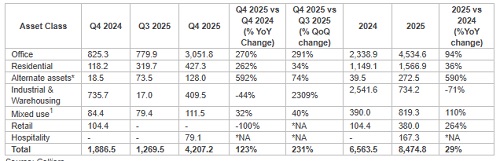
Office segment dominates with 54% share in investments during 2025, followed by residential assets
Indian office market witnessed record investments, attracting USD 4.5 billion in 2025, almost twice the levels in 2024, supported by rising participation from both domestic and foreign investors. Notably, the final quarter alone accounted for nearly two-thirds of annual capital deployment and coincided with strong Grade A space uptake across the country's major office markets.
The residential segment followed the office segment with USD 1.6 billion of inflows during 2025, registering a 36% year-on-year growth and accounting for an 18% share in total investments. Capital deployment in the segment continues to be supported by strong long-term demand fundamentals, including favourable demographics, rising income levels, and increased developer expansion into Tier II cities through joint-venture platforms, attracting both domestic and foreign investors.
Meanwhile, mixed-use, retail, and alternative assets too witnessed significant traction, cumulatively totalling to about USD 1.5 billion and accounting for nearly 17% of total investments in 2025. Investor appetite in these segments continues to be driven by portfolio diversification and growing focus on assets powered by end-user demand, such as data centers, co-living, second homes, etc.
“Indian office market has scaled new highs in 2025, attracting a record USD 4.5 billion in institutional investments. Interestingly, alongside this surge, the year also marked the listing of fourth office-focused REIT and notable acquisitions by older REITs, marked by superior tenant quality, higher occupancy levels, and strong rental growth. Investment traction is supported by strong operational performance and consecutive record-breaking Grade A space uptake in the last 3-4 years. Looking ahead, with over 370 million sq ft of existing office stock having a potential to be included in future REITs, we anticipate greater degree of institutionalisation and consolidation supported by cross-border capital flows over the course of next few years,” said Vimal Nadar, National Director & Head of Research, Colliers India.
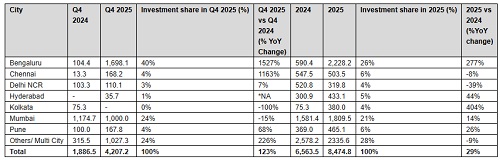
Bengaluru & Mumbai together drive nearly half of real estate investments in 2025
Led by large office transactions, Bengaluru and Mumbai together drew close to half of the total investments in 2025, with inflows of around USD 2.2 billion and USD 1.8 billion respectively. Of the total USD 4.0 billion inflows in these cities, office assets drove close to three-fourths of the investment activity. Interestingly, five out of seven major Indian cities saw a year-on-year rise in capital inflows in 2025. Meanwhile, of the USD 2.3 billion multi-city investments during 2025, over 40% were in residential assets, reflecting growing investor interest in early-stage residential projects and expansion in newer residential markets, including emerging Tier II/III cities.
City wise investment inflows in Q4 2025 and 2025 (in USD million) –
Above views are of the author and not of the website kindly read disclaimer









.jpg)