Weekly Commodity Market Report by commodity research desk by Prabhudas Lilladher

THE WEEK IN COMMODITIES
Gold and silver fell in a week when the usual reason for them to fall went away. Last week the ten-year bond yield rose above 5% and pulled gold down with it. This week the yield dropped back below 5%, which on its own should have helped gold, and gold fell harder than the week before. When a metal falls while the thing that normally drives it moves in its favour, the selling is coming from somewhere else.
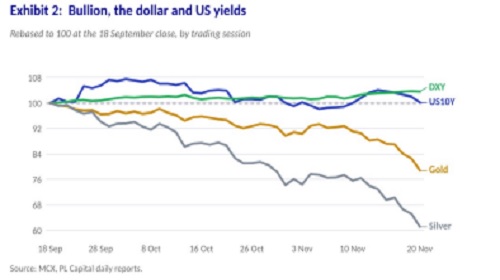
It came from the stock market. US shares fell for five days running as investors questioned how much the spending on artificial intelligence will earn, and strong results from Nvidia on Wednesday did not stop its shares falling. A fund that loses money on shares has to find cash, and it sells what it can sell quickly at a profit. Gold and silver had both risen a long way over the past year, so they were sold. Bond yields fell because the same investors bought government bonds for safety, and the dollar rose for the same reason.
The Federal Reserve added to it on Wednesday, when the minutes of its October meeting showed nearly every member expecting a rate rise in December. As shares fell, the market scaled that back: the odds of a half-point rise fell from 18% to zero, and the total rise expected over the next year dropped from about 87 basis points to about 60. A quarter-point rise on 8–9 December is now the only move priced.
Silver fell nearly twice as far as gold because it was hit from two sides. It is sold with gold when investors need cash, and it is sold with copper when industry looks weaker, because most of it goes into factories. The gold to silver ratio rose from 79.7 to 85.8, which is silver getting cheaper against gold.
The selling came from funds trading futures, not from people who hold the metal. Holders of gold funds kept almost all their bullion, Indian dealers charged a premium on the fall rather than a discount, and Chinese buyers paid record prices for copper delivered now. A fall driven by futures funds ends when their selling ends, and the physical demand underneath is the level the price comes back to
Oil fell again, and this time freight disagreed with it. Tankers were struck in the Strait of Hormuz and the cost of hiring one rose for the first time in six weeks, while the barrel fell because US stocks are building and the International Energy Agency expects more oil than the world needs this quarter. Freight usually turns first, so a second week of rising freight would be the first sign that war risk is coming back into the price.
Gas rose in the US on the weather. Forecasts turned colder for the central and eastern US in the last week of November, and demand is expected to rise sharply next week. The MCX contract ended almost flat because the rupee’s rise absorbed part of the gain and the US contract settled after the Indian session had closed.
Copper and aluminium moved further apart. Copper’s shortage has gone in London even as China pays record premiums for metal, while aluminium’s has become the tightest the exchange has seen, with one holder controlling much of the metal on offer. The first is a selling opportunity for funds; the second is a squeeze that lasts until new metal arrives.
inflation measure, come on Wednesday with the revised growth figure and durable goods orders, and US markets close on Thursday for Thanksgiving. Thin trading around a holiday makes moves larger in both directions. The selling in gold and silver stops when the stock market stops falling, and the first sign of it will be gold rising on a day when shares rise too.
PRECIOUS METALS

GOLD
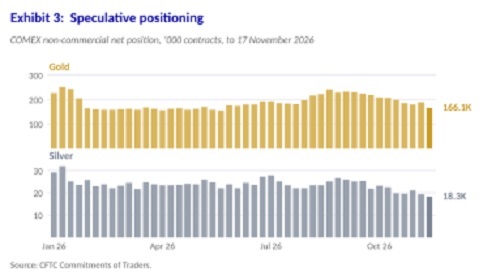
The fall was driven by futures funds, not by long-term holders: funds trading on paper made their biggest cut since February while the largest gold fund barely changed its holding. Selling forced by margin calls ends when the calls end; a fall driven by savers leaving can run for months.
The fall was driven by futures funds, not by long-term holders: funds trading on paper made their biggest cut since February while the largest gold fund barely changed its holding. Selling forced by margin calls ends when the calls end; a fall driven by savers leaving can run for months.
RATES AND THE DOLLAR
Gold normally falls when US yields rise and rises when they fall. This week the tenyear yield fell 19 basis points and gold still fell, because investors sold gold and bought bonds together to get out of shares. With the half-point odds gone, rates are no longer working against gold, and once shares steady gold is left facing a lower yield, the setting for a rebound.
SILVER
Silver’s industrial side is weakening: world demand is now forecast 5% lower this year, with less going into Chinese solar panels and jewellery. Two signs point the other way. London’s cost of borrowing silver rose 9 basis points on Friday, small and from a low level, but lease rates rise when metal is hard to find, and Shanghai exchange stocks fell 74 tonnes in the week to 1,262 tonnes. When metal is drawn down while the price falls, the selling is in paper, and recoveries from paper selling are quick.
SPECULATIVE POSITIONING
These funds trade on paper, never take delivery, and move first. Gold’s cut 24,000 contracts in the week to 17 November, the most since February and before the three heaviest days, so the true cut is larger; they still hold 166,100, about 12,000 above the May low. Silver’s hold 18,300, the least in two years. Silver has little left to sell, so a short-covering rise can be sharp; gold has room for one more leg.
INVESTMENT DEMAND
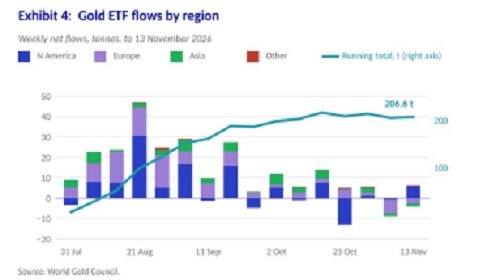
A gold fund holds real bullion, so its flows show what long-term investors do. Regional funds added 2.0 tonnes in the week to 13 November, led by 5.8 in North America, and the largest fund lost only 2.6 tonnes in the week the price fell 9%. If these holders sell too, the fall extends; if they hold, the selling stays in futures and is near its end.
SILVER INVENTORY
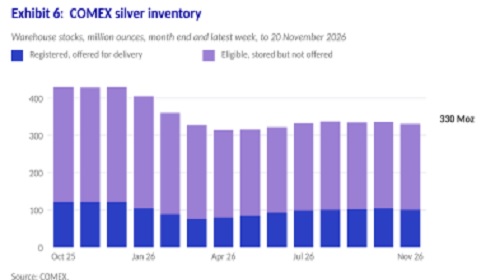
New York vaults hold 330.4 million ounces, down 2.4 million on the week, and the part offered for delivery fell 0.5 million to 101.2 million. Both moves are small, but they say physical silver is tightening while the futures price collapses, and that gap drives a sharp recovery once the paper selling stops.
ENERGY

CRUDE OIL
Supply is winning over war risk. Middle East exports are recovering through the Strait of Hormuz, where flows are still about half of pre-war levels, and the International Energy Agency expects supply of 105 million barrels a day to run 1.7 million above demand this quarter. OPEC+ has held its targets steady rather than cut into the surplus. US crude is backing up: Brent’s premium over WTI has widened past $8 a barrel because exports to Asia and Europe no longer pay, which keeps US barrels at home and adds to the stock builds.
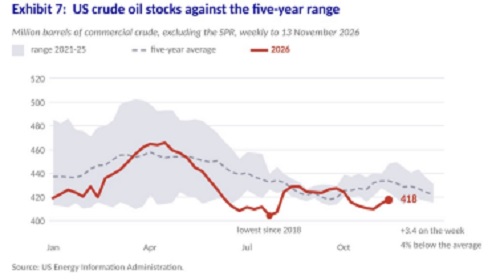
US CRUDE STOCKS
US crude stocks rose 3.4 million barrels to 417.8 million in the week to 13 November against about 1 million expected, a second build after five weeks of drawdown, and petrol rose 5.2 million. Stocks are still about 4% below the five-year average, but their direction has turned with the price. Two more builds of this size would remove the low-stock argument that has supported the barrel since the summer, and only a rise
NATURAL GAS
The demand side has turned. Forecasts show colder than normal weather across the central and eastern US in the last week of November, demand including exports is expected to rise from 121.6 to 128.1 billion cubic feet a day next week, and gas flowing to export terminals is near a record 21. Storage added 20 against 27 expected, so the market is tighter than the models allowed. With storage near its seasonal peak, each colder forecast now draws on a surplus of only 80.
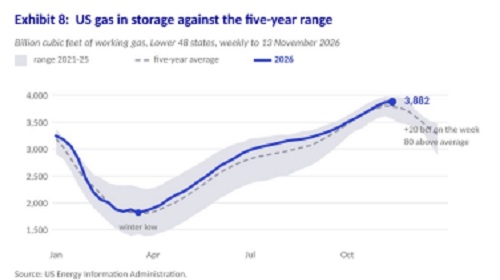
GAS IN STORAGE
Storage rose 20 billion cubic feet to 3,882 against 27 expected and a five-year average build of 15, so the surplus to the average widened from 75 to 80. A smaller build than forecast means demand or exports are running ahead of the models. Injection is almost over and withdrawals start within weeks; a surplus of 80 is roughly one cold week of draws, so a cold start to December would remove it and lift the price.
FREIGHT AND WAR RISK
Tanker rates rise when shipping is attacked, so this index shows how much war risk the market is paying for. It rose in four straight sessions to 5,081, up 13.3% on the week, as tankers were hit in the Strait of Hormuz, while crude itself fell. Freight turns before the barrel. If it keeps rising next week the war risk is coming back into the oil price; if it falls back, the surplus remains the only story.
WEATHER
This is how much heating the country bought, weighted by where people live. In the week to 14 November demand rose from 72 to 95 degree days and the shortfall to normal narrowed from 29 to 21. The forecast for the last week of November has turned colder across the central and eastern US, where most gas is burned for heat. Gas prices move on the forecast before the cold arrives, which is why the US contract rose this week.
BASE METALS

COPPER
Copper is falling in London while it is scarce in China. The premium Chinese buyers pay for imported metal hit a record $500 a tonne on 19 November, and Shanghai exchange stocks fell 18% in a week to 27,642 tonnes, the lowest since December 2023. The selling comes from funds that had bet on demand from artificial intelligence. Record premiums pull metal from London to China, and when London stocks start to fall the price follows.
ALUMINIUM
Aluminium is tight where copper is not. Metal for immediate delivery costs a record $353 a tonne more than metal in three months, and London stocks are the lowest this year. One holder controls 30% to 39% of the metal on the exchange’s warrants, so anyone who needs aluminium now must buy from that holder or wait. That keeps the near price high even as the three-month price falls with the rest of the complex.
ZINC
Zinc’s premium for metal now widened from $40 to $167.50 a tonne, so near-term supply is tighter, but London stocks rose 2.1%, which says new metal is arriving to meet it. Funds hold 29.6% of open contracts betting on a higher price against 19.7% on a lower one, the most crowded of the three. Crowded bets are the first to be sold when a sector turns, so zinc carries the most risk if copper’s selling spreads.
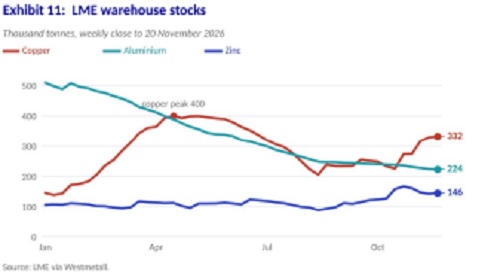
EXCHANGE STOCKS
Copper stocks rose 0.9% to 332,025 tonnes, a third week of building, but the pace has slowed from 15.6% two weeks ago. With record premiums in China pulling metal there, the next move in London stocks is down, and falling stocks support a price. Aluminium slipped to 223,525, the least this year, while zinc rose 2.1% to 145,675. In copper the slowing build matters more than the level.
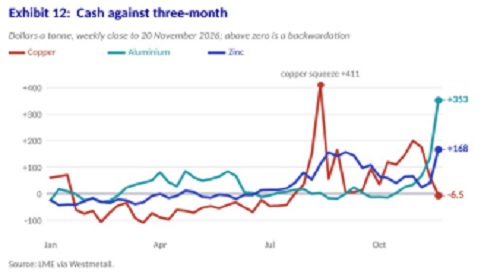
CASH AGAINST THREE-MONTH
This gap is the market’s measure of shortage. When metal today costs more, as in aluminium at a record $353, holders are paid to release metal and short sellers are squeezed; when it costs less, as in copper at a $6.50 discount, there is no shortage and the market pays to store metal. Copper’s move from a $175 premium two weeks ago ends the squeeze that held it up. Aluminium’s widens while one holder controls a third of the deliverable metal.
HOW THE FUNDS ARE POSITIONED
Funds cut all three metals in the week to 13 November, before copper’s worst days. Copper’s net position fell 1,936 lots to 16,149 after a 6,325 cut the week before, so funds are leaving steadily. Aluminium fell 2,755 lots to 114,663 and zinc fell 2,767 to 36,748. Copper’s long is now small, so most of its selling is done, while zinc’s 29.6% long against 19.7% short is the position still left to unwind.
Please refer disclaimer at https://www.plindia.com/disclaimer/
SEBI Registration No. INH000000271







.jpg)