The female force driving India forward by Motilal Oswal Wealth Management

India’s economic transformation is often discussed through infrastructure expansion, manufacturing growth, or digital payments. But as we celebrate International Women’s Day on March 8, another structural shift in the economy is becoming clearer.Women are steadily expanding their presence across India’s paid economy as workers, driven by rising education, improving labour force participation, expanding entrepreneurship, and deeper financial inclusion.
Education is widening the economic pipeline
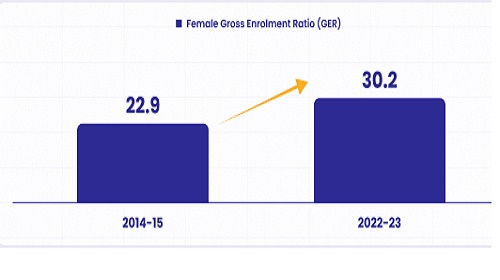
One of the most important drivers behind this shift is education. As access to higher education widens across states and social groups, a larger cohort of women is moving through universities and professional programmes, gradually strengthening their presence in skilled and formal occupations.1
Education therefore represents the first stage of economic participation. As more women complete higher education, the pool of talent feeding India’s workforce, entrepreneurial ecosystem, and professional sectors continues to expand.
More women are stepping into paid work
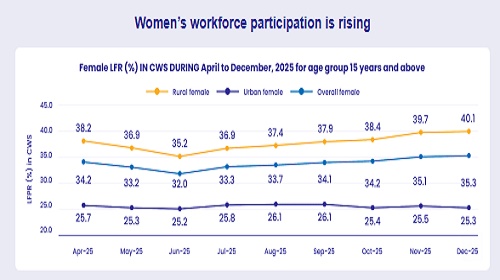
Labour market data is beginning to reflect this and how. India’s female labour force participation rate has risen significantly in recent years.2This rising female labour force participation signals a gradual expansion of women’s economic agency. More women entering paid work increases household incomes, strengthens financial independence, and expands career opportunities.2However, the gap between rural and urban participation highlights that access to jobs, childcare, mobility, and formal employment opportunities still shapes how widely these gains are shared.
Entrepreneurship is expanding women’s economic role
Not all economic participation comes through jobs. For many women, starting a business has become the most accessible entry into the paid economy, particularly in regions where formal employment opportunities remain limited.
The scale of this shift is becoming visible. More than 2.86 crore women-led MSMEs were registered on the Udyam and Udyam Assist platforms, reflecting a sharp rise in women formalising businesses across sectors from retail and food processing to services and small manufacturing.3
Women are a rising tide in financial markets
Another shift is unfolding in India’s financial markets. The country’s retail investing boom, once dominated by male investors, is slowly drawing in more women as well.The scale of participation has expanded dramatically. The National Stock Exchange crossed 12 crore registered investors in 2025, and women now account for around 25% of this base.4
Much of this shift has been enabled by structural changes in how Indians invest. Digital brokerage platforms, app-based trading, and simplified online account opening have lowered entry barriers significantly. For many first-time investors, the journey into equities now begins on a smartphone.
This also reflects a deeper behavioural shift. Investment decisions that were historically mediated through male family members are increasingly being taken independently by women.As more women begin managing their own savings, equities, and long-term financial planning, India’s expanding retail investor base is slowly becoming more gender balanced.
Constraints still remain
The next challenge is not participation, but sustaining the transition. Even as more women enter education, entrepreneurship, and the workforce, structural constraints continue to shape how far and how fast this shift can go.
A major barrier remains the unequal burden of unpaid care work. Women spend around 363 minutes a day on unpaid domestic work, nearly three times the 123 minutes spent by men.5This imbalance directly affects labour market participation. Care responsibilities, limited childcare infrastructure, workplace safety concerns, and rigid work arrangements often determine whether women can sustain paid employment.
The result is that while India is clearly moving toward greater female economic participation, the next stage of this transition will depend on reducing the unpaid care burden and expanding supportive work infrastructure.
Our take
India’s long-term growth will also depend on how widely economic participation is distributed. Women make up nearly half of the country’s population, yet their participation in the paid economy has historically remained far lower than men’s.
Expanding women’s role therefore does more than improve inclusion. It raises the size and productivity of the workforce itself.
As more women earn incomes, start businesses, and build financial assets, the effects extend beyond individuals to household welfare, consumption, and long-term economic resilience.
India’s growth story, therefore, is no longer only about sectors expanding. It is increasingly about who gets to participate in the economy and how fully that participation translates into growth.
For More Research Reports : Click Here
For More Motilal Oswal Securities Ltd Disclaimer
http://www.motilaloswal.com/MOSLdisclaimer/disclaimer.html
SEBI Registration number is INH00000041